
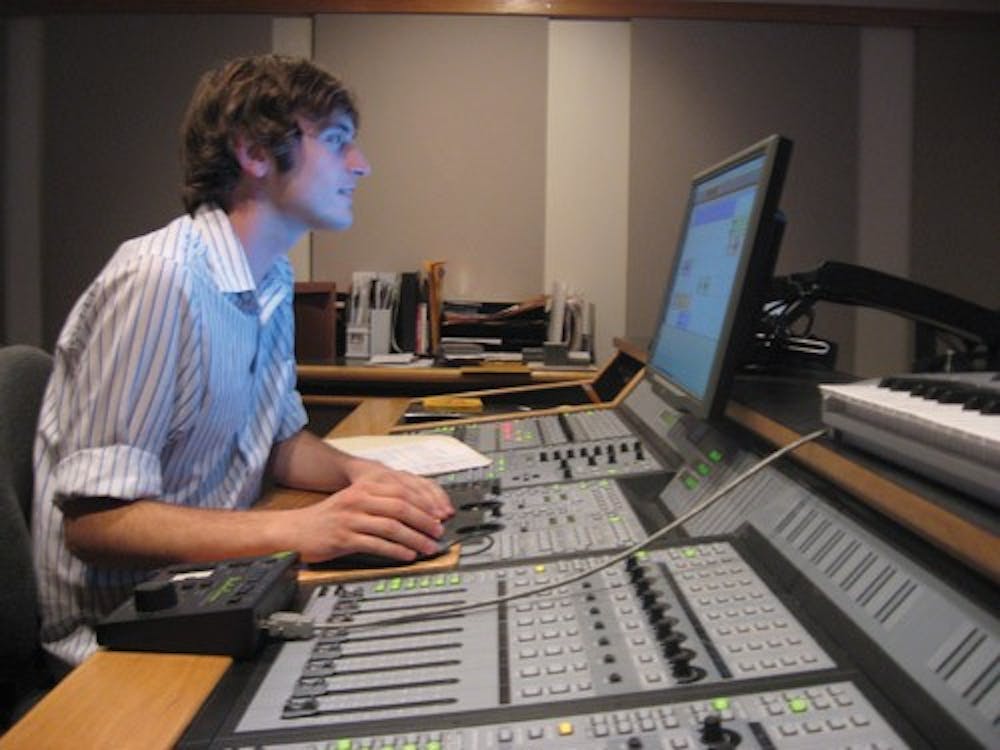
It is 10 p.m. on a Tuesday night, and IU students across campus are shutting their textbooks and turning on TVs in an attempt to stave off mid-week boredom.\nSenior Drew Vandenberg, a recording arts major, is also finishing up his homework. His “textbook” is a bit more interactive than most, since he is seated at the controls of the Jacobs School of Music’s primary mixing and editing studio, M354. \nCushioned from the rest of the Simon Music Center by a spring isolation system and powered by independent generators, M354 is a recording engineer’s fantasy. Boasting an array of digital recording equipment that any big-time producer would love to have, the studio is one of the several state-of-the-art facilities that the IU Department of Recording Arts is proud to call its own. \nAnd Vandenberg, like all of the 50 students in the department, has his own key. \nThe IU Department of Recording Arts prides itself on the virtue that “doing is learning”. \n“The vast majority of our education comes from hands-on experience,” Vandenberg said. “We work in a field that is both a science and an art so actually experimenting with techniques is very important.” \nWith an average incoming class size of 16, the recording arts program sets a standard for selectivity. \nHaving accepted a mere 17 of the 200 applications it received for the current semester, the department does not have much material that is not hands-on. Applicants who are musicians themselves have a leg up on the competition, but experience with recording technology, good grades and strong interpersonal communication skills are also valued qualities. \n“Our students can rack up 1,000-plus hours of hands-on experience by the time they graduate,” IU Department of Recording Arts lecturer and course designer Michael Stucker said. “It is a huge time commitment, but nobody complains.” \nIn other words, you probably will never hear the tragicomical question, “Why are we learning this again?” asked by these particular students. \nDirector and Chair of Recording Arts Konrad Strauss, whose past clients include some of America’s top TV networks, symphonies and record labels, epitomizes the professional excellence that the faculty provides for students. His own recordings have resulted in numerous accolades, including multiple Grammy awards. \nAll six of the department’s faculty members are IU graduates, having worked professionally before returning to campus. \n“The program is designed to give the equivalent of a four-year apprenticeship at a major recording facility within the context of a university education,” Strauss said. “Our faculty offers a great mix of professional and academic experience.” \nStucker added, “We didn’t intend to be teachers; it just happened that way,” \nThe difference between the audio recording program at IU and those at other universities is the quality of music students are working with. The Jacobs School of Music is among the nation’s best.\n“We are fortunate to have an incredible amount of world-class music for us to record,” Stucker said. “Who and what you are recording is just as important as the equipment you use to record it.”\nLocal music also provides students with some of the Midwest’s top musical talent for their recording enjoyment. \n“Bloomington has a very rich musical scene – all kinds of music, from classical to country,” Strauss said. “Our students draw on this; the classical and jazz of the Jacobs School, and the rock, traditional and roots music of the Bloomington community.” \nThe Department’s students are constantly recording live performances, on and off campus. This experience is invaluable, since it cannot be replicated through lectures and exams.\nTravis Gregg, coordinator of audio production, asserts that many professionals in the field lack experience with live production, a skill that graduates of the program have polished through hundreds of hours at the controls. \n“A lot of audio engineers don’t have that experience, which requires a combination of experience and nerves,” Gregg said. “Our graduates are sought after and receive high marks once they enter the field.” \nRecording Arts students know their music, too. Gregg pointed out that audio recording students take the same theory courses that are required of every Jacobs School student.\n“The variety of courses creates a well-rounded education,” Vandenberg said. “We have courses in live sound, sound for film and classical recording, just to name a few.” \nThe Department of Recording Arts is constantly upgrading its technology. The result is a true representation of what a student would see in recording studios throughout national music hubs such as Los Angeles and Nashville. \n“We certainly believe we have the best music-recording school,” Stucker said. “Other places may have good instructors and equipment, but not the same quality of music.” \nWith work ethics to match their cutting-edge studios, these students can be found working around the clock. \n“We are in the control rooms with our students at all hours of the night,” Gregg said. “For our students, it is a labor of love.”
For the Record
The Jacobs School of Music is home to 50 students armed with top-notch facilties in pursuit of the mastery of sound
Get stories like this in your inbox
Subscribe



