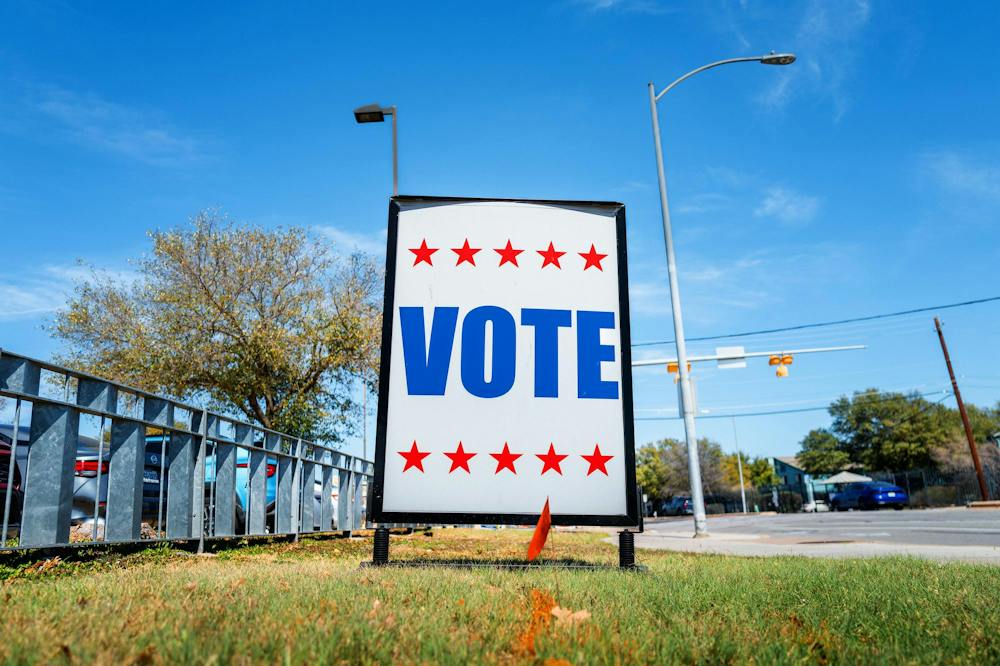
The 2026 midterm general elections are right around the corner, but a large block of voters might not make it to the polls come Nov. 3.
In the 2022 midterms, only 23% of 18-29 year olds voted, and Indiana ranked lowest in youth turnout rates, according to the Indiana Bar Foundation.
At Indiana University, student groups like IU Student Government and College Democrats at IU, as well as certificate programs like the Political and Civic Engagement program, are working to increase student voting across campus.
IUSG and PACE are working together to host Voterpalooza on Oct. 21, an event dedicated to educating and engaging potential voters through activities like trivia and arts and crafts.
“We have registered hundreds of voters this semester,” Mark Fraley, PACE associate director, said.
Ben Baranko, student engagement director of College Democrats at IU, said the group increases student outreach through tabling and social platforms. Baranko joined the College Democrats to make a difference in his community, and he said one way to do so is to increase youth turnout to match that of older generations.
“Imagine if students, if young people, had a similar dynamic, if we were a voting block,” Baranko said. “I think people would take us much more seriously.”
In order to change the system in favor of youth voters, Baranko said youth must vote.
“Your vote does matter, change can happen, change will happen,” Baranko said. “Your vote matters one hundred percent, and the more people that think that it does, the more it will matter.”
In an attempt to increase voter turnout for more students, IU began participating in the Big Ten Voting Challenge in 2018. The challenge offered titles for highest turnout and greatest increase in voter rates. Vanessa Cruz Nichols, an assistant professor of political science, said IU’s participation helped boost its turnout rates because it embeds a sense of competition into the act of voting.
The competition halted in 2026 due to a U.S. Department of Education investigation into possible FERPA violations. But Fraley said PACE has continued working on outreach and distributing nonpartisan voter information.
Young people are consistently the smallest group of voters in elections. Cruz Nichols said “the easy explanation” is claiming that unregistered or nonvoting students are apathetic.
“The parties are not doing their homework to engage young voters,” Cruz Nichols said. “Are they falling short on their parts to better help people understand where their views would be aligned and where they have a political home?"
According to U.S. Census Bureau data, 14.7% of registered voters didn’t vote in the 2024 presidential election because they “did not like candidates or campaign issues,” whereas 19.7% stated they were just “not interested.”
“To what extent do they feel that the candidates on the ballot align with their interests and excite them in some way?” Cruz Nichols said. “Maybe they're voting because they don't want to see someone in the office.”
Cruz Nichols said lack of widespread voter education also plays a role, and distributing registration, absentee ballot and deadline information help increase their likelihood of voting.
She also said that parental political guidance contributes to voter turnout, as the more often young adults see their parents vote, the more likely they are to adopt the same habit.
Cruz Nichols grew up as the eldest daughter in an immigrant family and would help translate political issues to her parents. She said they figured out politics together based on what she learned in school and saw in the news and advertisements.
“They were telling me about the issues that they cared about, what they wanted to see their candidates prioritizing, and so there's more of this bi-directional learning that happens in immigrant families,” Cruz Nichols said.
Still, youth voter registration rates are consistently higher among nonimmigrants compared to first and second generation voters. A 2014 Urban Institute study found only 6% of first-generation immigrants aged 18-24 voted in both the 2010 and 2012 national elections.
The process of voting itself can also be difficult, Cruz Nichols said. For out-of-state students, differing state registration requirements coupled with absentee ballot requests can be a barrier to voting.
Unlike other states, Indiana requires voters to complete their registration almost a month prior to an election. In addition, legislation like Public Law 70 can complicate the voting process for Indiana college students.
With the removal of university-issued student cards as a valid form of voter identification, it is more difficult for students to verify their identity at the polls, especially out-of-state students who might not have an Indiana-issued ID.
Cruz Nichols said students often think their vote doesn’t matter, which can often be as harmful as structural barriers.
“If my students are too cynical, then they kind of bury their heads in the sand, then the system doesn't change because their voice isn't being heard,” Cruz Nichols said.