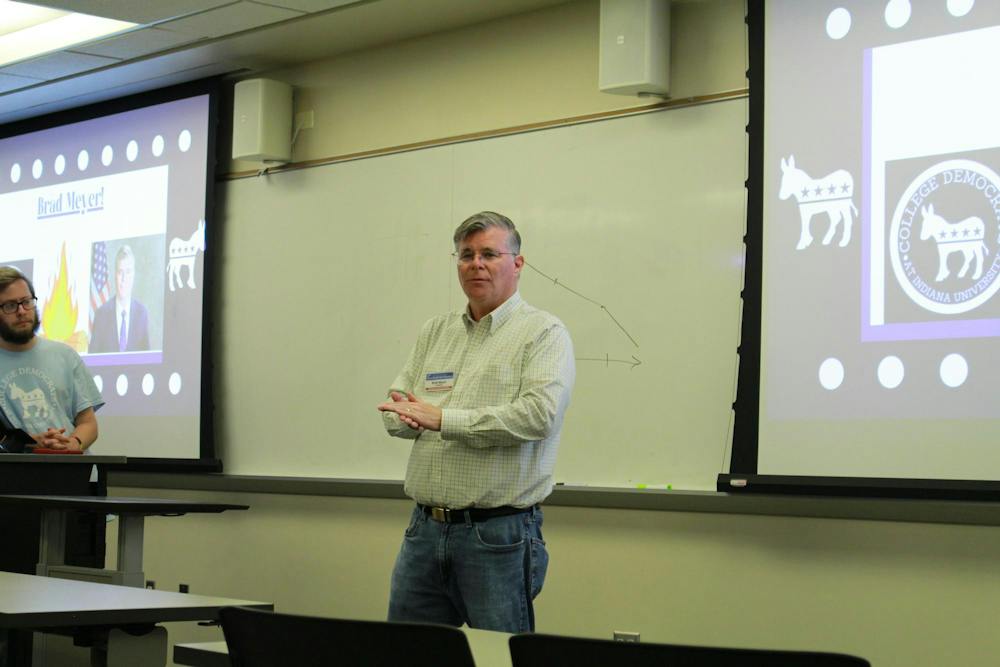
Democrat Brad Meyer, who is running to represent Indiana’s 9th Congressional District, spoke at a voting town hall Tuesday night at the Paul H. O’Neill School of Public and Environmental Affairs in Bloomington.
The town hall was facilitated by College Democrats at IU, IU Bloomington’s College Democrats of Indiana chapter. The hour-long conversation focused on issues IU students said they were concerned about, such as AI’s impact on the job market, immigration policies, money in politics and women’s rights.
About a dozen students attended the hour-long Q&A-style town hall, moderated by Isaac Chapman-Whitehead, club president. Chapman-Whitehead also introduced Meyer, who jokingly apologized to the audience for being a Purdue graduate.
Meyer advocates for higher wages and fair taxes for the middle class. Some of his key policies priorities include universal health care, affordability for citizens and public education, according to his campaign website.
Meyer does not have a background in politics. The former Navy civilian engineer decided to run for Congress to combat “anger and division” he believes President Donald Trump and his allies have caused within neighbors and families.
Meyer will face Republican incumbent Erin Houchin for the 9th Congressional seat in the Nov. 3 election. Houchin advocates for border security and anti-abortion movements, according to her website.
After a brief introduction, Meyer turned the discussion over to the audience, encouraging students to ask questions and voice concerns.
One student asked how Meyer plans to unseat Houchin, who is a staunch Republican, in a historically red district. Meyer said he has held 34 town halls and five roundtable discussions, among other community outreach initiatives, during his campaign run, emphasizing the importance of community engagement and social media growth.
“You have to be an optimist to run as a Democrat in southern Indiana, that’s a fact," Meyer said. “And I am an optimist.”
Another student asked Meyer about his beliefs regarding money in politics, specifically, like Political Action Committee money, or funds raised by organizations to elect and defeat candidates.
“Our campaign is 100% funded grassroots,” Meyer said. “So, no corporate money, no PAC money.”
The conversation shifted to Meyer’s opinions about U.S. Secretary of Defense Pete Hegseth. President Trump signed an executive order Sept. 2025 changing the Department of Defense’s name to the Department of War. The change remains unofficial, as an official change would require a Congressional act.
“I’m very proud of the work that I did working for the Department of Defense,” Meyer said. “I have no interest in working for the Department of War.”
Meyer also asked questions back to the audience, one of which being how students felt about AI.
Most of the audience said they had negative opinions toward AI, with one student, IU junior and journalism major Benjamin Cowles, discussing how he fears AI will impact his major.
In his response, Meyer said while the efficiencies of AI can’t be denied, AI will also cause an enormous disruption in the job market.
“You guys, I think, are looking at it, saying, ‘Oh crap, I’m going to be graduating soon, and AI is going to keep me from getting a job,’” Meyer said. “And mid-career people are thinking, ‘Holy crap, there’s a bunch of university graduates that know how to use these tools, they’re going to take my job.’ Everybody’s afraid, and they’re right to be afraid.”
Cowles is the press secretary and marketing director of College Democrats.He’s worked at College Democrats for nearly a year and said a drive for service pushed him to join the organization. He said while it can seem “insurmountable” to go against Indiana Republicans, he believes change happens through small actions like voter turnout.
“In my opinion, I think Indiana is a purple state,” Cowles said in an interview with the Indiana Daily Student. “If we just had better voter turnout, we could sway the vote to be more blue, and so in my opinion, that starts with local service, but also with college students.”
After briefly discussing cryptocurrency, the conversation shifted back to AI, with one student voicing her concerns regarding the environmental impacts of AI and the noise pollution that data centers cause.
Meyer acknowledged her concerns as legitimate and said both federal and local government have responsibilities to ensure they follow through with concerns regarding the centers.
Meyer said he is neither pro nor anti-data center.
“If a community has that information available to them on what the economic impacts and environmental impacts are, and they decide that it’s in their best interest to do it, then God love them, that’s great,” he said. “If they decide they don’t, I respect that as well.”
Another student voiced concern about Trump’s immigration policies and asked how Meyer feels about Immigration and Customs Enforcement. Meyer said the issue with immigration is primarily an economic one. He said instead of addressing the problems of immigration, he believes Republicans are instead choosing not to see those problems.
“The issue is that there is a policy in place right now that the only way that ICE can implement it is through ever-increasing brutality," Meyer said. “The policy is wrong.”
Meyer suggested that a certain number of additional visas could be issued per year for immigrants to enter the country legally, and once they arrive, he said they should be treated with respect and dignity.
IU sophomore Siddhu McLeod, who interns for Meyer, was one of the town hall attendees. As an intern, McLeod said he’s driven Meyer to town hall events and helped him with campaign logistics.
“I’ve never seen a more people-centered campaign, I think Brad really cares about his community,” McLeod said. “He’s just a really people-centered person, and I really appreciate that about his style and how he approaches his campaign.”