Editor’s note: All opinions, columns and letters reflect the views of the individual writer and not necessarily those of the IDS or its staffers.
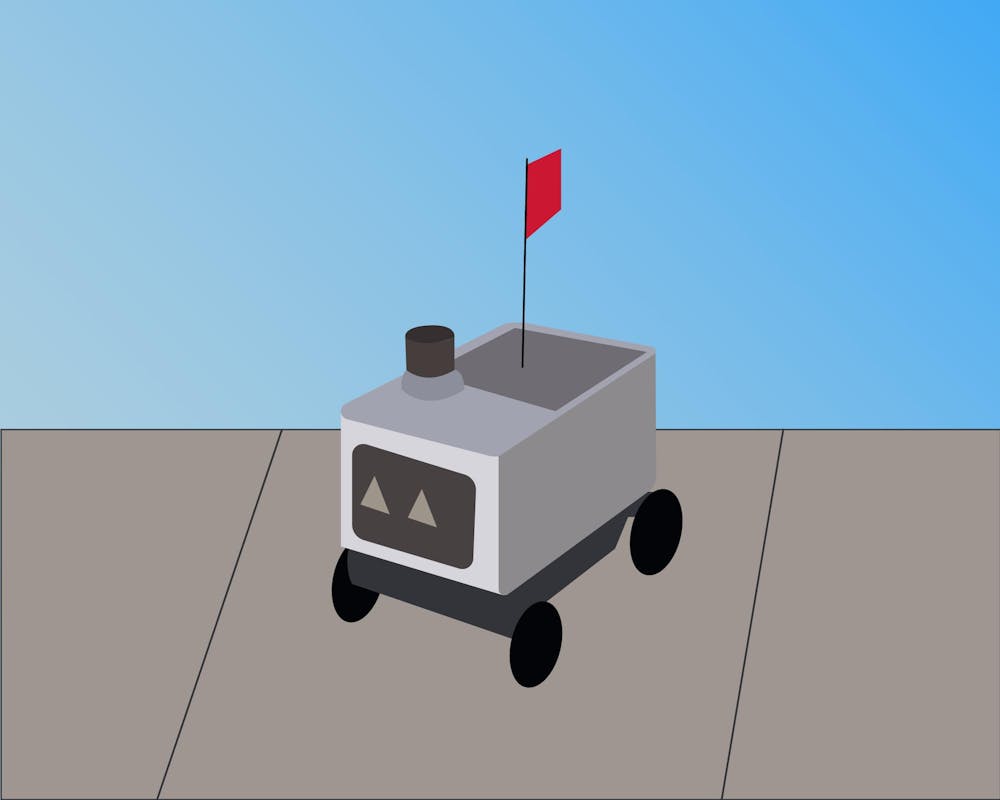
I walk home after a long day of classes, headphones blasting “Rubber Soul” by The Beatles, with the crisp fall wind blowing through my hair. The trees are finally starting to turn colors. I pass lots of fellow students on the sidewalk — an almost perfect day. Then, all of a sudden, there they are: cubic food delivery robots rolling down the sidewalk, their digital faces blinking heart-eyes. They roll in a line, three or four of them, taking up the entirety of the thin strip of concrete I’m walking on. I’m forced to skirt around them, into the grass.
But mild inconvenience is the least of the evils these new Grubhub delivery robots can bring.
It seems like the ideal world: square-shaped, rolling friends with blinking, animated faces helpfully delivering food to your door. Not quite as dystopian-seeming as Amazon drones, yet still a step toward the future.
The robots are built for convenience: an IU dining employee loads the food into the robot, and it takes care of the rest. It travels almost anywhere on campus, no need to hire a delivery driver, and it’s safer, providing no-contact delivery. For students, the robots could reduce the stress of figuring out when and how to eat amidst a busy schedule of classes and extracurriculars. The service is specifically tailored to deliver to campus buildings, so having a bite delivered to the dorm in between study sessions is easy.
However, this world of delivery robots isn’t as ideal as it seems.
Researchers have studied the concept of a “baby schema,” wherein children and babies have certain features that cause adults to instinctively want to protect them. We are also more likely to perceive them as honest and kind. This effect can apply to animals, cartoon characters and yes, even your robotic pals.
So, when a robot displays these childlike qualities, we are more likely to be attached to them. In other words, the cuter the face, the more trust we put in the robot. When it makes expressions that seem friendly and endearing, we are inclined to like it.
But the cute faces are merely a distraction from real concerns.
First, the robots have caused real issues on other college campuses. At Baylor University, similar food delivery robots often arrived with spilled drinks or wrong orders. In bad weather, the robots are liable to get stuck or not function properly.
At the University of Notre Dame , surveyed students indicated they noticed a “decline in the efficiency of the robots.” They also experienced late or missed deliveries. Student employees for Notre Dame dining talked of the robots decreasing efficiency at dining locations, because employees were obligated to stop serving in person customers and load the robots during busy hours.
Other students were concerned about the campus environment. The robots may begin to take sidewalk priority over pedestrians and students who are just trying to get to class.
The idyllic fall on IU’s beautiful campus could be stained by a modern view of robots swarming the sidewalks. Part of the appeal of IU is the beautiful views of nature on campus. Now, a dining robot could appear in every picture at the Sample Gates.
So, the robots do not work as well as they are meant to. And yet, many love them anyway. This is part of the business model: if the cute face makes people trust the robots implicitly, they are more likely to ignore these issues.
This isn’t even to mention the technology involved. In order to work, the robots use cameras, GPS and AI. This makes sense, as the robots are expected to navigate on their own. They sense when it is safe to cross the street and when they need to stop for pedestrians, as well as calculate the best routes.
However, when cameras are involved in new technologies, there are always concerns about privacy. In the city of Los Angeles, where dining robots have been taken beyond the confines of college campuses, the robots’ camera footage was used as evidence in a criminal trial. This brings attention to the possible use of the robots in a growing field of police surveillance. It also calls into question what companies are doing with the footage after it is taken, specifically if and how it is being stored. Avride, the company that makes the robots, claims the cameras blur faces and license plates, although this still leaves some questions unanswered. The bottom line, we don’t know where the information could be going and what it could be used for.
The robots may be cute, but we cannot let their digital smiles blind us to the issues underneath. Caution is required when using any technology, and these are no exception.
Sasha Burton (she/her) is an elementary education major with minors in Spanish and English.