Editor’s note: All opinions, columns and letters reflect the views of the individual writer and not necessarily those of the IDS or its staffers.
What we may miss after graduation is not just college itself, but an environment designed in a way that makes connection effortless.
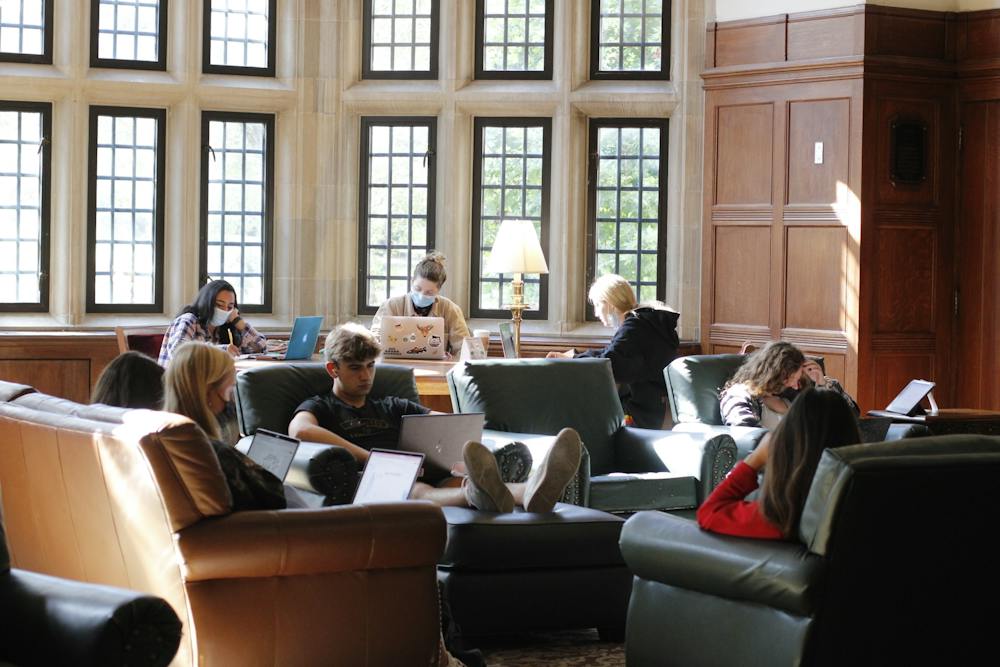
Walking across campus, it's easy to find people existing together. At McNutt Quadrangle, students set up a spikeball net. Inside the Luddy School of Informatics, Computing and Engineering and the O’Neill School of Public and Environmental Affairs, couches and tables are filled with students studying, talking or passing time between classes. Students fill the Herman B Wells Library, dorm lounges and countless other common areas.
These interactions seem like an ordinary part of college life, but it’s the spaces that allow them to happen that serve an important purpose.
In my suburban New Jersey town, the experience of simply existing is completely different. Going almost anywhere requires driving, turning daily life into a routine of home, destination and back home again. Cafes and restaurants require spending money, parks rarely serve as everyday gathering places and there are few places to simply sit and exist around others. Instead of happening spontaneously, social interaction must be planned.
College campuses give us places to exist around other people without needing an invitation, scheduled event or reason to be there. These are examples of “third spaces” — places outside of home and work where people can gather and interact informally such as courtyards, malls, parks and cafes.
So, what happens to communities when the spaces that make these everyday interactions possible begin to disappear?
That has happened to the United States, and the decline of third spaces has coincided with a shift in how Americans socialize. An analysis of the American Time Use Survey found that between 2010 and 2013, Americans spent an average of 6.5 hours per week with friends. By 2019, that figure had fallen to just four hours — a roughly 37% decline.
No single factor caused this shift. The expansion of digital life has moved many activities that once required physical spaces online. Malls, for example, once served not only as shopping destinations but as places to meet friends and spend time. Now, malls are shutting down as digital stores take their place. Many gathering places that remain are commercial, meaning the ability to stay often comes with an expectation to spend money. A noticeable contrast on IU’s campus is the Indiana Memorial Union, where students can hang out without being required to purchase anything.
The design of our communities plays a role in social interactions. On campus, walkability makes being around other people a natural part of everyday life. Students bump into friends or classmates as they move between classes, shared spaces and activities without having to get in a car or make deliberate plans to see each other. In many suburban communities, however, daily life is more spread out, reducing opportunities for spontaneous interaction.
The loss of third spaces matters because these places build what researchers call social capital — the networks, relationships and trust connecting people within a community. Social capital does not only come from close friendships. It can develop through repeated interactions with neighbors, classmates, workers and even people we only recognize in passing.
Without third spaces, isolation becomes a normal part of everyday life. A 2026 study in the Journal of Urban Policy and Planning examined shopping centers as third spaces and found that people valued relationships more through repeated visits.
It becomes easier to move through the day, from home to work and back home, without meaningfully interacting with anyone outside a pre-existing social circle. Third spaces interrupt that isolation by giving people a reason to leave their private space and participate in the social life happening around them.
Increasing individualization has consequences beyond our personal relationships. Third spaces provide opportunities to develop a sense of belonging and investment in the communities around us.
A 2025 study reported by Urban Forestry and Urban Greening analyzed park systems across the 100 most populous U.S. cities and found that cities with higher quality park systems also had greater levels of social connection and civic engagement. Compared with the bottom 25 cities in the study, the top 25 had 61% more volunteers per capita, and 45% more civic organizations per capita, though the researchers caution that parks are one of several factors associated with social capital.
The consequences then extend beyond having fewer places to hang out. When shared spaces disappear, so do everyday opportunities to meet people, build trust and develop a connection to the community around us. Fewer shared spaces can mean fewer interactions, weaker social ties and ultimately fewer opportunities to participate in community life.
Communities like my hometown in New Jersey may not be able to recreate a college campus, but they can preserve and create the features that make Bloomington so conductive to connection: walkable areas, public parks, libraries, community centers, outdoor gathering spaces and places where people can spend time without the expectation of buying something.
As more of our lives move into private and digital spaces, protecting the places that bring us together becomes increasingly important. Preserving third spaces means preserving the everyday opportunities that turn a collection of people living in the same place into a community.
Tutku Sabuncu is a sophomore studying Marketing and Professional Sales.