
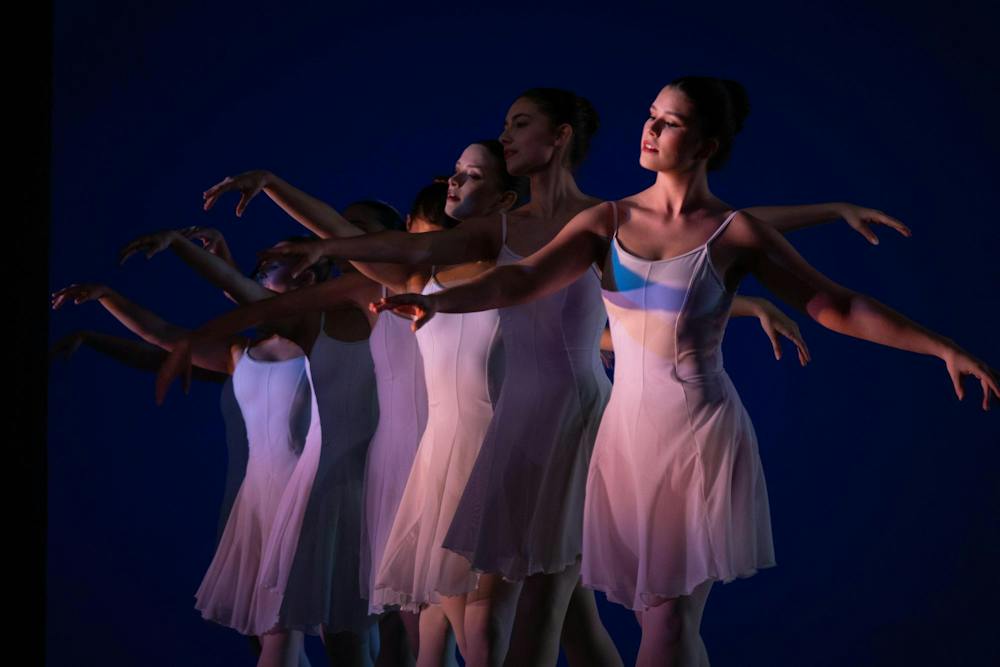
The curtains rose in the Musical Arts Center on Friday for opening night of the Jacobs School of Music's yearly Fall Ballet. The ballet was a mixed repertory program and featured four different works performed for the packed theater.
Beginning at 7:30 p.m., the program gave many of the ballet students the chance to participate. The main goal of the show is student growth, ballet program director and dance department chair Sarah Wroth said, and the Fall Ballet is almost like a midterm for the students.
“We want everyone learning, and we want everyone valuing all the learning in the space, whether you’re performing something or covering something,” Wroth said.
The four different works allowed room for several different styles of ballet.
The first ballet performed was “White Shadows,” choreographed by Jacobs senior lecturer in ballet and contemporary dance Christian Claessens. It included eight percussion students playing live on the stage while dancers performed in front of them. “White Shadows” explored the idea that people often shadow, or follow in the footsteps of, others in life.
The second work presented was “Valse-Fantaisie,” choreographed by George Balanchine, one of the most influential choreographers of the 20th century. This classic ballet featured six dancers, five of them wearing long purple tutus, dancing and twirling around the stage.
“I don’t care who you are or what gender you fall into, you will want to put on a skirt and dance to a waltz after watching that ballet,” Wroth said.
The third ballet was “Dignity in Restraint” by Caili Quan. This work was originally created as a video that took place in a studio. Being a contemporary piece, the movements of the five ballerinas were different than the previous dances.
Wroth also said that Quan left this ballet up to the viewer to interpret. Wroth found a few interpretations in her research, like that each dancer represents a different personality or a specific musical chord.
The show closed out with the premiere of “Stone Blossom” by James Whiteside, American ballet dancer, choreographer, model, drag queen and recording artist, who described it as a new ballet rooted in classical style. This final performance was in partnership with the Kinsey Institute at IU, which researches sexual behavior. The institute received a donation of work by photographer James Platt Lynes, an American artist known for photographing dancers.
The ballet itself included three male dancers along with a 32-dancer corps de ballet and tells the love story between Lynes and two other men. The three male dancers performed on stage and imitated some of Lynes’ photographs, which were displayed behind them during the performance, while the corps de ballet danced as one around them.
“It’s so beautiful the work that the dancers have done,” Wroth said. “It’s wonderful to see male presenters touching each other in peace, particularly in a time of war or in a time of unrest and strife in our nation.”
Bloomington resident Angela Glomm said that “Stone Blossoms,” the last ballet of the night, was a standout piece for her.
“I just thought the last piece was absolutely stunning and just such a wonderful study of gender and the roles that can be so freely adapted for everyone,” Glomm said.
Stella Roudebush, a sophomore studying cinema and media studies at IU, said she came to the ballet specifically because she had heard about Whiteside’s piece.
She said she knew the background about queer love going into the performance. She was also interested in the symbolism of the female dancers dancing around the three male ones and interpreted it as the three men questioning their identities.
Roudebush, who has performed ballet before herself, she said she was able to notice little details that others might miss.
“Seeing a step that you know is really hard and you’re like, ‘Oh, I can’t believe that they had to that that many times,’” Roudebush said.


