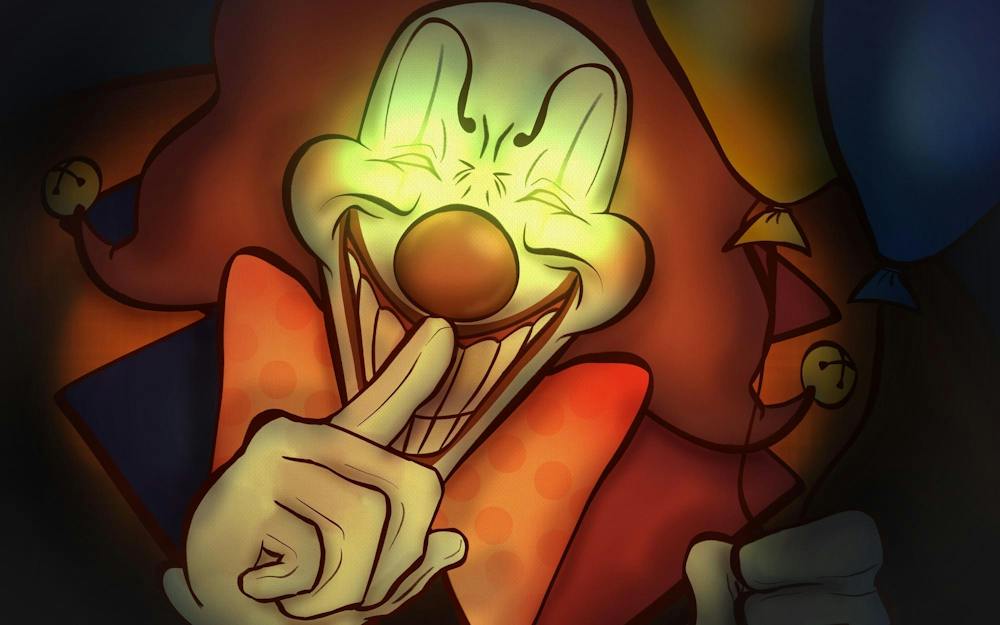
“Clown Panic,” an Oct. 12 Hulu documentary addresses the question so many people wonder: Why do so many of us fear clowns?
As someone who isn’t afraid of clowns, I’ve always found it odd that a bright, happy-go-lucky children’s party clown could be seen as a walking threat. After all, the clowns I’ve seen at the circus were always goofy entertainers who perform tricks like fitting themselves into tiny cars.
However, while their roots lie as silly tricksters, seeking to mock nobility, today’s clowns are often painted as symbols of evil and mischief in the media.
The 2016 clown craze seemed to be a time when the fear of clowns felt justified. “Clown Panic” dives into how the hysteria resulted in school lockdowns, police investigations, arrests and real violence.
The documentary mentions most of these “clowns” were most likely emotionally distressed teenagers, young adults and copycats simply dressing up to scare people and get attention.
For example, the documentary uses the example of one man who was arrested and charged with disorderly conduct and for other pre-existing warrants in Middlesboro, Kentucky, after crouching in woods next to an apartment complex wearing a clown suit. The 20-year-old admitted to police that he was trying to scare people, jumping out at people from the dark.
However, the documentary also covers the “Flomo Klown” incident in Flomaton, Alabama, where a person dressed as a clown was reported near the town’s school. The school was placed on lockdown after a Facebook page named “Flomo Klown” started posting disturbing messages and images targeting students.
These actions were traced over to a 20-year-old woman, who local police connected with the malicious messages. She eventually avoided prison time by pleading guilty to the charge of making a terroristic threat.
The first sign of clowns dates back as far as 2400 B.C. in Egypt’s Fifth Dynasty, when “denegs” — often people with dwarfism — wore leopard skins and masks and would dance humorously.
It wasn’t until Ancient Rome when a clown’s role would shift to that of the buffoon.
Finally, in the 19th century came the first circus clowns, who performed slapstick comedy. These clowns were first distinct for spoken monologues and Shakespearean quotes, engaging in banter with the ringmaster.
During this shift, a clown’s audience shifted from adults to children, with beloved figures like Bozo the Clown emerging.
Yet, “Clown Panic” discusses how children's reports, often proven to be pranks or unsubstantiated claims, of seeing clowns in the woods within a small South Carolina town escalated into a nationwide fear of clowns via social media and the news.
I suspect the way we view clowns now comes from modern popularized media, manifesting itself into real-world history in various ways. The film presents the 2016 incidents as a manifestation of the anxieties we faced at the time rather than real killer clowns plaguing the country.
At the time, the heated U.S presidential election between Donald Trump and Hillary Clinton created paranoia, leading many Americans to questions news station’s coverage of events, even if they were factual.
The film also focuses on how clown sightings mainly affected low-income communities, especially communities with large minority populations. In many instances, the documentary argues, clown sightings inciting violence weren’t taken as seriously as they would have been in more privileged communities.
When I first think of the word clown, my mind goes to Pennywise, the killer clown from Stephen King’s 1986 novel “It.”
The novel and its ensuing 1990 two-part miniseries and 2017 remake helped transform clowns from figures of childhood joy to horror movie staples.
And shortly before this novel’s release, in 1980, John Wayne Gacy was convicted of murdering 33 young men and boys and was later executed for his crimes. At the time, Gacy was performing as “Pogo the Clown” at children’s parties.
So, it is no surprise that the real-life murders would contribute to the “evil clown” trope and alter the public’s trust in clown entertainers. The 2016 clown craze has further intensified the real-life scare of killer clowns sent out to hurt us.
The documentary argues that these two figures are influential in shaping the 2016 “killer clown” phenomenon. These real-life and fictitious clowns simply primed the public to instantly believe the worst about clowns, later allowing the internet hoax of murderous clowns to become a worldwide hysteria.
While birthday clowns still exist, the practice has become much less common, with many performers being affected by the evil clown trope. I think clowns deserve more respect and should be seen as true performers, as many of them are highly trained in improvisation and physical comedy.
As shown in “Clown Panic,” there seems to be no limit to the influence media has on our opinions. The documentary even features a real birthday clown, Guildford Adams, who speaks on the way the craze has affected the public’s opinions. He argues that real-world clown performers became innocent victims of this social craze and that good-intentioned performers like him are made into targets.
“The scary clowns aren’t clowns,” Adams said in the documentary. “They aren’t juggling or do they have those skills. They are people in latex masks, so I was getting blamed for something I wasn’t doing.”
So, let’s stop putting every clown into the box of the “killer clown” trope. For those who fear clowns, the next time you see a clown out and about, ask yourself if that jester looks like they truly have sinister intentions or if they simply caught up in a fictitious stereotype.