
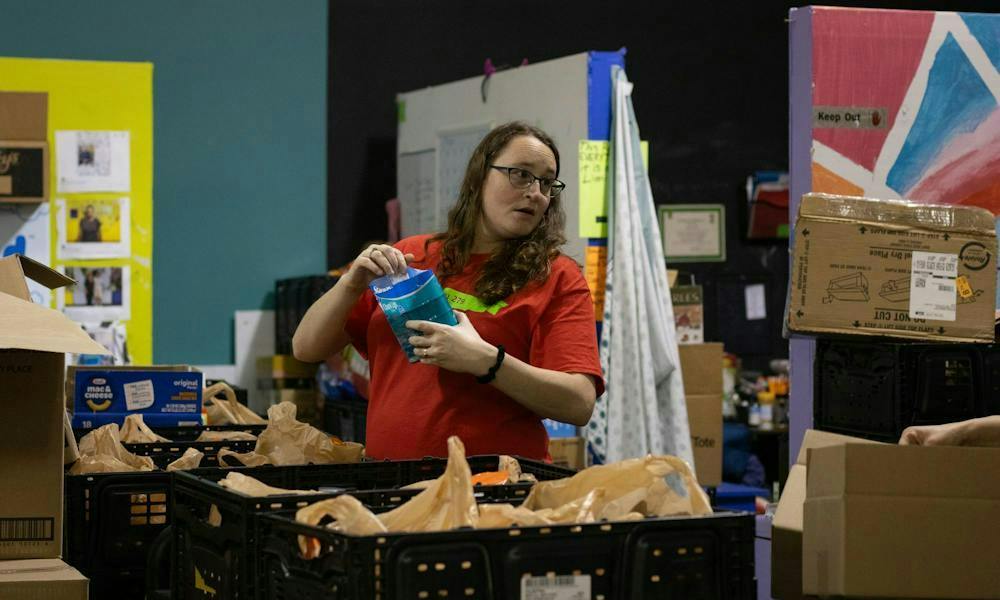
Many local food banks are facing their busiest year yet as community members grapple with a higher cost of living and cuts to government aid, including the Supplemental Nutrition Assistance Program, designed to help low-income families.
Hoosier Hills Food Bank provides food and support to about 80 food pantries and community organizations in six Southern Indiana counties, including Monroe County. Executive Director Julio Alonso said that the food bank’s partner agencies reported serving 11% more households per month from the first quarter to the second quarter of this year. Of those agencies, 40% also reported that the number of households is still increasing.
“We’re looking at a rough year of seeing benefits erode and seeing more people continue to access the food assistance network,” he said.
Alonso partly attributes the increase to SNAP changes. New work requirements went into effect in Indiana on Feb. 1; previously, adults ages 55 through 64 were exempt from a requirement to work 80 hours per month, as were parents with children aged 14 to 17 and homeless people. Now, they all must meet the work requirements to remain eligible. Many immigrants, including refugees and asylum seekers, are also no longer eligible for SNAP.
These changes can be traced back to the One Big Beautiful Bill Act, passed by both houses of Congress and signed by President Trump in July 2025, which tightened eligibility for both SNAP and Medicaid. According to the anti-poverty Food Research and Action Center, 5.2 million Americans have lost SNAP benefits since the bill went into effect. In Indiana, the Family and Social Services Administration reported 92,700 people lost SNAP from June 2025 to June 2026, a decrease of over 15%.
Indiana’s General Assembly passed additional state restrictions on SNAP in March 2026, including a $2,000 reduction in the amount of money a family can have in savings before they lose SNAP benefits, and a change to the eligibility equation, both of which have contributed to the cuts.
Experts say even more Americans could lose SNAP benefits in the months to come due to the program’s new funding model. Previously, states and the federal government evenly split operational costs, such as pay for state workers and training, but beginning this month, states must foot 75% of the bill. States might also be required to pay a portion of the benefits themselves if their error rate — the accuracy of the state’s eligibility and benefit determinations — is too high.
Experts like Katie Bergh from the Center on Budget and Policy Priorities believe states might react to the increased costs, which could be over $250 million for Indiana, by further restricting SNAP eligibility.
Local food banks say these national changes are having a large local impact.
Bloomington Township’s food pantry on the northwest side of Bloomington is on track to have its busiest year yet, said township Trustee Efrat Rosser. The rush began last October with freezes to SNAP benefits due to the government shutdown, but even after the freeze ended in November, demand didn't let up. In 2024, the food pantry served 140 families a month on average. By 2025, that number rose to 206, Rosser said, and this year, they’re averaging 232 households a month.
Vicki Pierce from Monroe Community Kitchen, located by Switchyard Park, said her organization saw a 10% increase in demand between August and September alone. The kitchen, which serves cooked meals, is usually a last resort for people who are struggling, she said, because they prefer to choose their groceries at a food pantry and cook their own meals.
“By the time folks need us, they’re usually in a much more desperate situation,” she said.
The numbers tell the same story at Mother Hubbard’s Cupboard on the west side of Bloomington, where Development Director Lou Barnhart expects to serve more people this year than last.
Cindy Chavez of Ellettsville’s Pantry 279 said some people who used to donate to her food pantry are now in the line seeking help themselves.
“It is terrifying, and it is frustrating,” she said. “I’m not sure what is going to happen in this dark future we’re facing.”
Indiana University’s Crimson Cupboard, which serves students and staff at IU, has almost doubled its number of weekly visitors since last school year, though Basic Needs Coordinator Alex Conger said the increase might be driven by improved marketing and a new location rather than broader economic or policy changes.
Conger said many of the cupboard's clients are international or graduate students, who receive low wages, might be unable to work because of their visa or aren’t eligible for benefits like SNAP.
For organizers at other food pantries in the area, though, the cause is clear.
“It’s a combination of the economy and what the administration has done to the safety net that folks would rely on to keep them above water,” Pierce said.
Even without the policy changes, pantry leaders say they would still face increased demand. Barnhart said demand for Mother Hubbard’s Cupboard’s services has risen every year over the past decade because the minimum wage has not kept pace with the cost of living.
MIT’s Living Wage Calculator estimates that a single adult with no children would need to earn $21.43 to make a living wage in Bloomington. Indiana’s minimum wage is $7.25.
Chavez said most of the people her food pantry serves work; she estimates 80% have between one and three jobs, and of the remaining 20%, most have disabilities and are unable to work. In January, Pantry 279 served about 11,000 people. In August, it was 12,500.
“Our people aren’t lazy,” Chavez said. “They’re trying very hard.”



