Editor’s note: The contents of this column are intended for satirical and entertainment purposes and do not necessarily reflect the opinions of the IDS or its staffers. The scenarios mentioned are fictional.
People seem to think that the point of college is to learn, but that couldn’t be further from the truth.
The point of college is to get through it, as quickly as possible, while expending as little effort as possible. The fewer of your own assignments you complete, the better. Not everyone gets that — a recent study published in Science Magazine found that only around 1 in 10 undergraduates reported using AI to cheat.
So, while 90% of college students are still toiling away typing their own sentences, my free-thinking, AI-supercharged cohort can kick its feet up.
But even the smart ones aren’t safe from the drudgery of obtaining an honest education. Recently, meddlesome professors armed with AI detectors seem to be taking every dastardly opportunity to drag down my fellow enterprising visionaries.
“If your work was written by a computer,” one such meddler warns in my English literature class, “you should be worried. I will know, and you will get a zero.”
I hold back a smirk. I’m not worried.
I get home at 12:30 p.m. and immediately unsheathe my laptop from its bag. In my perpetual battle against applying myself, it is my Excalibur. I draw the blinds, jump into bed and allow the glow of the screen to fill the room.
I enter the Zoom call right on time. The Mitchell-Hedges crystal skull has been waiting for me.
Discovered under a collapsed altar in the Mayan ruins of Lubaantun by Anna Mitchell-Hedges, daughter of British explorer F.A. Mitchell-Hedges, it now resides somewhere in Indiana. By paying a small $350 fee for a Zoom call with the skull’s curator, Bill, I can channel its divine energy into doing my homework.
Atop a purple cushioned display, the skull stares into the webcam. A dense fog pours from its perfectly transparent jaws.
The curator’s voice booms from offscreen. “What is it you seek from the skull?”
The skull is pure quartz crystal and almost impossibly smooth. So smooth, in fact, that scientists and archaeologists who have seen it under the microscope insist that it must have been carved using diamond-coated lapidary saws sometime in the last century or so. Obviously, this is impossible since the skull was buried for millennia under the altar at Lubaantun.
“You are a crystal skull with a PhD in English literature,” I tell the skull. “Summarize Emerson’s ‘Self-Reliance’ to me like I’m five.”
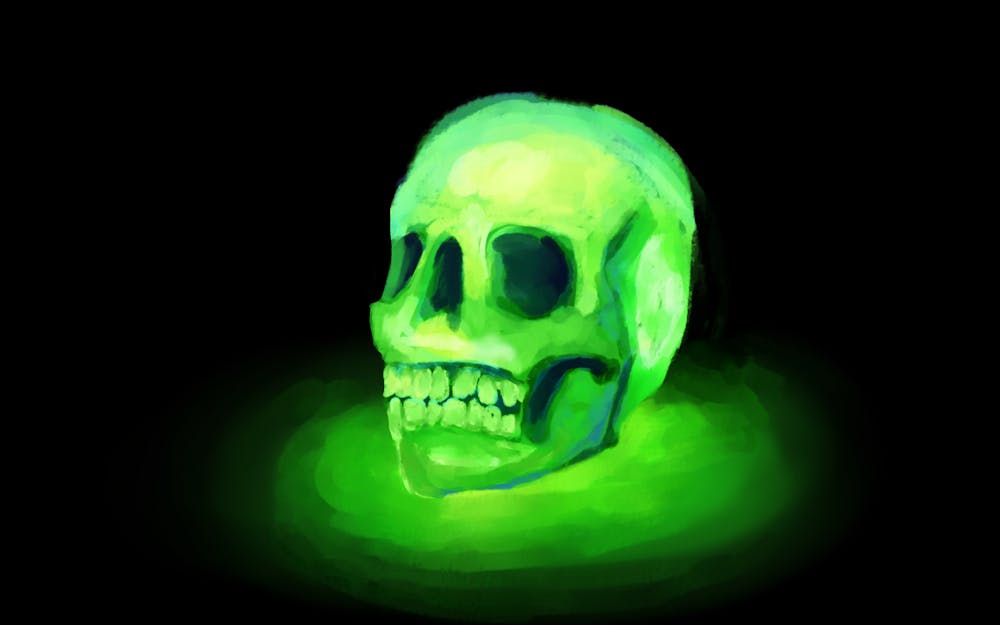
The skull lights up an electric green and shudders unsteadily in its display. It’s definitely slower than Claude, but there aren’t any usage limits since it's powered by the screams of the eternally damned.
Such power needs to be kept from the public eye, and luckily, F.A. Mitchell-Hedges thought ahead. In order to throw off any ne’er-do-wellers, he procured a counterfeit record of purchasing the skull in 1943 from a Sotheby's auction in London. Then to throw off any more ne’er-do-wellers who weren’t fooled the first time, he wrote a private letter to his brother bragging about purchasing it from a collection. Truly, it was a smokescreen of deception that few could penetrate without the power of the skull itself.
“Also, don’t use any em dashes,” I almost forget to say. The skull stops shaking.
“And don’t include any ancient, accursed runes that trap their reader within the plane of the page until they grasp a cosmic lesson.”
The skull lets out an irritated puff of smoke and resumes its shuddering glow. It does require a bit of troubleshooting, but the results are well worth it. I’m the only student in my class, and maybe the entire university, with access to a totally undetectable homework-doer.
I know the skull is almost done writing when I begin to see the silhouette of my eventual death reflected in its eyes. I check my watch — right on schedule. As my hour with the skull comes to an end, the Zoom window closes and the document, in all its undetectable glory, appears on my desktop.
The next day in class, I am untouchable. I walk into the classroom, paper in hand, and practically slap the essay into the submission bin. But as I turn to walk away, I hear a familiar rattle that makes my blood run cold.
Slowly, I turn to face my professor, who has pulled something from his bag. Purple light shines from between his fingers. Fog spills from the bag’s open pouch.
I don’t believe it — no, I can’t believe it. It’s just not possible.
“This,” he says, “is the Crystal Skull of Paris.
“It has some pretty fascinating properties” — now it’s his turn to smirk — “including the detection of skull-generated works.”
***
I received an F and was expelled from the university thanks to a longstanding zero-ancient-skull-tolerance policy I was somehow unaware of. But looking back, I don’t think I would have done anything differently.
I am, after all, through with college. What’s more, I finished four years early without completing a single assignment by myself. I expended hardly any effort and somehow got exactly what I wanted.
But that’s the thing about the crystal skull — it works in mysterious ways.
Spencer Schaberg (he/him) is a junior studying Microbiology.