Editor's note: All opinions, columns and letters reflect the views of the individual writer and not necessarily those of the IDS or its staffers.
First and foremost, I don’t like it. I really don’t. But through gritted teeth, I’ll give credit where credit is due.
This semester, colleges across the United States are introducing new academic programs centered on social media influencing. Most notably, Arizona State University has launched a bachelor’s degree in Content Creation, which includes skills like video production, audience analytics and social media strategy within its curriculum. Syracuse University and Colorado State University have introduced minor programs of a similar nature. And schools like Northwestern University and Stanford University have added content creation courses to some graduate programs.
Indiana University has also acknowledged the boost in student influencer content. In 2023, The Media School hosted a social media influencers bootcamp. And The Kelley School of Business offers an influencer marketing course.
Gray-haired skeptics might huff with disdain at these new developments. However, they come as part of a growing trend recognizing digital influencing as a serious profession. Looking at the money, I can certainly see why. The creator economy — the market in which independent content creators earn directly from their work — is estimated to bring in around $480 billion by 2027.
So, what does this career path look like for students?
Many have taken to posting short-form clips on platforms like Instagram and TikTok to build a dedicated following. From there, college students have secured brand deals, internships and other perks, like packages for product reviews. Syracuse senior and TikTok influencer Mattingly Weisholtz films about five paid partnership videos each week. Despite a relatively low follower-count compared to other influencers, she told The Washington Post she has been able to live off of her salary as a creator.
In fact, Forbes Magazine has noted the rise of the “creator middle class,” in which more modest influencers can earn comfortable wages from working directly with brands, a commonly cited benefit being self-employment.
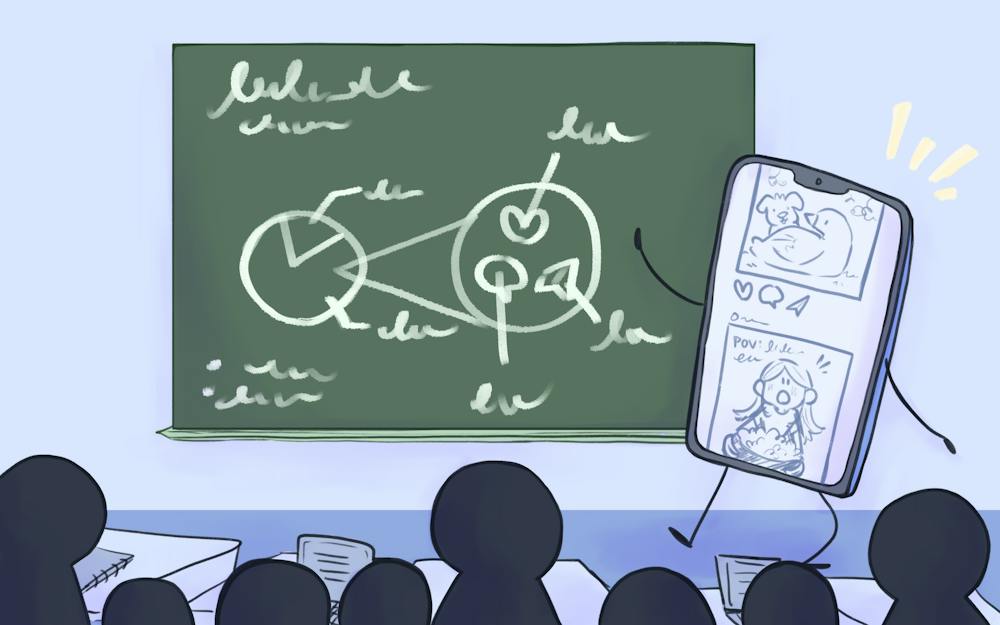
With these details in mind, content creation programs in higher education are quite practical, especially considering they provide students with legal and financial guidelines essential to working directly with brands, countering the popular idea that this type of coursework merely consists of making faces at a phone camera.
But to join the aged nay-sayers, I can acknowledge this curriculum’s practicality while still questioning its cultural impact or, perhaps, what this shift says about our current landscape. Raina Penchansky, the CEO of influencer talent agency Digital Brand Architects and a proponent of the new curriculum, believes college students play a key role in molding cultural norms.
“The younger creators understand the assignment when it comes to driving culture and shaping conversation,” Penchansky told The Washington Post.
At the risk of sounding a bit elderly, I argue that this is not exactly a positive, though the problem is not the age group sharing the content. Nor is it exactly the media itself — albeit the cheap, quick creation of short-form content does mimic other forms of mass production that tend to put quality on the back burner. Rather, it’s the distribution that concerns me.
If you’ve been following my writing, you know I’ve dried my pen on data commercialization. To reiterate, social media platforms use algorithms to recommend content we’re more likely to engage with. The data collected by analyzing what an individual is paying attention to is then used for digital advertising purposes. While this has been pitched as a wondrous plan to optimize our feeds, it prevents culture from being shared organically.
When we are shown only what an algorithm expects to catch our eyes, we’re barred from engaging with a variety of ideas. Stuck within our personal, predetermined zones of the internet, we lose opportunities to discover something new. Under this model, our beliefs and tastes cannot be challenged, only affirmed.
Undoubtedly, you might stumble across creators you can truly enjoy and even learn something from. I know I have. But due to algorithmic systems, expanding your worldview via the “World Wide Web” is never going to stack up to wandering the galleries of a museum, browsing your local library or even eyeing the nearest bulletin board.
These options are a more grounded approach to curating one’s taste, as they provide an array of works and ideas to consider, without pushing one’s feet toward a particular sculpture or shelf. Opposed to the unsubtly named “influencer,” this grants us more autonomy over our media consumption.
Social media content, the money-maker it is, will always put profit first. Influencer culture is the pinnacle of that, and we cannot reasonably say that it can replace other forms of cultural exchange in a way that benefits audiences.
Of course, it would be unreasonable to expect students to pursue degrees independent of financial considerations, and content creation is lucrative. This is not solely a reflection on the decisions of college students, but of the environment they are subjected to. We are, after all, obtaining a higher education at a time where job-readiness must exceed our thirst for knowledge.
From 2010 to 2023, while enrollment in smaller-earning degrees declined, higher-earning majors saw a drastic increase. And a study released this April revealed that 75% of college students face financial insecurity amid the rising costs of tuition and other fees.
I suspect that’s why more students are turning to ChatGPT for homework, rather than learning for the love of the game.
So, sure. Content creation as a career path could be practical. Practical doesn’t always mean better, though. My favorite part of the day is having that morning cup while reading some op-ed telling me to adapt or get left behind. But looking toward a future that maximizes profit at the cost of culture, I find myself more than happy to be left behind.
Emma Howard (she/her) is a junior studying journalism.