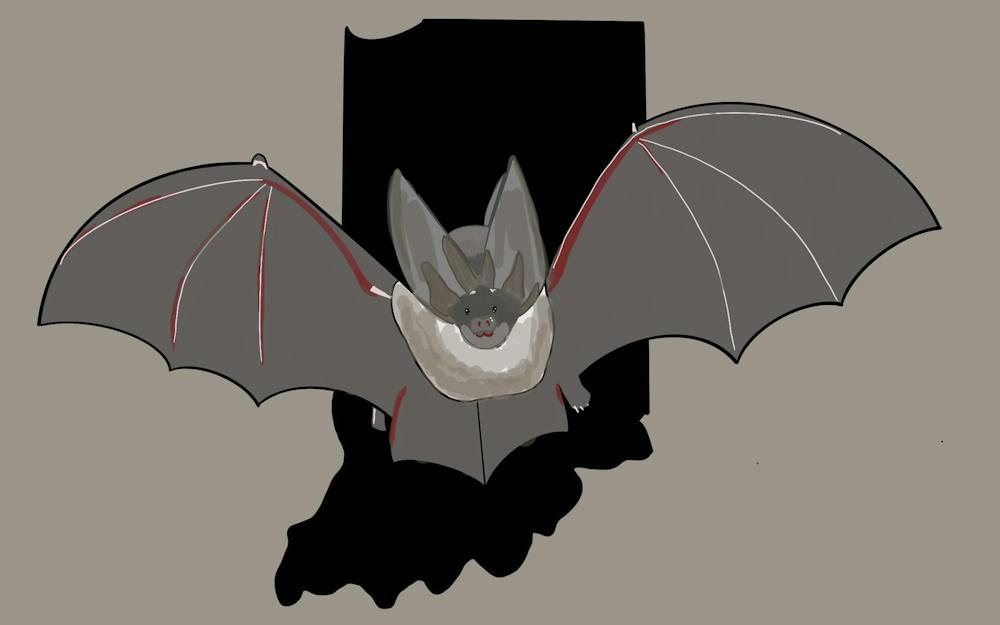
Desiree Coy, spends hours a day on Facebook, contacting local legislators and cities across Indiana, all for a bat.
The New Haven, Indiana, resident’s campaign — Our State, Our Bat — is pushing to make the Indiana bat the first Hoosier state mammal. The Indiana bat is an endangered species first discovered in 1928 in Wyandotte Cave in southern Indiana, close to the Kentucky border. The most recent U.S. Fish and Wildlife Service count in 2019 found 537,297 Indiana bats across 16 different states.
Coy said the campaign started on a whim after she discovered Indiana had no official state mammal. She created a petition and sent it to a few friends and family, who sent it to more friends. Now, the petition has over 3,000 signatures..
Indiana is one of only five states without an official state mammal, and Coy believes the Indiana bat is the perfect candidate.
“It's the only animal in the entire world that has Indiana in its name, so that already makes it a shoo-in,” Coy said. “That's already an incredible sense of unique Hoosier pride.”
Coy is not campaigning alone. In 2025, fifth grade teacher Heather Asher and her students at Riverside Intermediate School in Fishers, Indiana, pitched the idea to Rep. Victoria Garcia Wilburn, D-Fishers.
Wilburn introduced House Bill 1237, to make the Indiana bat the official state mammal, but it died in committee. She said in an email to the Indiana Daily Student she plans to reintroduce it in the 2027 legislative session.
The bat acts as a natural pesticide, with each bat consuming thousands of potentially crop-destroying bugs a night, according to the Bat Conservation Trust. The Department of Natural Resources estimates bats save America’s farmers nearly $4 billion each year on pesticides through their bug munching.
Coy said 11 Indiana mayors have announced their support for Our State, Our Bat. Bloomington Mayor Kerry Thomson announced her support in a June 29 letter to the Indiana Grand Assembly.
“Naming the Indiana bat as our state mammal would honor a species that bears our state’s name while highlighting the importance of conserving forests, caves, and natural habitats that define Indiana’s landscape,” Thomson wrote in her letter.
Coy hopes the campaign will eventually shift from raising awareness to creating conservation efforts. The Indiana bat’s population has decreased to half its size since being named an endangered species in 1967, according to the U.S Fish and Wildlife Service. The population continues to decline due to a fungal disease called white-nose syndrome.
White-nose syndrome, which was first reported in North America in 2006, causes bats to wake up during hibernation, leaving them without enough energy to survive winter. The Indiana bat’s population has declined 19% since white-nose syndrome was introduced to the continent.
Angela Sturdevant, a conservation project manager for the Nature Conservancy, said another threat facing Indiana’s bats is lack of habitat space. This is especially important for the Indiana bat, as 72% of the population hibernates in just four locations across Indiana, Illinois and Missouri. .
In the meantime, Coy continues to raise support through social media, and hopes to make a case to the state legislature that includes the perspectives of everyone from lawmakers to conservationists.
“By making it the official state mammal, we're not adding any new mandates or regulations,” Coy said. “We're just opening a door for classrooms and families and communities to learn about our amazing local biodiversity.”