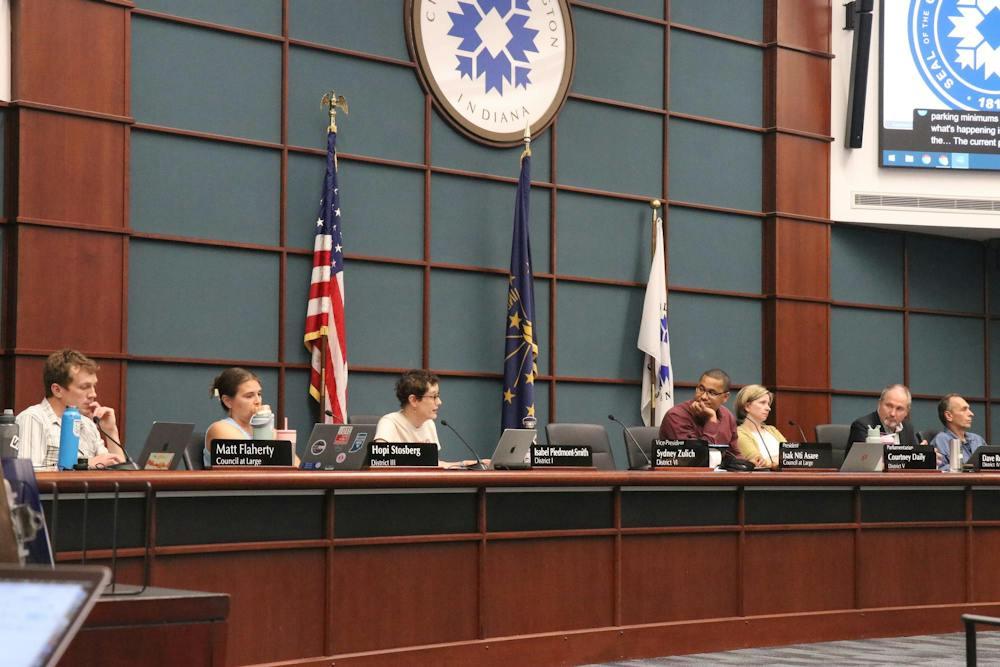
In a nearly five-hour long Wednesday meeting, the Bloomington City Council passed an ordinance of zoning changes aimed at housing affordability and introduced an ordinance that would ban the city from using license plate readers.
License plate reader ban
The council introduced Ordinance 2026-22, sponsored by Councilmember Isabel Piedmont-Smith, Council President Isak Nti Asare and Council Vice President Sydney Zulich.
The ordinance would prohibit the City of Bloomington and any city agent — including any Bloomington department, office, board, commission, authority, employee or contractor — from the acquisition and use of any automated license plate reader technology and surveillance camera system data that is shared with any third party.
The ordinance is a follow-up to Resolution 2026-04, passed March 4, 2026, which called for immediate transparency, limits and a public review process for automated license plate technology in Bloomington, including the vendor Flock Safety.
Since that resolution passed, the city decided not to renew its contract with Flock on April 15 after the contract expired March 5. The decision came after a month long city investigation into Flock.
Monroe County followed suit July 23, when its commissioners voted 2-0 to terminate the county’s own Flock contract.
Wednesday’s ordinance aims to “protect the health, welfare, privacy, civil liberties, and constitutional rights” of Bloomington residents by preventing the creation of administrative databases that track resident’s movements and locations without suspicion of criminal activity.
The council plans to discuss and vote for the ordinance in the next regular session Oct. 14 during a second reading.
Housing, TIF districts and convention center budget
The council voted 5-3 to pass Ordinance 2026-20, sponsored by councilmember Matt Flaherty.
The ordinance amends the Unified Development Ordinance by reducing minimum lot widths and building setbacks in residential zones, eliminating minimum parking requirements, among other recommendations.
Now forwarded to the council, these updates are outlined in City Council Resolution 2026-05, approved 6-2 by the Plan Commission on Aug. 10, to promote housing affordability and sustainability.
Operations Director for Habitat for Humanity of Monroe County Kari Bennett said the ordinance would “support more affordable homes.”
Councilmembers Courtney Daily, Dave Rollo and Andy Ruff voted against the ordinance. Rollo said he voted against it due to a “lack of affordability and availability” and Ruff said the ordinance was too “broad and experimental.”
Resolution 2026-20 covered the approval of the Monroe County Capital Improvement Board’s 2027 operating budget for the Bloomington Convention Center and passed 6-1, with councilmember Kate Rosenbarger voting against it.
Councilmember Flaherty was absent from the ordinance’s roll call, while Councilmember Zulich was absent the whole meeting.
The budget totals over $3.2 million in both projected revenue and expenses, funded entirely by convention center operations and innkeepers' tax revenue, without requiring a subsidy from the city.
The Capital Improvement Board took over center operations from the Monroe County Council on July 1, 2026, and is preparing for the expanded facility to open in January 2027.
Resolution 2026-21, which requests the food and beverage tax advisory commission to make a recommendation for expenditure of food and beverage tax revenues, passed unanimously.
Under Indiana Code, food and beverage tax revenue can only be spent on convention centers or related tourism and economic development projects. State law requires the recommendation before the city can spend any food and beverage tax revenue on the convention center project.
Resolution 2026-19, sponsored by Piedmont-Smith, passed unanimously. This resolution, which developed from the Bloomington Redevelopment Commission, would turn Hopewell South into an Economic Development Area, creating a residential TIF.
TIF’s, or tax increment financing, are districts which the city uses to finance redevelopment using property tax revenues.
Hopewell South currently gets their funds from the Consolidated TIF, according to the staff memorandum. Through the Hopewell South Residential TIF, funds used for its development can be reused for its own continued development or other projects.
Resolution 2026-18, also sponsored by Piedmont-Smith and originating from the Redevelopment Commission, passed unanimously. It updates the city’s software used to process TIF revenues by removing residential properties that do not belong in Bloomington’s Consolidated TIF District.
Commission changes
The council introduced Ordinance 2026-21, sponsored by Councilmember Hopi Stosberg, which makes changes to the membership of the Transportation Commission and the size of the Environmental Commission.
The Transportation Commission, created in February 2025, makes recommendations on transportation and parking regulations within the Bloomington Municipal Code.
The ordinance, would reconfiguring the remaining community member seats on the commission, adding a spot for a Monroe County Community School Corporation representative who could be a MCCSC board member, employee or volunteer who lives in Bloomington limits.
The Environmental Commission currently has five vacant seats — three appointed by the mayor and two appointed by the city council. The city established the commission in 1971 to help preserve the city’s environment and natural resources through recommendations and raising awareness.
Through the ordinance, seats with long-standing vacancies — including two mayor-appointed positions and one council-appointed position — will be eliminated to reduce the size of the commission from 12 to nine members.
The commission’s vice president Karl Gaisser expressed concern about the decrease in seats.
“While it may help us in the short term, I think in the long term, this is going to injure the performance of the environmental commission,” Gaisser said.
The ordinance will likely be voted on at the council's next regular session Oct. 14 in Bloomington’s City Hall. The 2027 budget legislation will be introduced during a common council special session Sept. 23.