Editor's note: All opinions, columns and letters reflect the views of the individual writer and not necessarily those of the IDS or its staffers.
I finally did it. After months of my best friend twisting my arm and telling me that life isn’t a Jane Austen novel, I downloaded Hinge.
Huddled around my phone screen in the corner of the Blackbird Cafe in our hometown, we created my profile. After pouring over every photo in my gallery, a million takes to verify my identity and a million more utterances of “I don’t wanna do this,” it was done.
Little did I know I had just unlocked a whole new level of doomscrolling.
Of course, when you’re flipping through thousands of profiles telling you how much they love banana bread and physical touch, it’s evident they’re not all going to be winners. All you can do is hope the next swipe will bring you a guy that looks good holding a puppy or a baby. But what might initially feel like searching for a pair of hot lips is actually a classic case of psychological conditioning.
Does that sound crazy? Well, let’s throw pigeons into the mix.
Behavioral psychologist B.F. Skinner developed the theory of operant conditioning, or the idea that if an action yields rewards, we are more likely to repeat it.
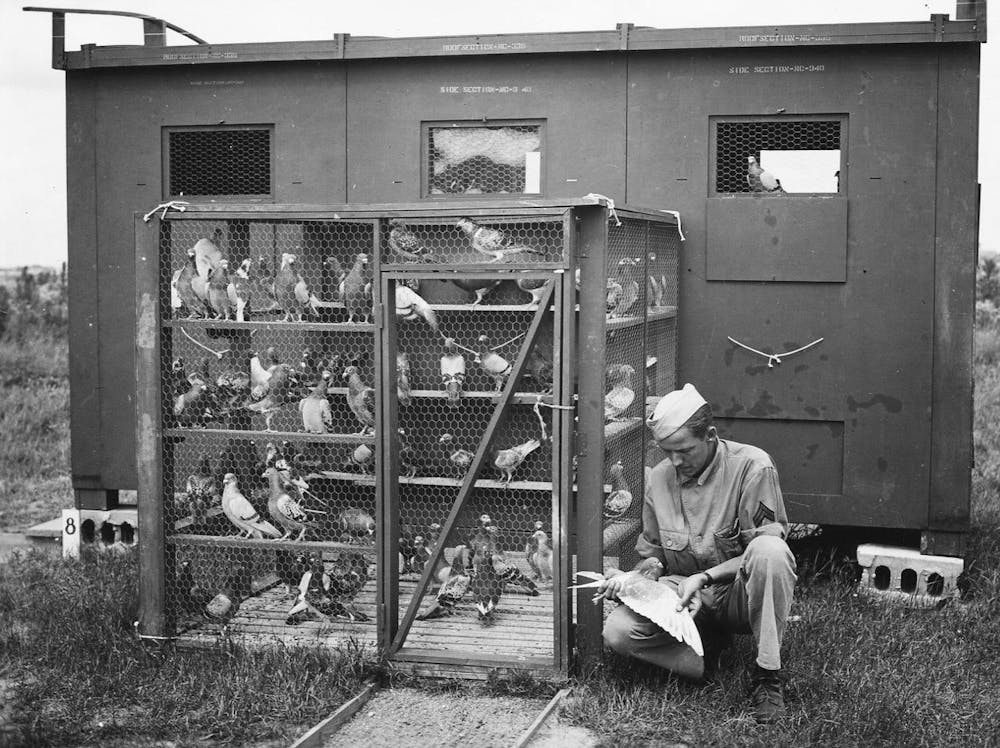
In 1948, he studied operant conditioning using the Skinner Box, an enclosed contraption including a button or lever that an animal could easily manipulate. When hungry pigeons were placed into the box, they received a pellet of food after pecking a button. While not every tap of the button would bring with it a pellet, the pigeons continued the action anyway.
Giving a whole new meaning to the phrase “bird-brained,” Skinner’s experiment revealed some uncomfortable truths about our own habits.
Even if a behavior is not consistently rewarding, we’ll continue it repeatedly for the positive outcome we’ve already associated with it. This natural tendency is a wonderful cash collector for companies, as it’s the same force that feeds slot machines and keeps “Candy Crush” crushing. When we’re scouring Instagram Reels, it’s the occasional gem that keeps us going, so we tolerate everything in between.
In the case of Hinge, Tinder, Bumble, etc., it’s digging for your soulmate amongst a plethora of fish-wielding apoliticals.
It is certainly no secret that dating app algorithms can be pretty inefficient in pairing compatible matches. While one in ten partnered adults do meet online, the conflicting goals of bringing users together and generating profit create a paradox.
Some users agree that the apps must be purposely pushing bad apples at us to keep us scrolling longer. And while this may sound like quite the conspiracy, it’s not completely baseless. In fact, Christian Rudder, data scientist and co-founder of the dating service OkCupid, openly admitted to doing so in 2014. In a controversial blog post detailing his experiments with the site’s algorithms, he revealed that OkCupid had been lying about compatibility ratings.
“In the back of our minds, there’s always been the possibility: maybe it works just because we tell people it does,” he wrote. “Maybe people just like each other because they think they’re supposed to?”
While OkCupid might be somewhat outdated in the dating app world, it would be no shock if the app that was “designed to be deleted” also manipulated its algorithms to keep users scrolling. After all, dating apps are a billion-dollar industry. In 2025, the market brought in around $6 billion in revenue. Match Group, the dating conglomerate that brought us Hinge, Tinder, OkCupid and others, made up $3.3 billion of that. Whether they’re selling users’ data to advertisers or selling Romeo a Platinum plan, dating apps are making bank.
The commodification of human experiences under capitalism is nothing new. In his 1956 book “The Art of Loving,” social psychologist Erich Fromm argued that capitalist systems distort our perceptions of love. Under the ideas of western consumerism, we begin to treat our interpersonal relationships as transactional. We view other people, as well as ourselves, as commodities that we must obtain the maximum number of benefits from.
“Two persons thus fall in love when they feel they have found the best object available on the market, considering the limitations of their own exchange values,” he wrote.
Something tells me Match.com wouldn’t be to his taste.
Online, romance is an industry in which we are the products. And we, unfortunately, are all too happy to market ourselves.
I just about twisted into a pretzel choosing a profile picture. When scrolling through the masses of eligible singles, we examine selling points, not people. We display what aspects of ourselves might generate likes, while excluding the undesirable. When we combine our thirst for validation — Hinge says getting a Rose is quite the compliment! — with our desire to find a serendipitous match, we turn an attempt to connect with others into more of a shopping experience.
He’s a 6-foot-3 history buff? Consider me engaged.
This market-based system is why apps designed to be deleted are time and time again deleted and redownloaded. Apps are escape rooms built by our lonesome. We walk through the halls under the promise that the perfect match will be there at the turn of every corner. You might not find the love of your life around the corner, but you might find a shirtless gym picture of Brad.
Unfortunately, apps are the only way to find romance anymore. Or so we are told.
After advertising services for over a decade, companies are now pointing the finger at younger generations for their own fatigue around dating. Hinge CEO Jackie Jantos claims that Gen Z is “struggling to put themselves out there” due to socializing less in person. Her solution? AI features to help strike up a conversation.
Technology, particularly instant messaging, has provided an outlet of connection amid times of loneliness and, in return, stunted social skills. Jantos certainly has a point there. Dating app usage faced an overwhelming increase during the COVID-19 pandemic. Tinder, in particular, saw a 15% boost in matches and a 10% boost in messaging. However, we’re often told that technology is an inevitable force we must embrace, but more often than not, tech is selling us back solutions to problems it created.
So sure, life isn’t a Jane Austen novel. But it never was. Austen wasn’t just a romance writer, she was a social satirist critiquing the superficiality of English high society. Instead of simply accepting the less-than-romantic state of courtship in the Regency era, she took up her pen to envision something different.
While CEOs might try to convince young people there’s no other path to finding love and friendship, they’re still ultimately trying to sell a product and reframe it as the norm. Yet, it doesn’t have to be. So many lament their exhaustion surrounding online dating — can we not envision something different, too?
Emma Howard (she/her) is a junior studying journalism.