
Content warning: This article includes mentions of suicide.
Pride month has begun, and what better way to start it off than by watching films that hold a special place in the community’s hearts.
If you haven’t seen the 1983 film “Yentl,” starring Barbra Streisand, think of it as a Jewish studies version of Disney’s 1998 film, “Mulan.” In both films the female lead dresses up as a man in order to join a part of their respective cultures that doesn’t allow women’s participation.
These films often were the only representation for young gay and trans people at the time. While these movies weren’t explicitly created through a lens of queerness, the subject matter of crossdressing in both films often leads to scenarios of men falling in love with women who they’ve only known as men for most of the film.
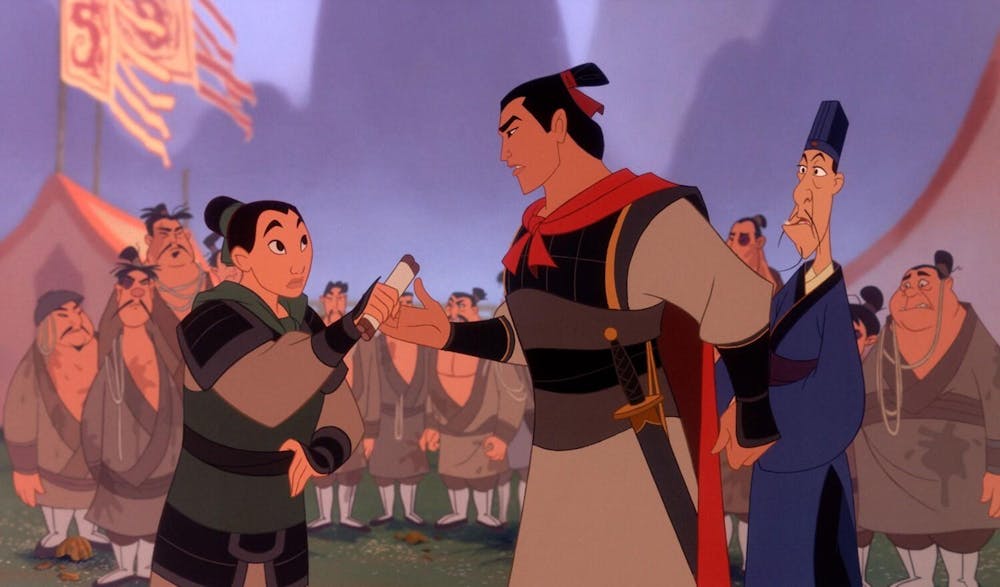
Let’s start with the more popular film, “Mulan.” Mulan (Ming-Na Wen), the clever and carefree daughter of an aging war hero, never quite fits in among her female peers in the village. She is rebellious and outspoken to male authority figures and eventually dresses up in her father’s armor to join the war in his place.
While most of Mulan’s actions against her gendered status quo are explained by her simply being clumsy or a result of the oppressive culture toward women, the trans narrative is still quite clear as she becomes “Ping,” a male soldier, for the majority of the film.
Mulan also sings “Reflection” near the beginning of the film. A song which has become something of a queer anthem due to its lyrics about not being accepted and feeling like you have a different identity than what you see in the mirror.
While Mulan’s storyline has sparked a lot of love from the LGBTQ+ community, one of the most popular fan theories surrounding the film is about Li Shang (BD Wong), the general of Mulan’s unit and her eventual love interest.
In the movie, we see Shang and Mulan, dressed as Ping, grow closer during training and in various battles. This is often marked as the beginning of their romantic relationship, leading many to believe that Shang is bisexual. These fan theories are backed up when toward the end of the film Mulan is discovered to secretly be a woman and Shang seems a little more than just disappointed that the person he’s had feelings for might have lied to him.
I have always thought that this character was very bisexually coded because he seemed to fall in love with Mulan a bit too quickly after she was revealed to be a woman. Right after the film’s main conflict, Shang goes to visit Mulan's family, seemingly in love with her as he stays to eat dinner with them. However, she had only been perceived as a woman by him for a short time so many people think his attraction to her began while she was Ping.
Many of these character analyses hold true for their counterparts in “Yentl.”
Throughout the movie, Yentl (Streisand) disguises herself as Anshel, a dorkish-looking schoolboy, to continue her study of the Torah after her father who taught her dies.
While Mulan disguising herself as a man can easily be written as her having a strong sense of duty and protectiveness over her aging father, Yentl dresses up as a man because she wants to do things only men are allowed to do in her culture.
As Anshel, she is free to argue with men, read religious texts and finally go to a school where she can learn all she wants.
Yentl’s love interest, Avigdor (Mandy Patinkin), appears even more explicitly bisexual than Shang. Not only that but Yentl and Avigdor’s betrothed, Hadass (Amy Irving), also seem to be bisexual. Let me explain.
Starting with Avigdor, even while Yentl was Anshel, the two of them were close study partners. They argued like a married couple, sometimes slept in the same bed, wrestled and tickled each other. Perhaps this can be written off as the way a lot of straight men act, but even so, their chemistry was off the charts.
When Yentl finally reveals to Avigdor that she is truly a woman, the two get into a fight. While this happens, Yentl breaks down and says, “Because I loved you.” Avigdor says, “I loved you too.” Confirming that he loved her even when she was seemingly a man.
I also think that Yentl is bisexual as she quite literally marries a woman about halfway through the movie.
When Avigdor’s family is deemed “cursed” after it’s revealed his brother committed suicide, Hadass’ family breaks the engagement. In a desperate bid to marry her off quickly, Yentl, dressed as Anshel, ends up marrying Hadass instead.
Instead of consummating the marriage like Hadass’ parents wanted, Yentl secretly teaches her Torah, turning the naive Hadass into a knowledgeable and rebellious young woman. After reading that a wife could demand intimacy from her husband, Hadass’ attraction to Yentl was far clearer. The two end up kissing, but Yentl fears that Hadass will discover her secret and quickly shuts down her advances.
Despite Yentl having to step on glass to not reveal her secret, under all that worry, it seemed like she really loved Hadass and cared for her deeply.
While none of these theories are explicitly stated as true by the filmmakers, both films have become beloved parts of the LGBTQ+ community. If you want to create your own analysis of these characters, “Mulan” and “Yentl” are wonderful films to watch this June.


