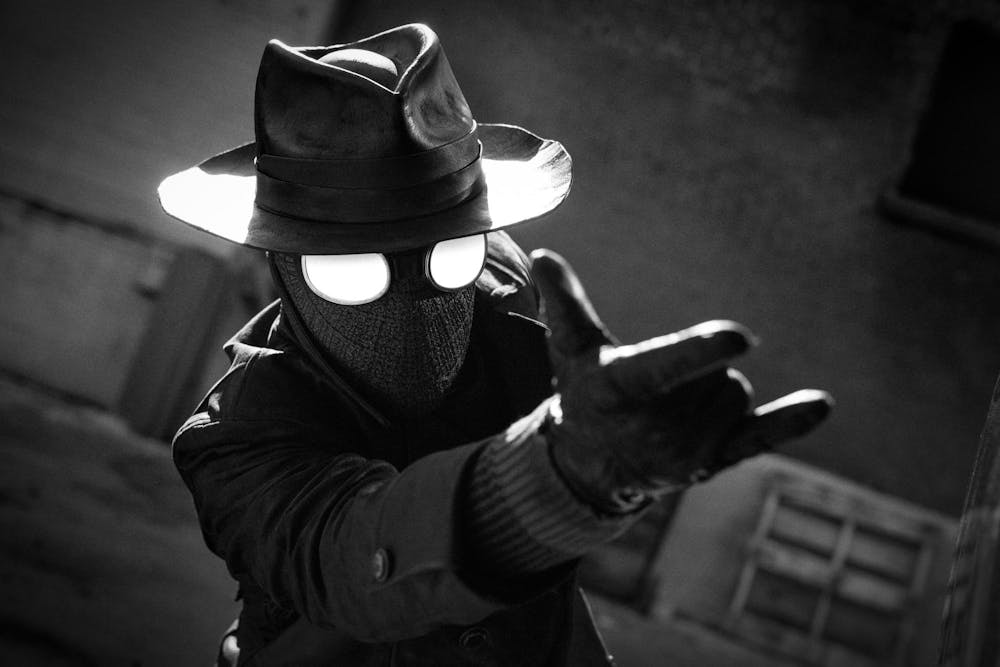
SPOILERS: This column contains potential spoilers for “Spider-Noir.”
Prime Video’s “Spider-Noir,” released May 25, is a stylistically bold series, reminiscent of the early days where film noir was front and center.
With the charming personality of lead Nicolas Cage, this series blends noir tropes, such as the femme fatale, while parodying the genre hilariously by embracing the original comic book’s absurdity.
“Spider-Noir” is set in 1930s New York City, where depression and crime are forced to blend with superhero presences and odd human hybrids. Ben Reilly (Cage) works as a private investigator, taking up gigs from various clients. On the surface, Ben is an average guy. But he is keeping the secret that he is The Spider, the town’s aged crime-fighter who retired after the loss of his wife.
What initially made this series stand out to me is that it is an odd and simultaneously interesting combination of Nicholas Cage, the noir style and Spider-Man character.
Not only does this series include Cage, who I am most familiar with for acting in hilariously bad movies such as “Willy’s Wonderland” and “Dream Scenario,” but it is also set within a dramatic crime-filled New York. So, a noir Spider-Man who retired from the limelight of crime-fighting played by Cage sounded quite chaotic.
Despite this, I was pleasantly surprised by the series with Cage’s rendition of the character becoming one of my favorite elements.
While I was initially scared for how bad the show could be, due to his often boldly horrendous choice in which films to act in, I felt after watching that Cage was allowed to evoke his true potential as an actor in this role.
The result was a character who became extremely representative of film noir, maintaining an expressive flair and over-the-top energy. Cage himself describes the character as “70 percent Humphrey Bogart, and 30 percent Bugs Bunny.” This performance became even more comical to me as I saw Ben as an older man trying to relive his glory days and go back to his prime despite very clearly having aged.
However, the series doesn’t hold back on its serious moments, particularly with Ben’s tragic backstory. He is emotionally plagued throughout the entire series.
Ben blames himself for the loss of his wife, partly because he was out drinking when she needed help and partly because she was killed by one of his angry clients. It’s her death that causes Ben to leave the hero façade behind.
Throughout the series, he wishes he wasn’t The Spider, going so far as to almost drink an antidote that would make him normal again, until he ultimately decides that he will still protect the city while dealing with his guilty past.
This drew The Spider closer to me, establishing a sense of relatability in a shared human experience of regretting past actions or feeling disdain with oneself. By stripping Ben of The Spider persona down to being just another man in New York City, the series allowed Cage to step into his character’s playful relatability.
Adding to the series’ uniqueness, viewers were given the option to watch the series in either black and white in true film noir nature or in color.
I chose to watch the series in black and white, and I believe the show should be watched in this format because it really helped represent the intended genre. But I understand that some viewers who are accustomed to modern films might not enjoy the lack of color.
While I enjoyed the show, it sometimes felt that the series over relied on the noir aesthetics, creating a much grittier result compared to other Spider-Man adaptations. So, I would advise those looking for a family-viewing superhero experience to skip this one for the rough nature and gore present throughout.
I can admit that balancing the very two different aspects of Spider-Man and noir can be challenging. At times, “Spider-Noir” felt less like a superhero series than a crime thriller, introducing a whole system of crime and murder under the hands of the evil Silvermane (Brendan Gleeson).
I also became a little confused regarding the complicated relationships that femme fatale Cat Hardy (Li Jun Li) established. She and Ben fell in love for a short while until she very quickly betrayed him, later devoting herself to The Sandman mutant Flint Marko (Jack Huston) as she had done before in this series.
Overall, “Spider-Noir” takes a unique look at an often over-saturated superhero genre. One that masterfully establishes a noir aesthetic while somewhat diverging from the stereotypes seen in many superhero shows. I enjoyed the harsher aspects of the series, though more traditional superhero fans might find some events too intense.
But one thing I think is evident is that Cage did an excellent job in his performance, and I look forward to seeing how he continues his Spider-Noir character in the 2027 release of “Spider-Man: Beyond the Spider-Verse,” the third movie in the Spider-Verse film series.