
Clifty Creek Elementary School is bilingual.
Kindergarteners squirm through the hallways in Columbus, Indiana, under candy-colored backpacks as their teacher scolds one student yelling “Vamos en la fila Juan Pablo!” which means “let’s line up Juan Pablo!”
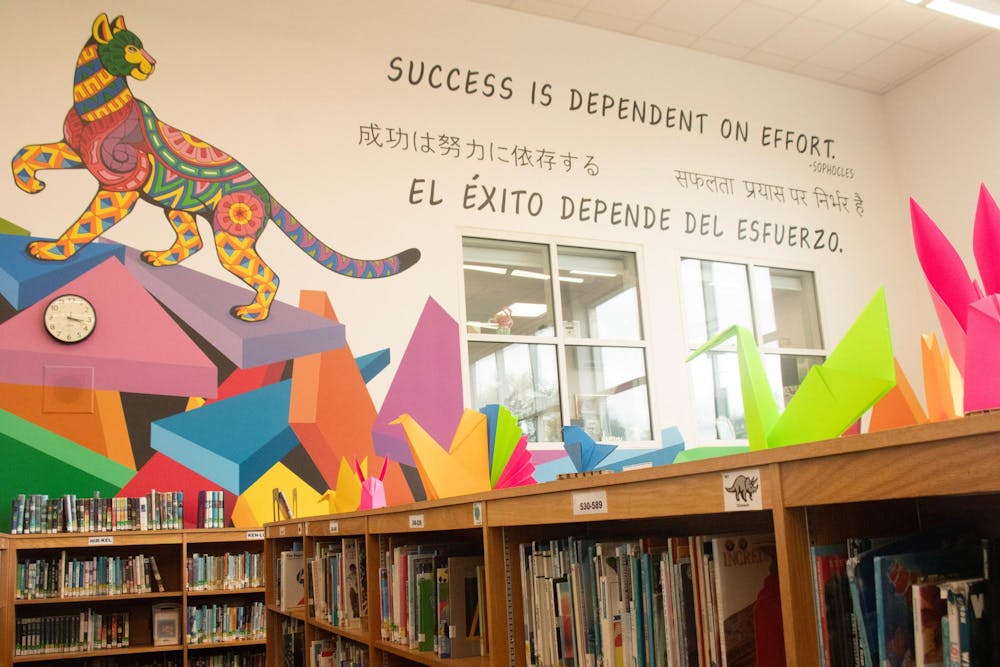
The library features a version of the school’s mascot, a royal blue cougar, painted in bright colors watching over shelves of books in Spanish and English
The teachers, books, and painting are all part of a bilingual education program called the Legado Spanish Immersion Academy.
The program was launched in fall 2018 with kindergarteners and has grown to include classes from pre-K to seventh grade, with two classes per grade level and a bilingual librarian, Liliana Lamadrid.
Legado, which translates to “legacy" in English, follows a model where the students involved spend 80% of the school day in Spanish and 20% in English. Then in second grade it shifts to a 70% and 30% split slowly, getting closer to a half and half split. Generally, language arts and specials such as art, music and STEM, a type of creative science-based class, classes are taught in English. Math, reading and writing, as well as other subjects, are all taught in Spanish.
Starting in third grade, the program transitions to more instruction in English for math and reading and writing to help students gain the academic vocabulary they need for state-wide standardized tests like ILEARN.
Clifty Creek Elementary School Principal Patrick Mahaffey was part of the planning committee when the program was first suggested. He said the 80/20 model forces students to engage with the language and learn to keep up with the class. It prevents students from just waiting to learn and engage until their preferred language is used, which can sometimes happen in a 50/50 model, he said.
Former Bartholemew Consolidated School Corporation Superintendent Jim Roberts encouraged the school district to adopt a dual language program after his experiences with the dual-immersion program for Mandarin in Batesville, Indiana.
According to the Indiana Department of Education there are currently 43 dual-language programs across the state all using Spanish and English except for Batesville, which does Mandarin. This includes Summit Elementary School and Batchelor Middle School, two Monroe County Community School Corporation schools.
Legado fourth grade teacher Eric Huggins sees the program as a beneficial alternative for English as a Second Language students. For the 2025-26 school year there were 1,690 ESL students enrolled in BCSC schools.
“What makes the program meaningful for me is that it's for the kids who come in who are Spanish speaking at home,” Huggins said. “They traditionally would have gone into like an ESL program, where essentially, they have to learn English before they can ever access the content in the classroom at all. And it takes, you know, three, four years to develop that academic level of English.”
Legado aims to have classes with half native Spanish speakers and half native English speakers, so students can learn the languages from each other and not just their teachers.
While it was hard to convince families to sign up at first, the wait list is growing every year, Legado Instructional Coach Greicy Patiño said.
“One thing I tell (families) is that for our kindergarten kids this is the only kindergarten they’ve ever known, so this is just what school is,” Mahaffey said. “It’s usually far more confusing for parents than for kids.”
First grader Eleanor Ramey, 6, enjoys learning Spanish, especially reading books in Spanish from the school library. Her favorite book is from the “Piggy and Gerald” series called, "Vamos a Dar una Vuelta," which means “we're going on a trip.”
Huggins, who before teaching at Legado was a high school Spanish teacher, finds teaching younger children much more impactful.
“This is perfect, because these kids are learning Spanish and English, but from at the time when they are really flexible, their minds are flexible and it's really the proper time for them to learn it,” Huggins said.
Throughout the day, teachers use different colored lights to indicate what language the students should be using. Blue is for English, green for Spanish and purple for whatever language the students want to use.
The program faced some community backlash when the school replaced its English-only signs with bilingual ones in front of the school, Huggins said. Teachers not in the Legado program have also been concerned that their jobs could be replaced in favor of bilingual teachers and said the program spilt the school in half between Legado and traditional classes.
Mahaffey has worked to close the gap by holding meetings with traditional and Legado teachers and hosting school-wide programs like the whole school reading “Charlotte’s Web” throughout next year.
Greicy Patiño, one of the founding teachers of Legado, sees the program as a beautiful reflection of the diversity of the community. According to the Columbus city website there are 54 different native languages spoken in the school system, with immigrants making up 15.9% of the population.
“There are kids in (Clifty Creek Elementary School) who are afraid to speak Spanish,” Huggins said. “But then they come over to Legado and it's like, ‘Oh, I can speak Spanish at school and be proud of it.'”
Several of Legado’s teachers were originally teachers abroad and through Legado can teach in the United States. Second grade teacher Karen Camargo is originally from Brazil and calls Legado her “happy place.”
“If I make them be happy, believe in themselves, they can learn whatever I want to teach them,” Camargo said. “I think my main job is make the kids enjoy coming to the school every day, be happy to be here, feel safe in this place, and they can learn all the things they can.”
Camargo sees the impact Legado has on students. One project involved students reading a book called the “Paletero Man,” meaning popsicle man. After reading, the second graders invented their own flavor of popsicle, with one student creating a bilingual flavored popsicle, one side English and the other Spanish.
Camargo hopes to continue teaching at Legado for years to come.
“Somos awesome," she said.
Elizabeth Schuth covers immigration issues in southern Indiana. Her work is supported by a rural reporting grant from the Hearst Foundation. Edith Morales, also supported by the grant, contributed to this reporting.



