
Editor's note: All opinions, columns and letters reflect the views of the individual writer and not necessarily those of the IDS or its staffers.
It’s 2 a.m. You’re sleep deprived and delirious, but you simply must know if Victorians actually thought ankles were scandalous. How historically accurate are the costumes in “Shrek?” And is milk… evil?
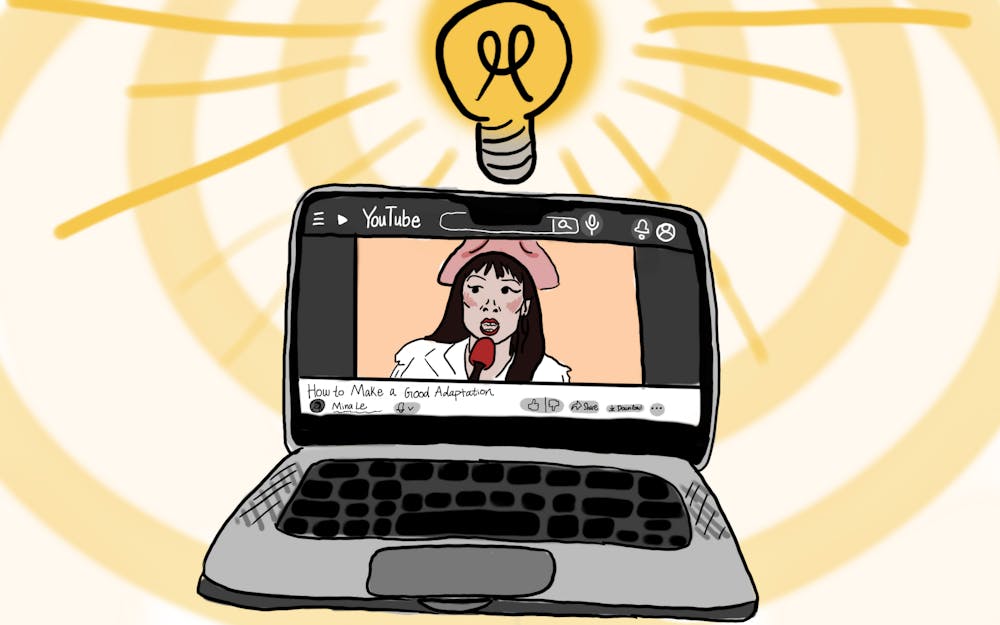
YouTube creators have answered all these questions and more, providing video essays that dive deep into any niche topic you could imagine. Fun, accessible and engaging, they provide information without expecting anything in return. No tests, no homework. Just learning for the love of the game.
Taking off in the late 2010s, video essays boomed six years ago during the COVID-19 pandemic. Spanning anywhere from 15 minutes to over 8 hours long, they provide lasting entertainment amid a world of quick clips. As creators delve into their specific topics, they include a variety of different audio and visual elements to engage audiences. From aesthetically pleasing visuals, memes and even comical reenactments, these aren’t your grandpa’s documentaries.
Despite the more casual approach to educating viewers, many creators, such as Mina Le, a video essayist covering media and fashion history, carefully script their videos and frequently reference academic sources. In these commentary videos, snappy antics go hand-in-hand with factual evidence. This nuance leads to a perfect balance of savvy and scholarly, wrapping knowledge in approachable packaging.
Naturally, we all have that one professor who throws a plethora of material at you in a slide show. Let’s face it, with the rise of short-form content, our brains suffer enough from information overload. The beauty of a video essay is that it unpacks a singular topic at length. Want to be disgustingly educated on one particular subject? I shall point you in the direction of YouTube.
With one specific focal point, we actually take in information more efficiently. According to the American Psychological Association, our brains are not wired for multitasking. Research has shown less efficient performance when test subjects are required to complete multiple tasks at once. In fact, only about 2.5% of people are able to multitask successfully. Opposed to that long lecture or a routine doomscroll, with video essays, your focus is on one subject, and you’re learning it like a pro!
This is demonstrated in the neuroscience behind how we learn. In 1949, psychologist Donald Hebb proposed that synapses, the links that connect our brains’ neurons, could change. This is now referred to as synaptic plasticity, in which those links build up and break down as we gain new information throughout our lives. When our brains rapidly switch from one topic to another, it becomes more difficult for new synapses to form. This disrupts the process of long-term plasticity, where new synapses grow and older ones weaken; ultimately shaping how our brains learn and remember over time.
Not only is this formatting helpful for absorbing information, it’s also a great testament to our self-motivation. It’s academics without obligation. Is anybody going to quiz me on why so many lighthouse keepers went insane? No. But am I locked in? Absolutely.
In all honesty, after a test about biological anthropology, I’m going to get my grade and abandon all thoughts about Charles Darwin. When our goals are centered around a grade point average, actually retaining knowledge gets put on the back burner. Much like checking out books in a library, picking and choosing the educational content we consume allows us the freedom to expand our horizons on our own terms. Classes are important, but some of my most valuable lessons have come not from instructors, but videos I wanted to watch.
Those lessons don’t just have a one-way ticket from YouTube to our brains. Rather, they can introduce you to topics that will ultimately create new, possibly lifelong interests. In the depths of the pandemic, Karolina Żebrowska introduced me to the fabulous world of fashion history. She not only taught me about various styles and their eras of glory, but her work led to further research and a deeper understanding of what I was already consuming. For example, after watching her videos I began to read classic literature differently, picturing actual Regency attire in the works of Jane Austen.
So I encourage you, you good reader, you, to become a watcher. Not to take a test, but to learn for the fun of it. That random, kind-of-derranged thumbnail that’s speaking to you in the dead of night just might lead to a new obsession. Of course, we all have our own niche. But if you’re stumped for ideas, I’ve assembled a squad of some amazing creators for you to explore.
- Bernadette Banner: Fashion history,costume design/analysis, DIY
- Karolina Żebrowska: Fashion history, costume design/analysis, DIY
- Kaz Rowe: Various niche history topics, including supernatural, LGBTQ+ and Hollywood history
- Mina Le: Analysis of media/pop culture trends, fashion history
- ModernGurlz: Analysis of media/pop culture trends, fashion and film history, costume design/analysis, interviews
- Princess Weekes: Pop culture analysis, POC and feminist perspectives
- Shanspeare: Analysis of media/ pop culture trends
Emma Howard (she/her) is a sophomore studying journalism.



