
Editor's note: This column includes mention of potentially triggering situations, including exploitation of minors. Resources are available here. All opinions, columns and letters reflect the views of the individual writer and not necessarily those of the IDS or its staffers.
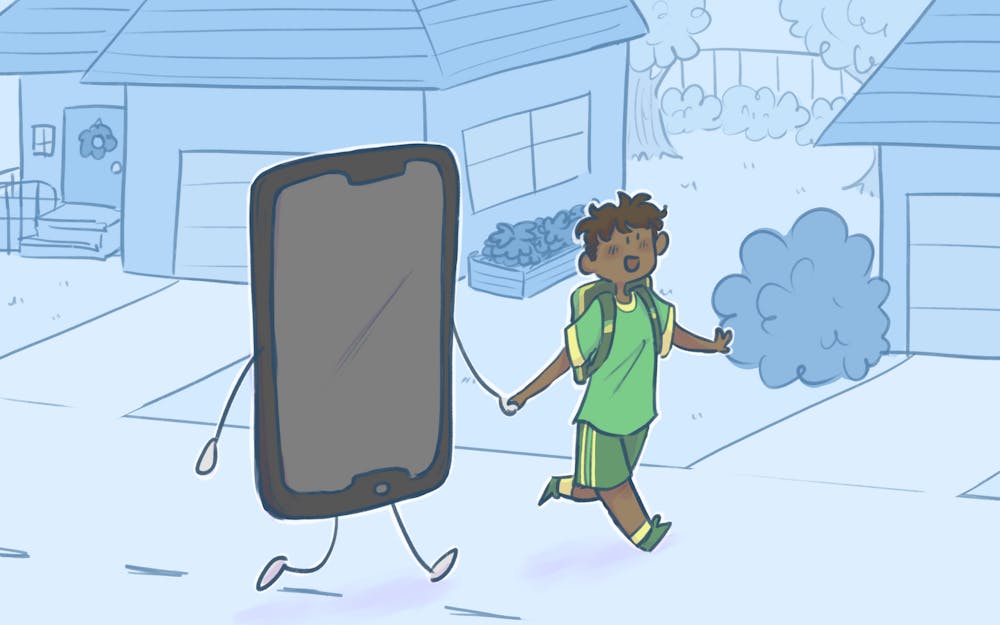
A sticky-fingered child with an iPad, coming soon to a location near you!
We’ve all seen it, the tablet screen, also known as the 21st century’s answer to the pacifier. When children are constantly given a source of stimulation to soothe their boredom — cue the “CoComelon” — they lose out on the ability to sit with their own thoughts and self-reflect in an essential way during their formative years. Lonesome has now become a problem to be solved, and our phones provide just enough connection to satisfy the mind. The addictive nature of such devices and the social media they present is correlated with depression, anxiety and other mental health issues among adolescents. But tech companies aren’t alone to blame.
In a landmark case this March, technology conglomerates Meta and Google were found liable for negligence by a California jury, citing carelessness over harmful design features. A user alleged the companies’ addictive formatting led to their mental health challenges and sued the companies. Now the companies owe the plaintiff a combination of $6 million in compensation. And yes, platforms like Instagram, Facebook and YouTube all operate on an endless-scroll system, strategically designed to addict users. For that, they should be held accountable.
But despite the many petitions from teens, parents and schools against social media outlets, they aren’t going anywhere. The everlasting algorithms are still generating stacks of cash, and in the United States, current laws do little to regulate social media companies. Under Section 230 of the Communications Act of 1934, media providers and users cannot be held liable for information distributed by another person on the same platform, which means companies generally cannot be sued over content. The media will not reform over a lawsuit, especially when the legal action one can take against it is limited.
Simply, you cannot realistically expect tech companies to safeguard your children. However, you can educate yourself on the workings of social media and teach your kids how to use it responsibly. It’s essential to know the risks.
Of course, there’s the danger of the content itself. According to a 2023 American Academy of Pediatrics survey, around 15% of children reported seeing sexually explicit content online under the age of 11.
The problem extends beyond what material your children can access. On the internet, users become accessible, too. In 2024, an estimate of 300 million children globally were subjected to online solicitation, offences ranging from unwanted messages to image-based sexual abuse. One in nine men — around 10.9% — in the U.S. admit to committing an online sexual offence toward a child at some point.
Sexual exploitation ties into a larger phenomenon of cyberbullying. Nearly half — 46% — of teens aged 13 to 17 face it in some form. Children aged 10 to 16 years who have accessed or shared sexually explicit, violent or hateful content are reported to have a 50% higher risk of suicidal ideation.
Unfortunately, a lack of awareness about these risks heightens them. What more danger could a tiny screen pose than the outside world? Because phones and other tech can be used within the safe walls of home, many parents are unsuspecting of the dangers that internet exposure poses.
A 2025 IPSOS survey showed two in three kids aged 5 to 16 have access to the internet inside their bedroom. Meanwhile, about one in seven parents said they are not confident they know what their child views online.
The downsides of the internet expand beyond those initial threats to safety. When kids grow up with this technology during their formative years, it changes how they develop social skills. Digital messaging gives us connection at our fingertips. Want to chat? Shoot off a text. But the downside is that with easy connection, we aren’t being as authentic as we could be.
Because computer mediated communication allows us to edit how we present ourselves to others, we only get the most polished versions of our correspondents. The result is the instant gratification of companionship, without the challenges that could ultimately build a fruitful relationship. There you have a “just right” middle ground between being social but not exerting oneself too much. Sherry Turkle, a social psychologist at the Massachusetts Institute of Technology, refers to this as the “Goldilocks Effect.”
When kids experiencing the awkward stages of adolescence crave social connection, the accessibility of technology is all the more enticing.
“Tech appeals to us most when we’re most vulnerable,” Turkle said in a TED Talk.
We all know kids are about the most vulnerable people on the planet. Not only are they legally dependent on adults for support, they are still developing as people. Middle school, for example, is about the most raw, unfiltered epoch of embarrassment in the human experience. As kids and teens build relationships while they try to make sense of the world, tech preys upon them by providing an easier option. By having comfortable control over how they present themselves online, they can’t develop critical social skills they’ll need in adulthood.
When even toddlers get non-stop stimulation from tablets and games, boredom becomes practically unbearable. Being alone becomes a problem when we are granted access to so many people through social media. Take a road trip for instance. Time once taken to gaze out the window in a daydream is now spent hunched over a tiny screen. By not learning the art of entertaining oneself, kids are not thinking in ways that are essential to personal growth.
“What am I going to eat for lunch?” could, with time, become, “What is the meaning of life?” Thinking, no matter how simplistic, is a must. Let those babies ponder!
So, yes, technology and the internet pose many risks, especially for children and adolescents. Yet, it would be naive to assume that social media and tech companies will work toward improvement over a lawsuit. Especially considering how difficult it is for such a case to make it to court. I, as much as anyone, would love to see someone like Mark Zuckerberg pay the piper. I just wouldn’t bet on it.
Alternatively, parents can be the safety net for their own children. In a perfect world, I could easily say throw away the screens and it will be sunshine from there on out. But given how widespread that tech is, being used from the classroom to the workforce, it’s essential that they are given the tools to use it responsibly.
Have an honest conversation with your children about cyberbullying, graphic content and internet safety. Since you know the risks, they should too. Monitor their screen time and make sure you have a firm understanding of what media they are interacting with. Simply handing them an iPad and relying on a largely unregulated system to keep them safe and well-rounded is not enough.
Be in the know, keep them in the know and restrict where you can.
Emma Howard (she/her) is a sophomore studying journalism.



