
Editor's note: All opinions, columns and letters reflect the views of the individual writer and not necessarily those of the IDS or its staffers.
Shoving my hands in dirt never fails to remind me of hot summer days of yore — that is, childhood — with my mother in the back garden.
She hummed, expertly teasing out weeds. I tugged, surly, begrudgingly and haphazardly at offending roots. So I can’t say I’ve always enjoyed gardening, but revisiting the pastime as an adult, I now find tending to my leafy children the most restorative hobby I practice:
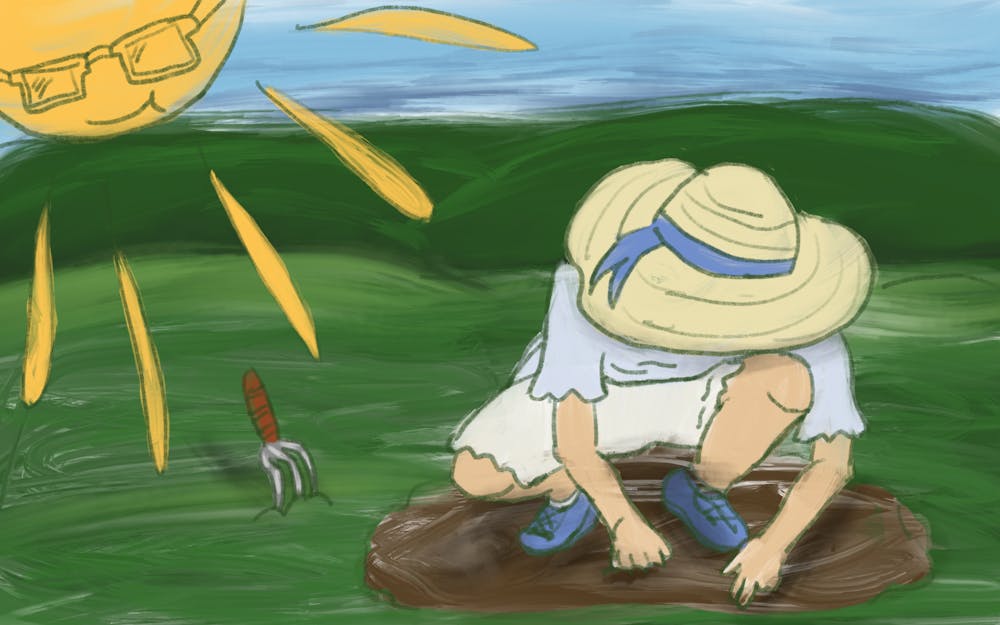
Donning a sunhat, scrubbing sunscreen over any uncovered tattoos and fixing a frown on my face, I, one particularly frazzled college student, step out the back door. A bag of soil in one hand and a houseplant overdue for repotting in the other, I settle on the back steps for a reprieve from all that’s on my plate.
Little did I know that each time I performed this ritual, I was giving myself a pick-me-up, which many of my peers desperately need. Sure, common sense tells you gardening is good for you because it takes you away from your problems by caring for another living thing. However, research has shown time and again the plethora of benefits to human wellbeing are more substantial than that.
One 2016 review summarizing the findings of many other studies suggested simply the activity of gardening — in both domestic and community gardens — has psychological-social benefits like reduced stress and symptoms of anxiety and depression in addition to increased life satisfaction, quality of life and sense of community. Gen Z seems in particular need of these benefits, seeing as young people’s life satisfaction and happiness has steadily declined over the past decade, according to the 2026 World Happiness Report.
Gardening brings increased hand and heart strength — like most physical activity, it reduces blood pressure and cholesterol levels — boosted vitamin D and, when the time comes to harvest, dopamine and self-esteem from your hard-wrought bounty. Furthermore, by gardening without tools or gloves, skin contact with the soil bacterium Mycobacterium vaccae, can decrease stress and anxiety.
How? Mycobacterium vaccae has been shown to boost the immune system by enhancing the ability of the brain’s central nervous system to activate immune responses. In a similar way, the bacterium can lessen stress-induced anxiety-like behaviors and consequent inflammation in the peripheral nervous system — i.e., not in the brain or spinal cord — which is linked to mood dysfunction.
In further support of M. vaccae’s capacity to mimic the effects of antidepressants, researchers in a 2007 study exposed mice to the harmless soil bacterium, to antidepressant drugs or to neither, then placed each mouse in a beaker of water for five minutes and observed how long they swam to escape before they gave up. How long mice pursue escape is a behavioral task commonly performed to test antidepressant drugs’ efficacy. The M. vaccae-preimmunized mice and those given antidepressants were both more determined to escape than the control group.
Another study saw similar effects, this time attempting to boost the immune systems to better attack lung cancer cells by exposing them to M. vaccae alongside chemotherapy in humans with lung cancer. While the treatment “didn’t prolong life,” patients reported “increases in things like vitality and cognitive function and decreases in pain,” study leader Chris Lowry of the University of Bristol in England told LiveScience.
How does bacteria do that? We’re not completely sure, but it’s the brain’s job to balance serotonin levels, which is needed in parts of the body for many reasons, including mood regulation. Antidepressant drugs either stop the brain from inactivating free serotonin or slow its re-absorption, while Lowry’s study suggests M. vaccae takes a third avenue, increasing the release of serotonin by activating a particular group of brain nerve cells, or neurons, that produce serotonin in an area of the brainstem.
Research published just this year studying the “hygiene hypothesis” has linked getting dirty as a kid — exposure to bacteria, but not necessarily viruses — to a reduced risk of developing allergies and asthma. Other recent research also supports the immune-regulating and anti-inflammatory properties of M. vaccae. Taken together, these studies give more credit not only to Lowry’s postulations, but also to the viral, ironically figurative, internet directive to “go touch grass.”
This all may seem too good to be true, but an evolutionary biologist or ecologist will just smile knowingly. Hominids — including modern humans — have been coevolving with plants for millions of years, providing such close, sustained ecological services as to “reciprocally affect each other’s evolution,” according to the University of California Museum of Paleontology. In ecology, that’s basically as best of friends as you can be. This relationship led to the Neolithic Revolution 12,000 years ago.
This marked the pivotal shift of human societies from hunter-gatherers to settled farmers. All this time, the friendship to end all friendships has evolved into one of symbiosis: specifically, a mutualistic relationship, aka, a win-win for both of us. We tend to plants’ vitality, and they reciprocally tend to ours.
You, like many, might have let a few wilting houseplants convince you of your black thumb, but I’m here to tell you that even these common mistakes shouldn’t detract from the benefits of gardening. After all, pobody’s nerfect, and if anybody understands that it’s plants, our millennia-old friend. Knowing the myriad benefits of gardening and recognizing that we’ve just passed St. Paddy’s Day, go plant those peas! Or, at least, go touch grass. Literally.
Odessa Lyon (she/her) is a senior studying biology and English, pursuing a minor in European studies.



