
Editor's note: All opinions, columns and letters reflect the views of the individual writer and not necessarily those of the IDS or its staffers.
We all know how expensive even an imitation bottle of vanilla can be at the supermarket.
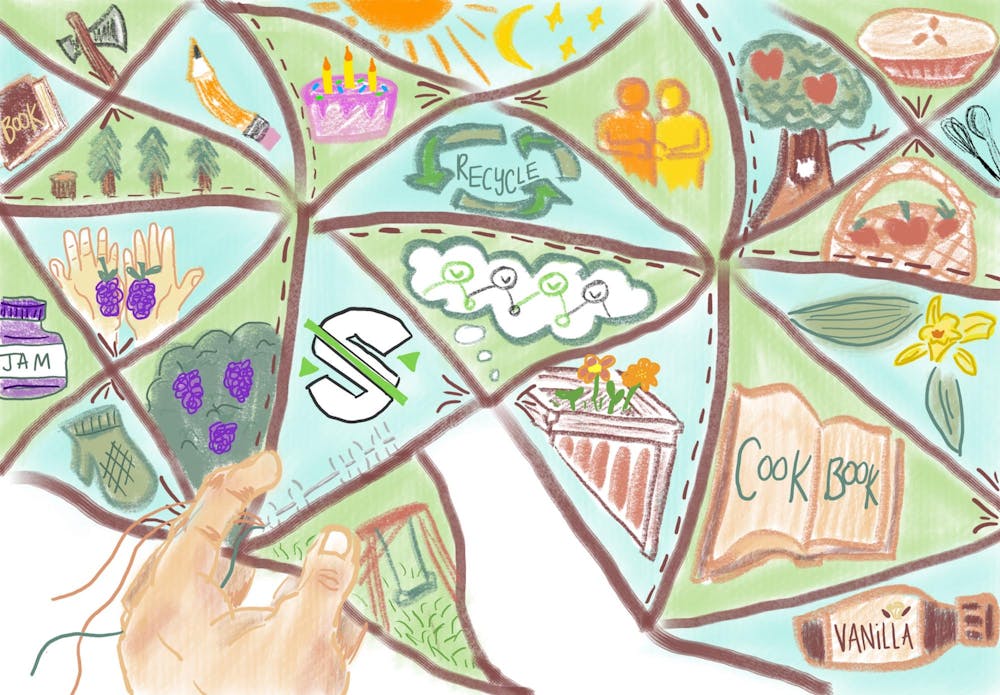
However, you might not know that the success of the vanilla industry in Madagascar — the largest current exporter— and other former French colonies is due to the hand pollination technique of Edmond Albius, a 12-year-old enslaved boy from Réunion, developed in 1841.
And you might not have noticed the sign in the Biology Building Greenhouse, warding off sticky fingers from the fruits of their vanilla plant.
Historically fraught with exploitation and economic turbulence, the crop has impacted many lives. Albius was discredited for his profitable discovery, let alone never awarded; freed at 19, he worked as a laborer and died at 51 impoverished. Now, Madagascar’s vanilla industry exploitation continues; almost a third of its work force illegally consists of children between 12 and 17 as well as many farmers working in debt bondage due to vanilla’s tumultuous value, seasonality and stealing.
Simultaneously, vanilla use is culturally rich and global. In 600 CE the Totonac Indigenous people in Mexico collected vanilla pods, the Aztecs spiced the ceremonial drink xocoatl with it and Spaniards traded it from New World colonies in the Columbian Exchange before touching the lips of European aristocrats.
Thus, the crop and its complex economic and cultural history expose the invisible threads tying together plants, the people who utilize them and the context in which they do so.
“I am a plant person, so I tend to ask questions through plants,” Sarah Osterhoudt, an IU researcher and associate professor in the Department of Anthropology, said in an interview. “The different ways plants become incorporated in our daily lives, not only how we use them for medicine and food but also how we think about plants, how we use plants as a way to make connections with one another and with our environments.”
These connections define ethnobotany, the field that studies how people and plants relate, which can turn on a dime.
Our dreams of a sustainable relationship with plants might seem abstract and flimsy, especially when every refresh of Instagram’s explore page brings increasingly devastating reports of global climate crisis. After all, as Taylor Swift put it in “Bad Blood,” “Band-Aids don’t fix bullet holes.”
But Osterhoudt’s research takes a step back from the screen, weaving a clearer, bigger picture of our connection to nature and how to sustain it.
For her doctoral research, Osterhoudt studied smallholder vanilla and clove farmers in Madagascar — who work in agroforestry systems of crops and native tree species — and asked how people got through the hardship of plummeting vanilla prices.
“This is a perfect place to ask these types of questions, as people have an incredible diversity of plants to work with, and also a complex history and culture around agriculture, forests, and the environment,” Osterhoudt said.
Even after a period of disaster or violence, Osterhoudt studied how using this plant-human connection can contribute to a community’s social and ecological resilience.
In Bloomington, we have farmers’ markets to bring together producers and consumers of local plants and outdoor activities of all kinds steeped in the wild flora and fauna of Griffy Lake Nature Preserve.
Our very own Switchyard Park emphasizes the importance of these relationships by centering human activities — a playground, dog park and a community garden — within not only a wholly green space but a connected one.
As Mayor Kerry Thomson said at a 2022 dedication, “Switchyard Park is meant to be a place where Bloomingtonians can come together for community, for health, for entertainment, for equity, for healing.”
The goal for a project Osterhoudt is involved with in Northern Iraq is to foster this sentiment.
“We worked with several ethno-religious groups that had been very disrupted by political violence, and saying, ‘what things make people want to return home? What can help restore ideas of community and connection?’” Osterhoudt said.
It turned out that collecting semi-wild and semi-cultivated plants was a big part of the story.
“They were especially important for celebrations or communal times,” Osterhoudt said. “It was both the process of going out and collecting them together, but also that they would go in these recipes and dishes that were really meaningful. They brought back memories; they brought generations together.”
In the big picture, this anthropological work converges on the idea of sustainability, one inextricable from the relationships of ethnobotany, defined by the Environmental Protection Agency as the goal “to create and maintain the conditions under which humans and nature can exist in productive harmony to support present and future generations.”
“I do a lot of work where I’m in a room with people from all different disciplines like scientists, economists, policy people,” Osterhoudt said. “A lot of times what I see my work as, in these discussions, is ‘people, people, people!’ to remind that sustainability is a human question.”
She wants to broaden sustainability from a purely environmental, economic effort — no, not just recycling that take-out container you tossed — to include a communal, personal view.
Just as Thomson stated that “we think about how many human stories and memories will happen” at Switchyard, Osterhoudt feels anthropologists and ethnobotanists can add that more personal dimension to a personal idea of what we’re trying to sustain.
“And how can we make that more meaningful for people, more exciting, more full of potential, more equitable for everyone?” Osterhoudt said. “How can we make sure that there’s room for everyone in sustainable futures?”
Her prescription? Slow down, stop and smell the roses. Be curious about the plants in your everyday life, your community, your environment. That’s ethnobotanical sustainability — mindfulness and attention to the details around us.
Odessa Lyon (she/her) is a senior studying biology and English, pursuing a minor in European studies.



