
SPOILER: This column contains potential spoilers for “Lee Cronin’s The Mummy.”
Following the financial success of “Evil Dead Rise,” Lee Cronin took on a new challenge with his terrifying reinterpretation of a mummy movie, released Friday. Unlike his past film, I think Cronin bit off a bit more than he could chew with his take on the monster.
While Universal Pictures owns the rights to its specific iterations of the mummy monster, which dates as far back as 1932, the general concept of mummification is open for anyone to make a film about.
Unfortunately, “Lee Cronin’s The Mummy” was released at a very awkward point in time; Universal announced earlier this year that its “The Mummy” franchise, starring Brendan Fraser, would be getting a fourth film. This led to confusion for fans, as many were unsure if this film would be connected to the franchise. Lee Cronin, the director, confirmed this as one of the driving factors behind putting his name in the title to remind audiences of its distinction from the other films.
I had never seen any other mummy films before Cronin’s, so I was open to seeing a darker approach than what others may have been used to. Alongside this, as a big fan of the “Evil Dead” films, I loved Cronin’s take on the franchise and was excited to see whichever horror project he would make next.
“Lee Cronin’s The Mummy” begins in Egypt, where Charlie (Jack Reynor) works for a local news station and is looking after his children while their mother, Larissa (Laia Costa), is away at work. Their daughter, Katie (Emily Mitchell), is playing in the garden when she is kidnapped by a mysterious woman who lures her out with candy.
Following the kidnapping, there isn’t much time spent in Egypt with the family, aside from the opening of the investigation, when the lead detective suspects the parents may be responsible for the crime. The film quickly jumps eight years in the future, with the family relocated to New Mexico, now living with Larissa’s mother (Verónica Falcón).
With such a shocking moment for the family, I would have liked a few more scenes immediately after the disappearance to show how they emotionally process the sudden abduction of their daughter. We get an awkward family dinner scene when they are first shown in New Mexico, but the dialogue is so forcefully packed with emotional turmoil, which would’ve been much more fitting for a conversation sooner after Katie’s disappearance.
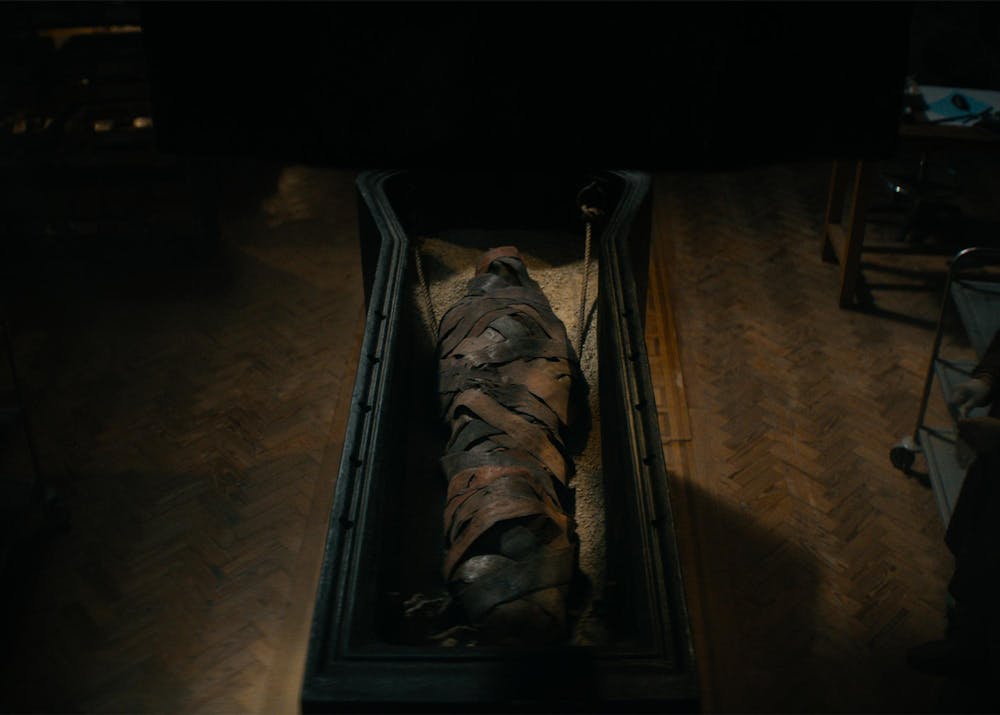
The film picks up its energy when an older Katie (Natalie Grace) is discovered alive in a sarcophagus found in a plane wreckage near their old home in Egypt, and the family reunites with her. From the first sight of Katie, it’s clear she has undergone serious transformations, with her entire body wrapped in parchment fused to her skin, inscribed with ancient texts, which serve to bind the entity possessing her. Larissa and Charlie attempt to interact with Katie, but she’s in a catatonic state, unable to move or speak.
While it’s understandable for her to be in this state, it made it difficult for Katie to be a terrifying character, since she presumably cannot charge toward people or frighten them with words. Cronin worked around this by having Katie secretly move around when the family least suspects, targeting individuals to possess or kill.
Personally, this was not enough to frighten me, as I am someone who gets scared by sudden, loud jump scares, as opposed to the calculated nature of Katie’s character.
Following Katie’s return, the film splits into a dual narrative with one side focused on the havoc Katie wreaks on her family and the other back in Egypt, where Dalia (May Calamawy), a detective, looks for a breakthrough in the abduction case.
I found Dalia’s detective work to be one of the most engaging aspects of the film, which makes me wonder whether the overall movie could have worked better if Cronin had placed greater emphasis on the mystery rather than its horror elements.
The jump scares may not have been anything groundbreaking, but Cronin certainly knows how to use the gross factor to terrify his audience.
Many scenes with Katie’s deteriorating body caused me visceral reactions. The combination of close-up shots and sounds was enough to make me squirm in my seat.
Cronin’s visuals may be his greatest strength in the film, but Katie and the other possessed family members act strangely similar to “deadites,” the demons from the “Evil Dead” universe, expelling various liquids and using explicit language to antagonize others. Although I enjoyed this type of evil spirit in Cronin’s “Evil Dead” film, I would have liked to see a different kind of demonic entity here since the mummy is such a different concept.
While Cronin’s interpretation of the mummy may not have resonated with me as much as I hoped for, I can appreciate his effort to try something new within the horror genre.


