
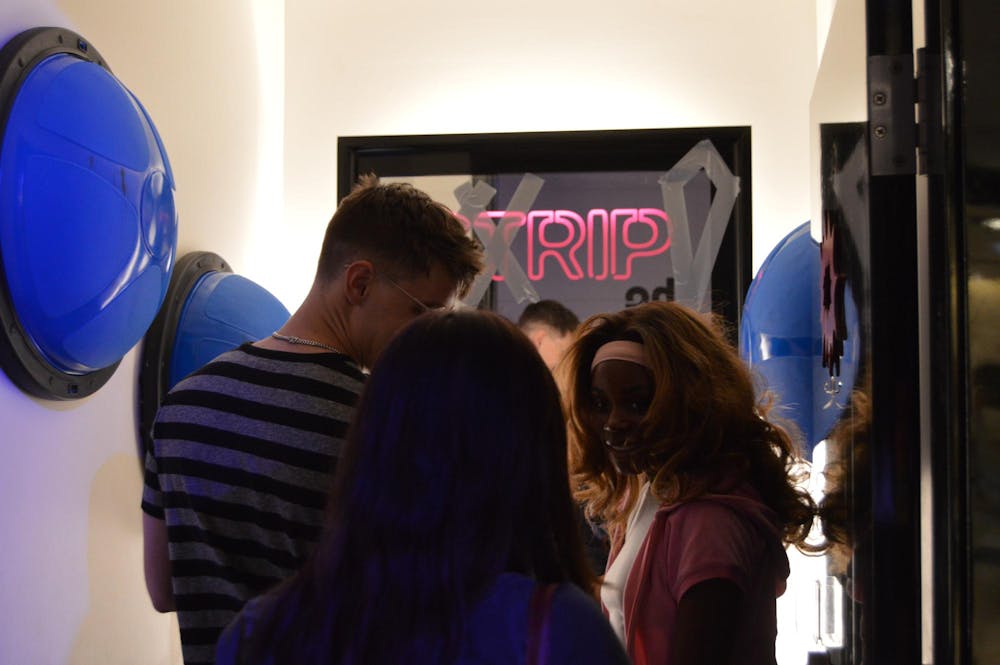
The pink letters on the mirror used to say “strip” — the space was a Victoria’s Secret, after all — but the “s” and the “t” have been crossed out with duct tape and an exclamation mark has been added at the end.
“Rip!”, it reads now, above a padded drum set where visitors to “The Changing Rooms” art project can take out their anger in a space dubbed “the release room.” The exhibit soft-launched April 4 inside the Pillar Arts space in College Mall.
“Changing Rooms” is a student-created exhibit that came out of Eskenazi School of Art, Architecture and Design lecturer Maxwell Fertik’s eight-week “Healing Commons,” an intensive seminar in comprehensive design. Students in Fertik’s class ideated, fabricated and installed the elements in a series of five "changing rooms”.

Duct tape crosses out the "s" and "t" in the word "strip" written on a mirror in College Mall on April 4. The mirror was in a former Victoria's Secret that is currently occupied by an art installation developed by IU students.
“Changing Rooms” is part of the “SOLACE” art exhibition that will be opening in full on April 18. The free exhibit will be open starting at 4 p.m. on April 18, 25 and 26.
“SOLACE” is presented by MDWST Fable, an arts organization focused on southern Indiana.
“We joke it's a benevolent conspiracy that tries to bring people together across the arts and from outside the arts to work together to make artistic experiences and storytelling experiences to appeal to everybody,” Tristra Newyear Yeager, co-founder, said.
The collaboration between MDWST Fable and Fertik began when Yeager reached out, Fertik said. The idea was challenging, he said, because he doesn’t usually work in multimedia, but he thought it would be a good opportunity for his students.
“[They’re] getting the real experience of working with a client, working with a real budget and with, like, real materials,” Fertik said. “Especially this one, like, they really had to go back and forth to the mall and go plant shopping with Tristra.”
The students gained experience with problem-solving and getting around constraints, too.
Pillar Arts occupies the space where Victoria’s Secret used to be, and Fertik said the place’s history provided both a challenge and a chance to have fun when designing the exhibit.
“So we're like, all right, now our question is, ‘How do we create healing spaces within a former Victoria's Secret?’” Fertik said. “Like, how do we find love in a hopeless place?”
Students in Fertik’s class thought through different dimensions of healing: religious, medical and social. The rooms were initially inspired by the five stages of grief: denial, anger, bargaining, depression and acceptance.
Nicholas Keasey, one of Fertik’s students, helped develop the concepts and install the rooms. Keasey said the ideation process was complicated because healing looks so different from person to person.
“One of the original ideas that we worked off with it was the stages of grief,” Keasey said. “And it gave us a lot of bones to actually work with to start kind of piecing these together. We ended up kind of changing that idea. We felt like it was kind of too on-the-nose and might have the opposite effect for some people.”
Keasey said he spent a lot of time working on the sky room, which features a projection of the sky over Griffy Lake. Griffy had come up in response to a question about healing spaces in Bloomington in a survey that Yeager and her MDWST Fable co-founder, Matt Rice, sent out to the community.
The survey asked questions like “What activity makes you feel better 80% of the time?” and “If your nervous system had a texture now, what would it be?”
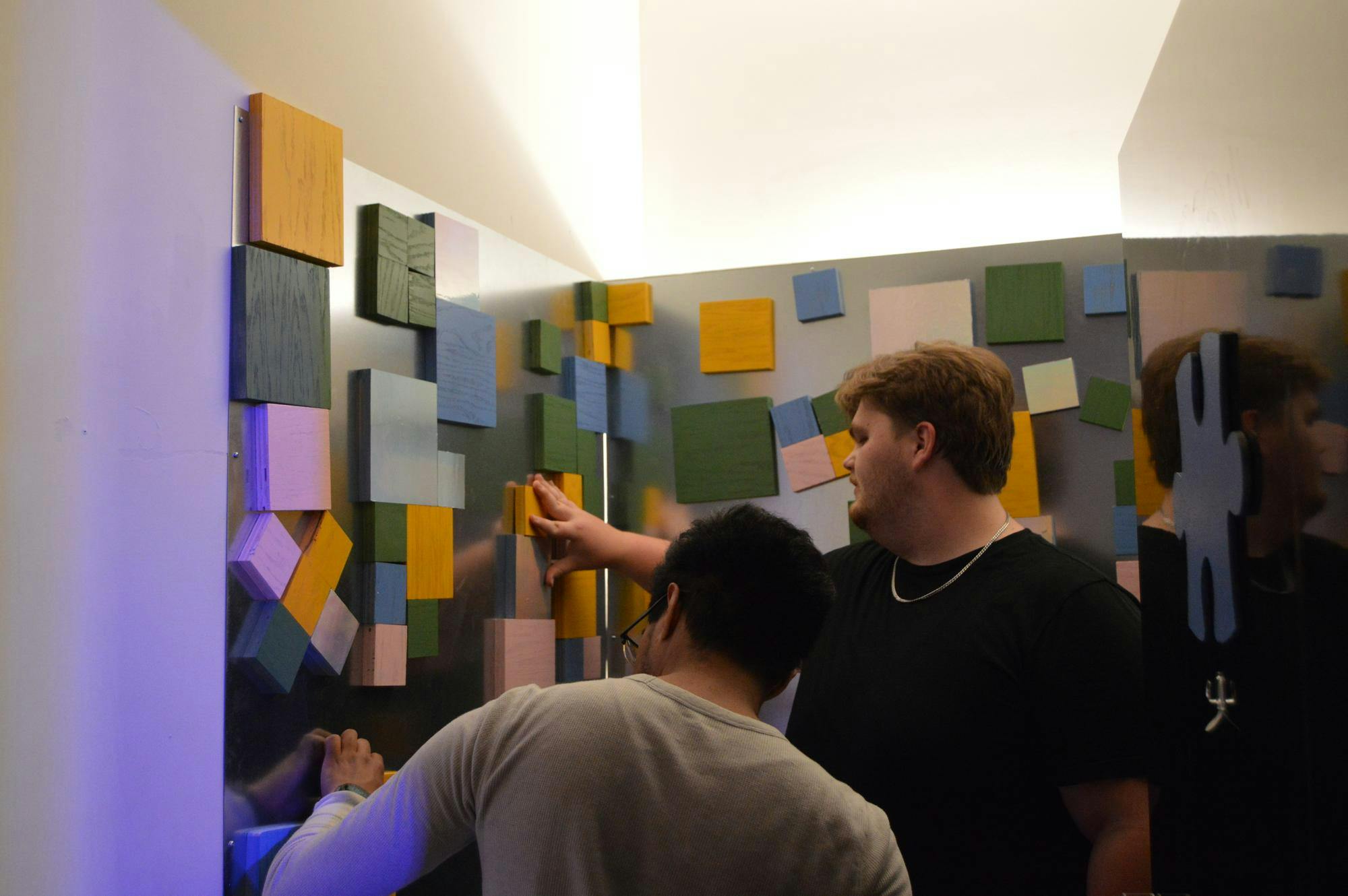
Nicholas Keasey, a comprehensive design student, moves puzzle pieces around a board in College Mall on April 4. Keasey was one of the students who developed and installed an art exhibit as part of an intensive seminar earlier this semester.
Yeager said Rice was responsible for developing the questions, and the aim was to get answers to the question “What is healing?” indirectly, to avoid descending into platitudes.
“If you ask too directly, it's like if you look directly at the sun, you burn your eyes,” Yeager said. “If you ask too directly, you just wind up in a cliche and you haven't learned anything.”
There were some commonalities to the responses, according to Yeager; several people responded to the question “What’s the shape of your missing piece?” with “triangle,” for instance. For the question about healing spaces in Bloomington, places with water came up frequently.
In addition to the sky room and the release room, there are three others: the puzzle room, the meditation room and the green room.
Junior Cooper Smith, who led the fabrication and design team, spent a lot of time working on the puzzle room. Smith said the room was loosely inspired by the “bargaining” stage of grief.
“So, the idea was that you’re moving these puzzle pieces around and you’re kind of like experimenting with yourself,” Smith said. “And it’s supposed to kind of emulate that sense of bargaining in grief.”
Senior Dawson Clark designed the meditation room based on personal experiences with meditative practices. It’s desert themed; two lights represent the sun, and the soft tan rug looks like sand. Clark’s inspiration was philosophy.
“I took that from Carl Jung’s red book, which talks about the barrenness of the desert and when you stick in the desert and finding the fruit within the emptiness and the barrenness,” Clark said.
The green room, on the other hand, is more fruitful. It developed out of the idea of acceptance and being grounded, Michelle Do, a student in Fertik’s class, said. Pink flowers drape across the mirror in that room, which now reads “Trip to nature.” Do said nature seems to ground people, so it was the room’s theme.
“In that room we’re inspired by elements of nature,” Do said. “So, we have plants in there, flowers in there, water in there, to promote, like, encourage feelings of being present with your emotions and accepting them. And also, being open about them, either to yourself or with other people.”
Kristin Tucker, a visitor to the exhibit, was most drawn to the green room.
“I really loved the plants and the fountain and the peace of, you know, knowing that things aren’t the same, but that there is a peaceful life to live,” Tucker said.
The idea of growth and metamorphosis is the driving force behind the exhibit. In terms of transformation, Fertik described the Victoria’s Secret-turned-art-space development as subversive. It also served as inspiration.
“But they have these dressing rooms, and they're also called changing rooms,” Fertik said. “And we thought that that was a really interesting wordplay that could happen. Like if these are healing spaces, these changing rooms could also be these places of transformation.”


