
Editor's note: All opinions, columns and letters reflect the views of the individual writer and not necessarily those of the IDS or its staffers.
BEEP! BEEP!
You smack your blaring alarm clock and roll out of bed. Before heading out the door, you brush your teeth, grab your favorite hoodie and throw your hair into a messy bun.
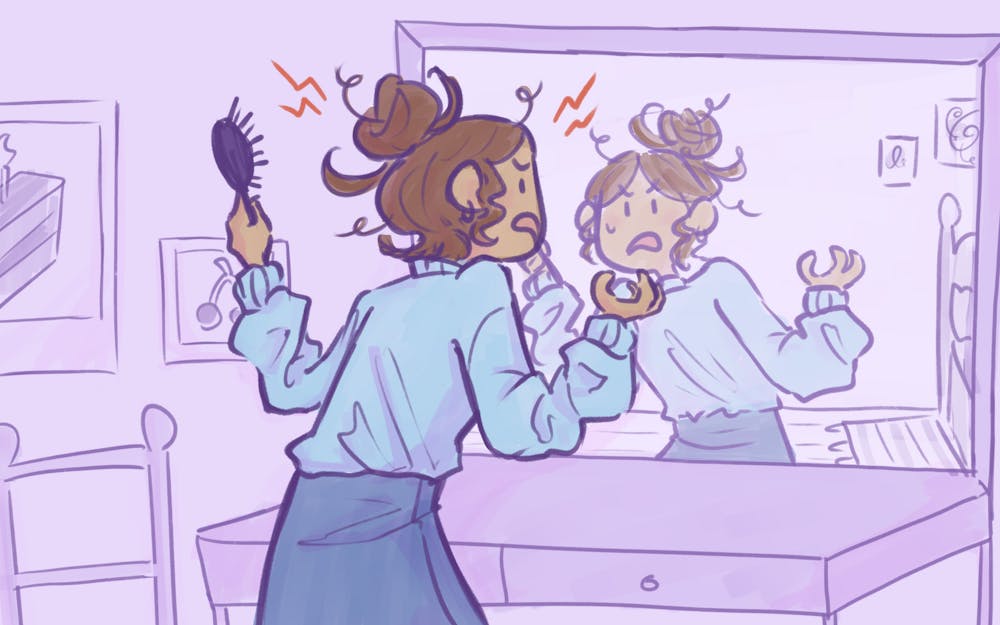
Except you didn’t exactly “throw” it into a messy bun. Since this is real life and your mom didn’t sell you to One Direction, that bun required a good 20 minutes of painstaking labor. The classic “messy bun” of the 2010s was, in theory, an effortless style. But to actually achieve one? Prepare for some arm-ache and lots of bobby pins.
This is the problem of the social media era: So much of what we do in attempts to appear cool, calm and collected requires heavy lifting. Especially on the internet. Whether you’ve created a spam account on Instagram to post more freely or hesitated before sending the infamous “double text,” you’ve fallen victim to the overthinking that dictates our online communication. In the pursuit of being “nonchalant,” we’ve become about as chalant as possible.
I was surprised to find, when I started using social media in high school, that many of my classmates ran multiple accounts, usually referred to as “spam” somewhere within the handle. Essentially, a spam account allows users to post more authentically to their closer friends, while maintaining a more polished image on their main profiles. As recently as last week, most advertisements on my feed promoted post-creating programs. “Share your trip without spamming!” Of course, the algorithm had creepily detected that I was away for spring break.
But why is spamming so bad? If the goal is to appear relaxed or, as many trends are saying, “nonchalant,” why is so much effort going into curating our public images? Does that not defeat the entire purpose of casual online engagement?
Though counterintuitive, spam accounts aren’t going anywhere. In fact, as of 2024 over 50% of high school students have a spam account on Instagram, with 70% believing that these outlets allow for self-expression. But I would argue that creating an entirely separate account to weed out the imperfections from your main profile is not the most genuine way to connect. By constantly switching between accounts to curate personal brands, users subject themselves to an exhausting double life.
Overthinking how others perceive us is an issue across computer mediated communication. Who hasn’t sent a screenshot of a thorny text to their friends asking how to reply? Or feared transgressing the social no-no’s of double texting?
Instead of communicating honestly and maturely, we’ve become avoidant in our online interactions to keep from seeming too eager. In a January study, researchers even sought to find an ideal time to text after a date. Apparently, it’s the morning after.
Social uncertainty is inherent to computer mediated communication. Screens provide fewer nonverbal cues we can interpret than face-to-face communication, leading to a lot of guesswork in what the person we’re communicating with is thinking.
Where we don’t have a smile or a nod, our brains fill in the gaps with cronemics, which are timing factors of a digital message separate from the content itself. The time the message was sent and the time taken to respond contribute additional context. Imagine receiving a “What are you doing?” text at 2 p.m. Could be a suggestion for lunch or coffee. Now, imagine getting that same simple message sent at 2 a.m. A bit riskier, to say the least. While the wording of the message is unchanged, other elements dictate its intention.
This overanalysis of subtext is part of a larger phenomenon called hyper-personal communication, in which we take a more intentional approach to our online correspondence than our real-life interactions. When we send messages, we are selective in how to present ourselves. We carefully decide what aspects of our lives and personalities we want to showcase, while filtering out the messier pieces.
On the other hand, when we receive messages, we blow these crumbs of information out of proportion. Small actions take on an outsized meaning when we can’t interpret the visual cues of a face-to-face interaction. Have a friend that loses it when their crush likes their Instagram story? That's the receiver effect for you.
Ultimately, these presumptuous thought processes are very natural. Without standard nonverbal cues, our brains are inclined to scrounge for meaning in other sources of context. This method of communication is exhausting.
Our desire to appear laid back is very much a learned one, perpetuated by influencers and social media. When it’s cool not to care, more people will spend the extra time on these apps trying to figure out what is best to post, send and share. Ironically, purposefully avoiding being “too much” requires a lot more effort than living as you please.
Actually want to be nonchalant? Just don’t overthink it!
Emma Howard (she/her) is a sophomore studying journalism.



