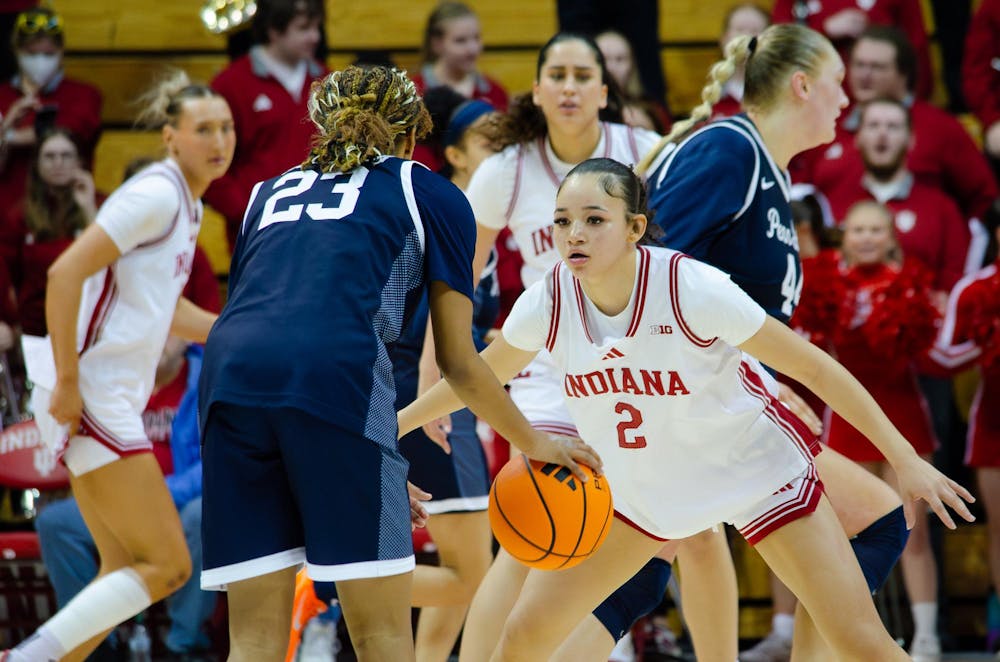
Indiana women’s basketball has finally found its rhythm.
The Hoosiers finished February 6-2 after defeating Penn State 93-59 at Simon Skjodt Assembly Hall in Bloomington on Saturday. After starting Big Ten play 0-10, Indiana has rattled off impressive wins over Northwestern, Oregon and now, the Lady Lions.
But with the Big Ten Tournament on the horizon — with its win-or-go-home matchups — Indiana must carry the lessons learned from Penn State into future games.
Lesson one: Push the pace more often in the transition
One of the most beautiful plays in basketball is a coast-to-coast layup. The ability for a player to grab a rebound, turn up court, outrun the defense into the lane and finish the basket is eye-opening.
However, that aspect of Indiana was cut out of the Hoosiers’ game plan for most of the Big Ten schedule. In half of Indiana’s conference games, the Hoosiers finished the contest with fewer than 10 fastbreak points. And unsurprisingly, all nine resulted in losses.
Coming into Saturday’s matchup, Indiana only averaged 8.2 fastbreak points per game, which ranked tied for 12th in the Big Ten. Only 12.2% of the Hoosiers’ points this season have come when pushing the pace in the transition, a contrast to the 19.5% total that conference leader Ohio State has amassed this season.
Since Indiana started winning in February, the game plan switched to one where the Hoosiers accelerate the offense. Against Northwestern on Feb. 1, Indiana compiled 20 fastbreak points in a 14-point win, its highest amount in a Big Ten game.
Against Penn State, Indiana had 29 fastbreak points.
“The way we scored the ball, we did feel like we could get out and run,” Moren said postgame. “Put some points on the board by just playing fast. So, I loved our pace.”
Senior guard Shay Ciezki led the way with 11 fastbreak points. When Indiana wanted to move down the court in under 10 seconds, the ball found Ciezki’s hands most of the time. It resulted in the 5-foot-7 Ciezki finishing with her highest total of fastbreak points in a Big Ten game this season, surpassing her nine against Iowa.
Freshman forward Maya Makalusky and freshman guard Nevaeh Caffey both finished with seven fastbreak points. Makalusky totaled 15 points, knocking down three 3-pointers in the process. Caffey compiled a career-high 18 points, going 6 of 12 from the field.
A higher tempo offense can play into Indiana’s strong suits — multiple times this season, senior guard Jerni Kiaku has gone downhill to the basket for a layup — but could also exacerbate the Hoosiers’ turnover problems.
Lesson two: Limit turnovers, win games
Entering Saturday’s contest, Indiana knocked down 47.2% of its attempts from the field and 38% of its 3-point attempts this season, ranking sixth and first in the Big Ten, respectively. The Hoosiers also ranked fourth in effective field goal percentage (54.1%) and second in true shooting percentage (58.4%).
However, the drawback to Indiana’s efficient shooting offense has been its inability to stop turning the ball over. In Big Ten matchups before Saturday, Indiana ranked first in turnovers per game at 17.5. Over 17 times per night, Indiana couldn’t get a shot up.
Against Rutgers on Feb. 25, Indiana turned the ball over 14 times in the first half, an amount that ranked second-most in Indiana’s Big Ten schedule. That number dropped to four in the second half, but the trend had already been established.
“Very frustrated by our turnovers,” Moren said postgame Feb. 25. “Just unacceptable, just careless.”
Heading into Saturday’s game, it seemed destined that Penn State could garner takeaways against Indiana. Yet, when the first half ended, Indiana only had four turnovers in the first 20 minutes. Penn State finished with 12.
Makalusky, Kiaku, Ciezki and junior forward Jade Ondineme each had one turnover. It was a far cry from January performances of 16 turnovers at Maryland, 12 against Michigan and 11 at both Purdue and Ohio State.
With the extra possessions, Indiana raced out to a 31-8 lead at the end of the first quarter and was up 57-23 at halftime. The Hoosiers took 32 shots from the field, connecting with 19 of them — including seven 3-pointers — for a 59.4% clip.
Lesson three: Let Nevaeh Caffey cook on defense
Penn State sophomore guard Kiyomi McMiller entered Saturday’s game on a six-game streak of scoring over 30 points. In that span, McMiller was averaging 34.3 points per game, including shooting 54.2% from the field and 62.1% from behind the arc. A 40-ball against USC on Feb. 25 capped off the hot stretch.
Until McMiller matched up against Indiana’s Nevaeh Caffey.
Four points, 1 of 12 from the field, 0 of 3 from behind the arc, six turnovers and four personal fouls. Those were the statistics that McMiller finished with. One could say that Caffey took McMiller to the cleaners.
“With all the prep that we did, and the coaches pouring into me, and my teammates pouring into me,” Caffey said postgame. “Knowing that everyone's going to be in their gaps and don't bite in none of her stuff, that helped me a lot.”
Caffey has been Indiana’s most consistent defensive presence this season. When Moren has needed a player to shut down an opposing guard, she’s looked to No. 2 for that task.
Coming into the season, Moren compared Caffey to former Indiana guard Nicole Cardaño-Hillary for her defense intensity. They were big shoes to fill, as Cardaño-Hillary earned All-Big Ten Defensive team honors after the 2021-22 season and was on the Atlantic 10 All-Defensive Team in 2017-18 at George Mason University.
But Caffey has passed the test. Even though she doesn’t have the most steals or blocks in the Big Ten, Caffey has given opposing guards trouble throughout the season. The freshman still has time to grow and develop into someone who can be awarded Big Ten Defensive Player of Year — which will be an easier award to win with UCLA senior center and Naismith Women’s Defensive Player of the Year Lauren Betts graduating.
Final thoughts
Indiana dominated in almost every aspect of the game on Saturday. It was a win the Hoosiers needed to bolster their confidence heading into the Big Ten Tournament from March 4-8 at Gainbridge Fieldhouse in Indianapolis.
Indiana had trouble in the first half against a now 1-17 in the Big Ten Rutgers team on Feb. 25. Every Big Ten win is hard — especially on the road — but the Hoosiers have been steadily progressing into a team that could make noise in the postseason.
So, a close 79-69 result against Rutgers ignited alarm bells for the Hoosiers. But the alarms were squashed Saturday. Indiana was 0-8 in January. The Hoosiers finished February 6-2.
Indiana has been playing “better basketball” recently, a sentiment that Moren agrees with. Now it’s time for win-or-go-home basketball. The Hoosiers will most likely finish as the No. 13 seed in the Big Ten standings, matching up against No. 12 Nebraska on Wednesday.
Nebraska downed Indiana 78-73 on Jan. 8, after the Hoosiers unraveled in the fourth quarter. If the rematch does happen, it’s finally an opportunity for Indiana to showcase the positive changes made in recent weeks.
Follow reporters Savannah Slone (@savrivers06 and srslone@iu.edu) and Max Schneider (maxschn@iu.edu) and columnist Sean McAvoy (@sean_mc07 and semcavoy@iu.edu) for updates throughout the Indiana women’s basketball season.