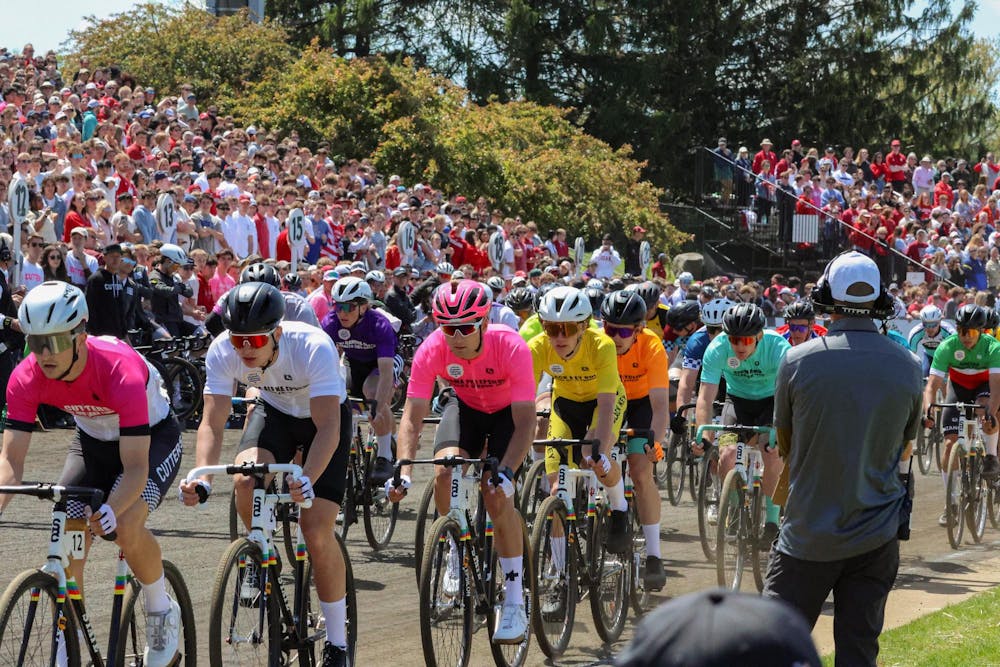
The storied race behind “The World’s Greatest College Weekend” began 75 years ago, when Howard “Howdy” Wilcox Jr. drew inspiration from a group of students racing bikes around an Indiana University dormitory.
The mini race drew a crowd, and Wilcox, who was executive director of the IU Student Foundation, decided to harness the enthusiasm to raise money for student scholarships. The funds were particularly meant for working students, in order to “help those who are helping themselves,” as early slogans said.
The Little 500, as the name implies, is based off the Indianapolis 500 car race, which Wilcox’s father — also named Howard Wilcox — won in 1919. The younger Wilcox was skilled at public relations, and headed up the first Little 500 race on May 12, 1951.
The South Hall Buccaneers of Collins Living Learning Center won with a more than four-minute margin over the second-place team. There were 7,000 attendees and the event raised the equivalent of $73,000 in 2024’s money, according to My IU.
By 1955 the Arbutus yearbook was already calling the event “an IU classic.” The tradition of hosting a concert began with IU Foundation director Bill Armstrong in 1960, when musical quartet The Four Lads performed on the Woodlawn tennis courts. Since then, notable figures and groups like Bob Hope, Chicago, John Mellencamp and then-presidential candidate Barack Obama have made appearances at the race.
Throughout the 1960s and 1970s, students of broadcast professor Richard Yoakam provided Indy 500-style broadcasts, according to the Indiana Broadcast History Archive. The campus radio station, WIUS, also provided live coverage from the mid-1960s on, and still does under the call sign WIUX.
National coverage of the race, especially after the 1979 coming-of-age movie “Breaking Away,” led to enough donations to build a new stadium, which was eventually named the Bill Armstrong Stadium and is the current site of the race. The Little 500 was held in the 10th Street Stadium until 1980.
The women’s Little 500 has its roots in the 1980s, though Kathleen Cerajeski, an alternate for the Cravens B team, made history in 1976 as the first woman to be part of a men's team.
In 1987, Kappa Alpha Theta sorority put forth a team that, while not qualifying due to having taken 34th out of 33 places, raised awareness that women wanted to race too. The first running of the women’s race took place the following year, with approximately 11,000 attendees and a victorious Willkie Spring team.
This year is the 75th men’s race and the 38th women’s race, and there’s still more history to be made.
This story was originally published in the Indiana Daily Student's spring 2026 Little 500 Guide.