Bloomington’s Parks and Recreation Department was awarded a $50,000 State Urban Forest Resilience grant from the Indiana Department of Natural Resources Feb. 19 to manage the impact of invasive beetles on the city’s trees.
Haskell Smith, urban forester for Bloomington, said the funding will support the assessment and treatment of 530 ash trees along public streets and in city parks. Smith said the grant will help determine which trees can be preserved through treatment and which should be removed as part of a long-term management plan.
The emerald ash borer, an invasive beetle that kills ash trees, was first detected in Bloomington in 2012. Since then, the insects have killed many trees across the city.
“We’ve lost hundreds, if not thousands, of ash trees all around Bloomington due to these little guys,” Smith said.
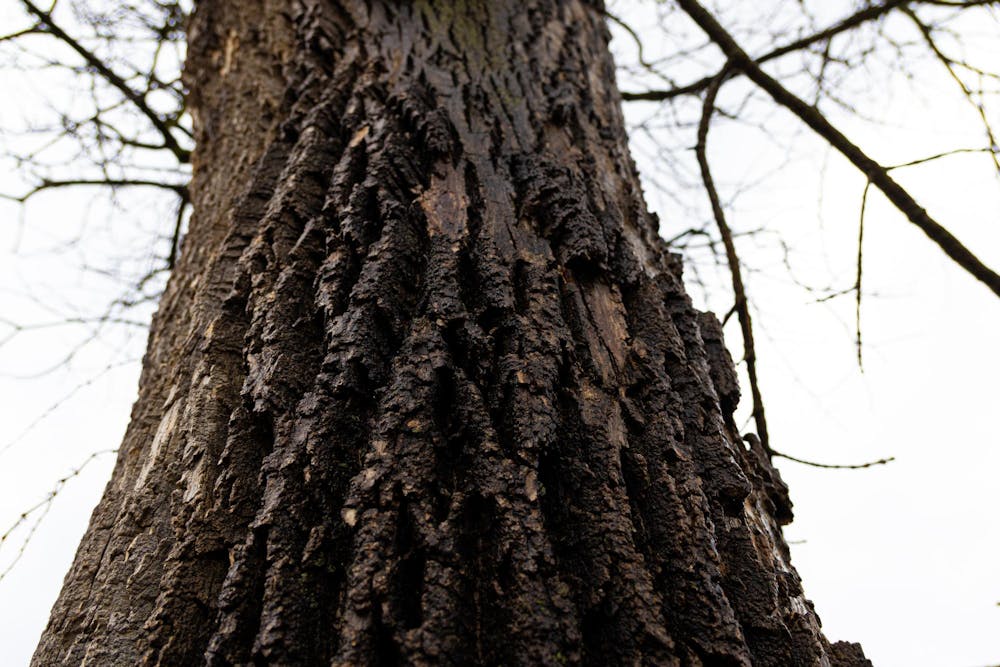
The beetle kills ash trees by burrowing beneath the bark and interrupting the tree’s ability to transport water and nutrients. Smith said infested trees typically die within two to five years without treatment. As trees decline in health and lose critical internal functions, they can become brittle and structurally unstable, increasing the risk of falling limbs during storms or high winds.
Smith said public safety is a key concern, particularly in parks, near sidewalks and along roadways where fallen trees or branches could pose hazards.
Under the grant, the city has a contract with The Davey Tree Expert Company to conduct upcoming evaluations and potential removals of the remaining ash trees on city property.
Smith said the evaluators will give each tree a health rating to guide decisions about treatment, monitoring or removal. Trees that remain structurally sound and show limited signs of infestation may be candidates for chemical treatment. Trees in advanced decline, or those located in high-traffic areas, may be removed.
Local city funding, Smith said, will match the $50,000 state grant with approximately $67,000. From that, the city has about $20,000 that is used for treating about 125 to 130 ash trees a year, Smith said. After planting trees, cutting trees, building reports and holding educational workshops, they have slightly more than $40,000 that they provide in their own funding.
“It’s a good start,” Smith said. “But it’s not gonna do everything all at once.”
The goal of the city’s already allocated funds is to reduce the number of ash trees requiring ongoing treatment to a manageable level that can be sustained in future budgets.
“I think the idea behind it is to get it down to a manageable number, so 250- to 300-ish number is what we’re looking to treat in perpetuity,” he said. “We’ve already been allocating this amount of funding for it and we will continue doing that, but we need to remove the ones that are on the way out on a timeline that makes sense. And then replanting as we go.”
Replanting is a central part of the city’s strategy. Officials plan to plant two trees for every ash tree they remove, using a range of native species selected for resilience and adaptability.
Smith said diversifying the urban canopy reduces the risk that a single pest or disease could eliminate a large share of the tree population. Increasing the variety of species can also improve overall ecological health and long-term resilience.
“Tree diversity prevents this from happening again,” Smith said. “If you have eight different species instead of two, then when something comes along, you may only lose 10% of your canopy instead of half or more.”
Officials encourage residents who have ash trees on private property to monitor them for signs of infestation. According to Smith, common indicators include visible stress in the tree canopy, small V-shaped exit holes in the bark and increased woodpecker activity.
Smith said homeowners should consider professional evaluation if they suspect their tree is infected.
“Emerald ash borer will kill your ash tree if it gets infected,” he said. “Have our team evaluate it, if it is not already getting treated, consider it. It is expensive, but usually good for two to three years, and if the tree means a lot to you, it’s worth it. I definitely suggest treatment.”
In addition to assessment and treatment work, the department plans to host public workshops to provide information about ash tree management and the city’s broader program. Sessions are scheduled for July 2026 and February 2027 and will focus on privately owned ash trees and options available to residents.
“We will focus on privately owned ash trees, what you can do, and I’ll talk about the city’s program and what we’re doing and have a couple other speakers,” Smith said.
The matching funding will allow Bloomington to address immediate safety concerns while transitioning toward a more diverse and sustainable urban forest, Smith said.
Residents seeking more information about ash tree treatment, removal or upcoming workshops can contact Smith at smithh@bloomington.in.gov or visit the City of Bloomington website.