IU Bloomington received a total of 10 Senate Enrolled Act 202 complaints in 2025.
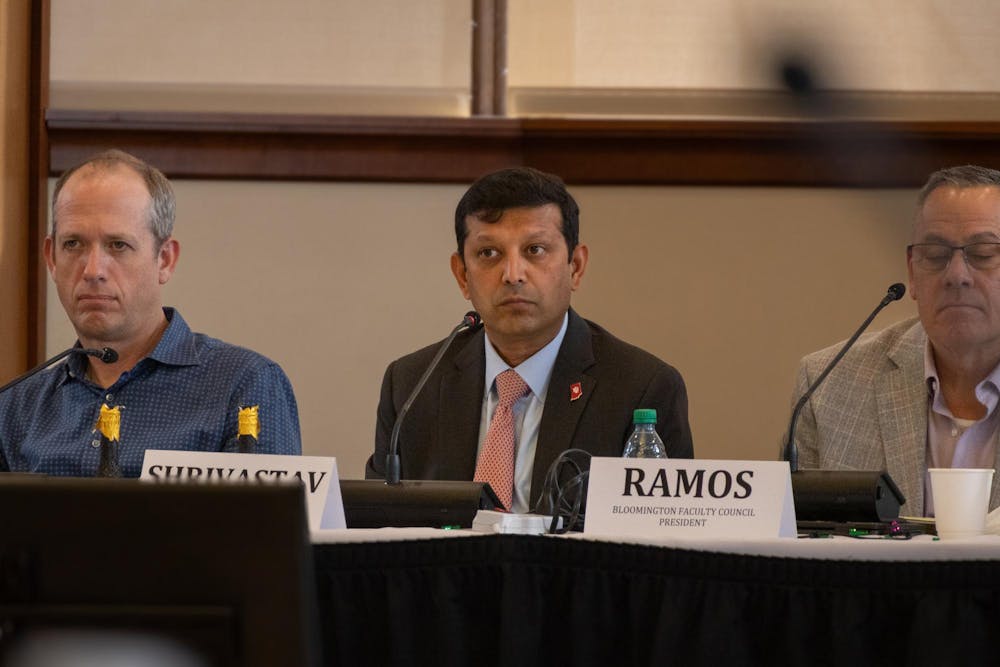
Of the 10 complaints, seven have been resolved, and one was “substantiated," IU Provost Rahul Shrivastav said during a Jan. 13 Bloomington Faculty Council meeting. The remaining two “remain in process under whatever local policies are overseeing that issue or federal policies,” Shrivastav said.
The complaints were submitted through IU’s Bias Incident Reporting form and EthicsPoint Reporting Hotline. Complaints can either be submitted anonymously or non-anonymously.
SEA 202 went into effect in July 2024 and allows students to report professors who they believe are not fostering “free inquiry, free expression, and intellectual diversity.”
From July 1, 2024 to Dec. 31, 2024, there were nine reported “legitimate” complaints across four different IU campuses, according to the IU’s annual report to the Indiana Commission for Higher Education obtained via a public records request by the Indiana Daily Student. Of these nine, eight were related to “political speech in classroom settings,” and the other concerned “failure to consider alternate viewpoints on a non-political matter.”
Compared to other universities in Indiana, IU ended up with the most complaints for the 2024 reporting period. Ball State University had three total complaints, while Indiana State University and Ivy Tech Community College had one each. Purdue University, the University of Southern Indiana, and Vincennes University did not receive any complaints, according to a report from the ICHE.
Who has been investigated so far?
A few of the IU faculty who’ve been investigated have gone public.
IU Germanic Studies Professor Benjamin Robinson was investigated after an anonymous complaint in October 2024 stated the professor spoke “against Indiana University on several occasions” in the classroom. The complaint also mentioned him speaking “negatively about the State of Israel” and describing the war in “untrue and unfair ways.”
The university eventually sanctioned Robinson in August 2025 after concluding that he had combined his personal opinions with his teaching.
Folklore and Ethnomusicology Professor David McDonald was investigated under SEA 202 when he received four complaints after showing a video of protesters opposing the war in Gaza as part of a talk in August 2024.
All four of these complaints were eventually dismissed.
IU also investigated IU School of Social Work Lecturer Jessica Adams for an alleged SEA 202 violation.
Adams was removed from her Diversity, Human Rights, and Social Justice lecture in September 2025 after displaying a graphic with forms of white supremacy, although she was allowed to come back six weeks later.
Questions over “frivolous” complaints
At the BFC meeting in January, Robinson asked Shrivastav about the number of complaints that were tossed out and why. Shrivastav pointed to differences in individual school policies.
“I don’t think the provost said anything in answer to my question,” Robinson said in an interview. “We don’t know the criteria that the university uses to make these decisions.”
In the 2024 IU report to ICHE, there were 37 “frivolous" complaints that were closed. An example of a frivolous complaint in the report was “Professor xxxx studies the black female experience and is an award-winning teacher and prolific publisher.”
Shrivastav didn’t have the number of complaints tossed out for 2025 but said in the BFC meeting that they would be “collected and reported at the end of March.”
“There is a reporting obligation to ICHE,” Robinson said during the BFC meeting. “The campus and the university should be collecting this data.”
Robinson told the IDS there should be a structure for the SEA 202 complaint decision-making process through specific guidelines.
“If you're going to be making sensitive decisions, and those decisions are not going to be discriminatory against a certain viewpoint, then we need to know who is making them, who is accountable for them and on what basis are they making these decisions,” Robinson said.
Processes regarding SEA 202 complaints are guided by the IU Board of Trustees with additional guidance from each individual school depending on their processes, IU spokesperson Mark Bode said in an email.
Bode declined for request to comment on the number of SEA 202 complaints at IU.
For the College of Arts and Sciences, the general process for responding to SEA 202 complaints begins with an assessment of the complaint itself by the executive or executive associate dean, ensuring it has standing, sufficient identifying information of the event and sufficient objective evidence.
If the complaint is found to have merit, the faculty member investigated has the option of review, which may be completed by the Complaint Review Faculty Committee, if requested. The review process may include interviewing witnesses, holding hearings and determining if the complaint is of merit.
If it is found to be of merit and there is no resolution reached, an investigation is initiated.