Editor's note: All opinions, columns and letters reflect the views of the individual writer and not necessarily those of the IDS or its staffers.
“But everything about phones is made to be addictive.”
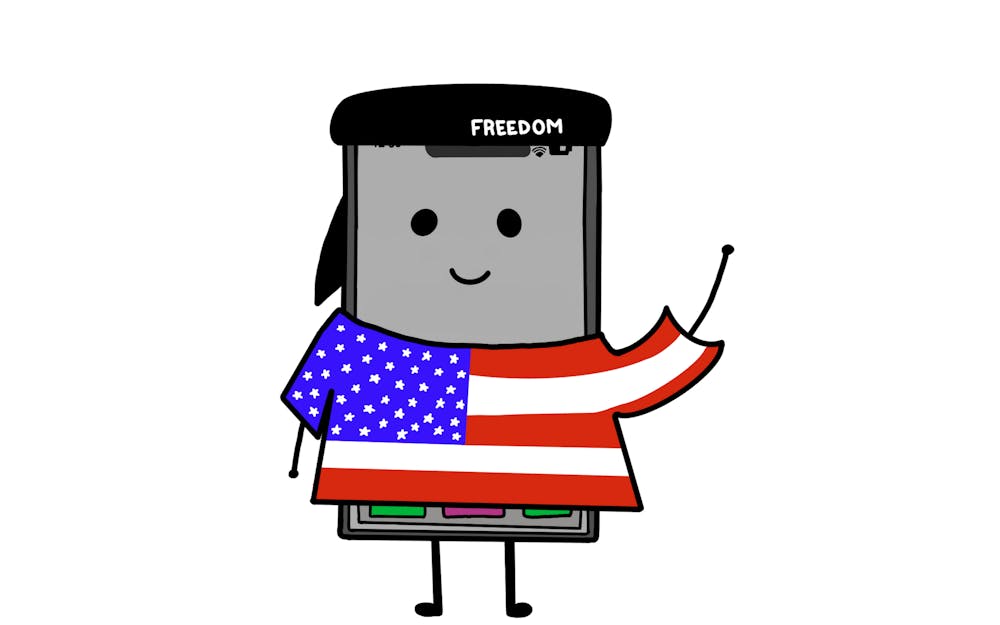
That was what two friends said when I shared with them this column’s premise: Indiana should not have banned phones in public schools at any time during the school day, let alone entertain a stricter prohibition over the whole day.
My rationale? Verbatim: A 16-year-old sophomore should have enough self control to put away a phone when class starts. My friends found this argument unconvincing.
A third confidante was surprised by my take. My sample population, admittedly, falls short of any scientific standards. Still, I was surprised to find no one in a phone-ridden generation interested in defending their third palm. Not a single sufferer of Stockholm syndrome. Here I stand, then.
In several previous columns I have chided the present nanny state. Whether the executive branch octopuses into other arms of government, campus administrators lock away landmarks seemingly intended for hijinks or artificial intelligence sanitizes our learning experience, our societal managers leave too little room for freedom as it is.
We need more freedom. Sometimes, it is restored to us. Yet when this happens, its tailside — perhaps its cost, if you see it that way — is that it demands responsibility. Freedom is worth having at all because we have it for some greater aim; freedom is for something.
A high school sophomore should be allowed to keep their phone in school because they should be a responsible actor. But they can only learn responsibility when they are free.
There is perhaps no other period of life more important for learning responsibility than high school. The learning lab of life looks much more like a day care when expectations of students are infantile. Bubble-wrapped restrictions will not work as well as elevated expectations to teach young adults to live responsibly.
I could cite academic studies on the benefits of heightened expectations, but I’d rather refer you to William Holman Hunt’s companion paintings, “The Light of the World” and “The Awakening Conscience.” They better illustrate that growth begins with invitation from a person you know, rather than barricades.
Indeed, the American Psychological Association recommends instilling students with a sense of ownership over their classroom, including by forming its rules and expectations. If the rest of Generation Z is anything like my friends, who opposed this column’s argument, we should be fine.
And school boards, superintendents, principles, teachers — where has their role in classroom policymaking gone? It seems like lawmakers are usurping decisions that have always been local.
Let’s not forget parents, either. They are, after all, their children’s first educators. As such, they should help teach their children responsible technology use. So far, I’ve focused on an imaginary high school sophomore as my would-be phone addict because, really, an elementary schooler should not even know what smart phones are.
Even so, my two friends’ rebuttal remains unexamined: phone addiction. Higher mobile phone use is correlated with lower well-being and increased stress in the general population, in which 12 to 21% of people engage in excessive phone use. But among adolescents aged 16 to 19, that proportion jumps to more than 37%. When phone addiction is self-reported, it plagues up to 50% of teens. On top of all of this, teenagers who are addicted to their phones are at a doubled risk of emotional problems, including suicidal behavior.
The argument to ban phones in public school is formidable. What good are they doing? Little, I admit. One could argue they are an unfortunate necessity in today’s age; emergencies arise now more than ever, meaning children may need to be able to contact their parents at a moment’s notice. Today, we have a greater consciousness of personal health issues and a societal epidemic of school shootings. But so-called “dumb,” or flip, phones can provide such contact. Really, the target of Senate Bill 78 is smart phones — a far more addictive technology.
Yet, temptation precedes addiction. And responsibility can only be tried by fire.
In the best case, SB 78 helps our imagined sophomore win the battle against their phone beckoning in their pocket. They ignore the device, instead paying attention to their classes and to friends around them. They also build a good habit. In such a scenario, SB 78 is rendered moot.
In the worst case, the bill is powerless to help our sophomore who can’t resist their phone. Perhaps the student even breaks the policy. In this scenario, what can the state do? Write another bill? Send in the police? No, the teacher will have to deal with this class disruption, as they would have to even in the bill’s absence.
Phones in class pose a problem — but one that best stays between students, parents and teachers. We should trust our fellow citizens to manage their lives without Indianapolis’ involvement.
Eric Cannon (he/him) is a sophomore studying philosophy and political science and currently serves as a member of IU Student Government.