
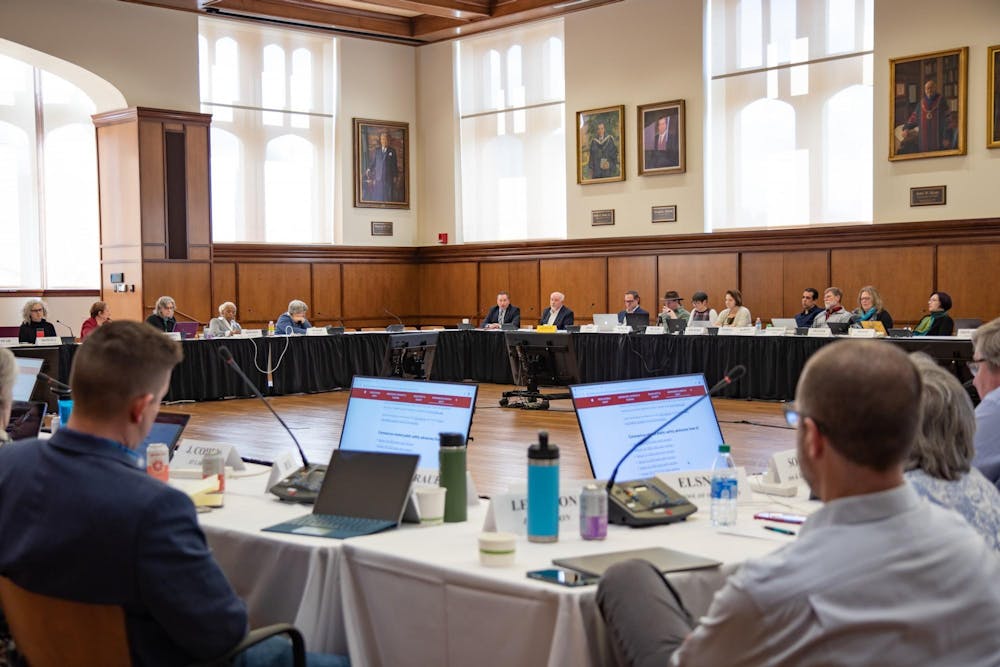
The Bloomington Faculty Council has erred in passing a resolution calling on Indiana University to remove U.S. Immigration and Customs Enforcement, U.S. Customs and Border Protection and the Department of Homeland Security from the list of approved employers allowed to recruit through the IU Events Calendar.
I share the seriousness of the concerns motivating the resolution. Allegations of constitutional violations, excessive force and reckless rhetoric by public officials warrant careful scrutiny. As faculty, we have a professional obligation to research, teach and openly debate the conduct of state institutions, especially those that exercise coercive power. Nothing in my opposition should be read as minimizing those concerns.
My objection instead centers on the institutional role of the university and the long-run consequences of the remedy being proposed.
First, I worry the resolution asks the university to abandon institutional neutrality by acting as an arbiter of unresolved legal and factual disputes involving lawful government agencies. Ongoing litigation and contested allegations are a persistent feature of modern governance. Conditioning employer access on the absence of unresolved cases creates a standard that is neither stable nor administrable and invites selective enforcement driven by political salience rather than neutral principle. Universities lack both the expertise and the legitimacy to adjudicate such matters, and the risk of error is substantial.
Second, the precedent set here would be difficult to contain. Many employers that recruit on campus — including police departments, defense contractors, healthcare systems and major corporations — are routinely involved in civil rights litigation or regulatory disputes. Once the university begins excluding employers based on contested claims, it is hard to justify where that line should stop or who should draw it. The long-run cost to academic freedom and institutional credibility is, in my view, high.
Third, I believe the proposed exclusion unnecessarily substitutes centralized administrative judgment for individual student agency. Students are not compelled to attend recruitment events. Those who object to these agencies can decline to engage, organize protests, disseminate information and engage in counter-speech. These decentralized responses preserve both moral expression and freedom of choice without requiring the university to impose a categorical ban.
Finally, while universities do apply mission-based criteria to employers in limited contexts, those exclusions typically rely on clear, final determinations and uniformly applied standards. Extending that logic to federal agencies with nationwide jurisdiction, based on unresolved allegations, is a qualitatively different and far more politicized step.
For these reasons, I believe the appropriate response to serious concerns about federal law enforcement agencies is rigorous scholarship, open debate and student empowerment rather than institutional exclusion.
More fundamentally, I worry the passage of the resolution represents internal confusion in the faculty over the university’s appropriate role in building civil society.
Justin M. Ross is a professor of public finance and economics at Indiana University Bloomington’s Paul H. O’Neill School of Public & Environmental Affairs.



