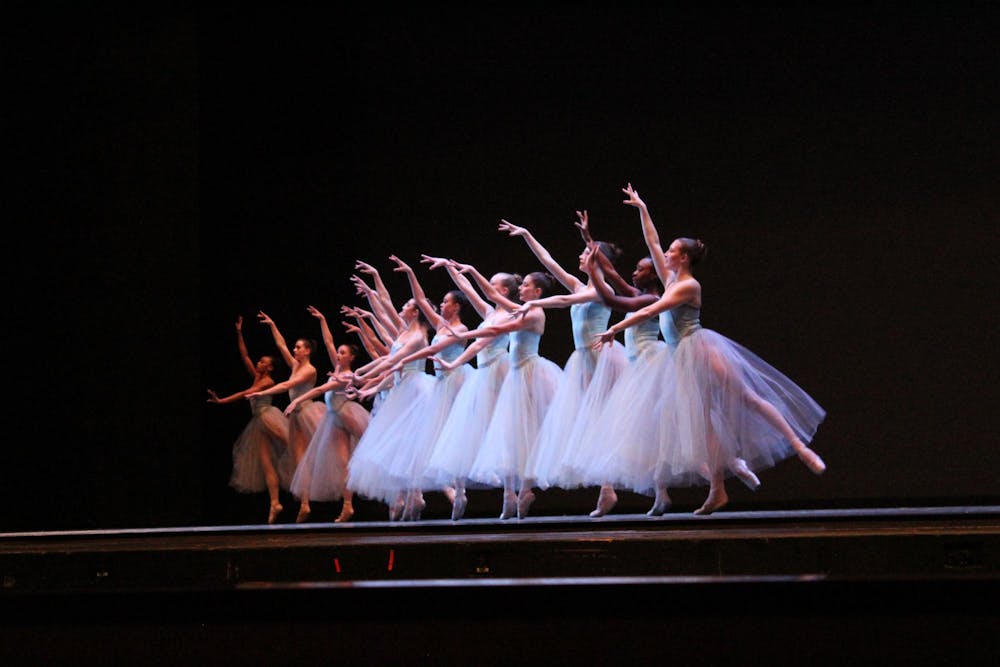
Indiana University announced Feb. 3 that Jacobs School of Music’s ballet program and the College of Arts and Science’s contemporary dance program will unite next school year to form the new Jacobs Dance department.
Jacobs Dance will offer a revised version of the degrees, allowing students to graduate with a concentration in either ballet or contemporary dance. Contemporary dancers are only given the Bachelor of Fine Arts degree program option, while ballet dancers can earn either a Bachelor of Science or Bachelor of Fine Arts.
The new department will also continue its Bachelor of Science in music with an outside field with a ballet concentration. This degree is currently only open to ballet students and will continue to only be open to ballet students next school year.
Sarah Wroth, chair of the ballet department, and Elizabeth Shea, and the director of contemporary dance, are spearheading the transition.
“The plan is for this first year to have just a new presence of dance and in a new location, and then as we see how we can enhance each other’s offerings and build stronger connections on the stage and in the community,” Wroth said.
The discussion of merging ballet and contemporary dance into one department within Jacobs has been in the works since Wroth joined the ballet staff in 2017. The merger has been languidly brought up at administrative meetings but was only given strong consideration when Indiana House Enrolled Act 1001 took effect July 1, which requires bachelor’s degree programs at public universities to have a minimum of 15 graduates.
The law affected both the contemporary dance and ballet programs at IU, which suspended new admissions into their programs last cycle. Proposals have swirled to form a new iteration of the programs, with IU considering moving the entire department of Theater, Drama and Contemporary Dance from the College of Arts and Sciences to Jacobs.
Linda Pisano, the chairperson for the current Theatre, Drama and Contemporary Dance department, said that Theatre and Drama are now also undergoing the early steps to merge with Jacobs.
Pisano said the process of merging her department into Jacobs will take a longer amount of time due to the robust number of staff and students as well as the 11 degree programs offered. The separate Theatre and Drama department will remain under the College of Arts and Sciences for the time being while the merging process is executed behind the scenes.
“We’re taking the next 18 months or so, until fall 2027,” Pisano said. “We will exist as Theatre and Drama, which is acting and directing, musical theatre, design and technology, history theory and literature.”
Jacobs Dance, on the other hand, will be offered to new and existing student dancers next school year. Students who are already within the ballet or contemporary dance programs will have the option to matriculate their original degree path or adopt one of the new iterations of degree programs offered.
The adjustments made to the Bachelor of Fine Arts in dance degree program are mostly the consequence of moving the degree from the College of Arts and Sciences and into Jacobs, with the general education requirements differing between the schools.
“Largely, except for minor changes and the changes to gen-ed requirements for contemporary dancers, there weren’t many changes,” Shea said. “And they fit beautifully into this Bachelor of Fine Arts degree.”
According to the university’s outline of the merging process, faculty are protected under a merger and will not be terminated because of the change. Since the only instance that termination can occur under a merger is when the transition is caused by financial exigency, all existing members of the contemporary dance and ballet faculty will join Jacobs Dance.
As Jacobs Dance steps onto the stage next year, Wroth and Shea said they see tremendous potential for collaboration between the two dance concentrations. Faculty and dancers alike will be given opportunities to dance a new style, choreograph different types of dances and work with dancers of a different style.
“I think we have a lot of shared strengths as individual programs and so utilizing those shared strengths to really connect with that identity and figure out how we want to present,” Wroth said.
“We love our dance colleagues,” Pisano added. “But we think that this is a great opportunity for them to be with other dancers.”