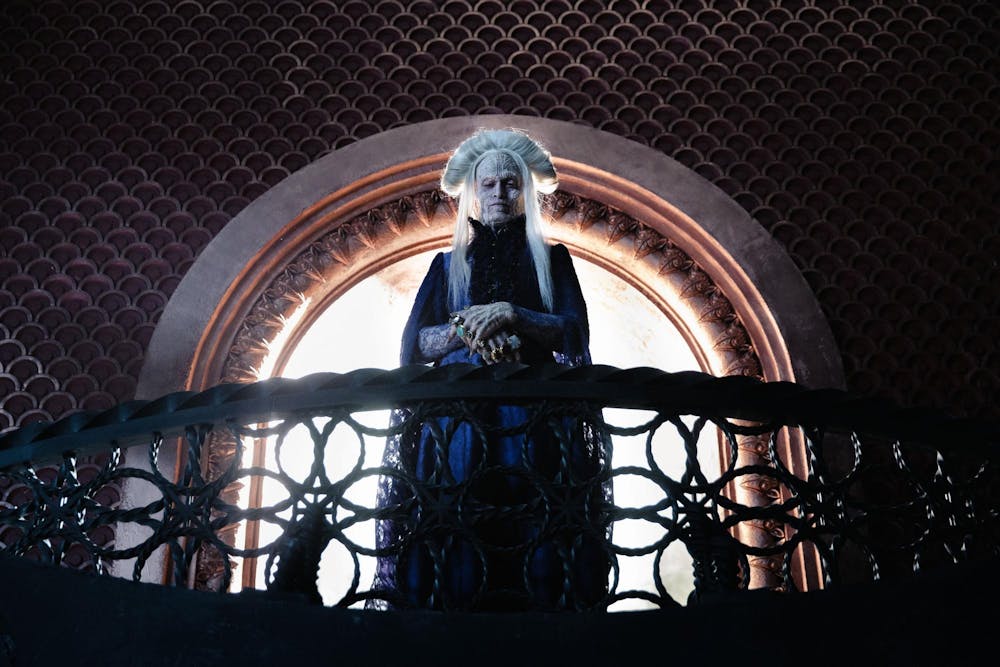
SPOILERS: This column contains potential spoilers for “Dracula: A Love Tale.”
In 1897, Irish author Bram Stoker made literary history with the release of his novel “Dracula.” Though the novel was only moderately successful during Stoker’s lifetime, his story of the powerful King of Vampires has attracted a massive fanbase and been marked as one of the most influential horror novels in history.
Given the sheer popularity of the novel, it’s no surprise the legendary Count Dracula has left a legacy of hundreds of movies, books and series adaptations all stemming from Stoker’s original work. What is surprising however, is how in only two hours and nine minutes French filmmaker Luc Besson’s latest film “Dracula: A Love Tale” manages to disrespect that legacy so completely.
“Dracula: A Love Tale” originally premiered in France in July 2025. Soon after its release, Vertical, an independent film distribution company, acquired the rights to it and the film received a wide theatrical release in North American theaters Feb. 6.
The movie is broken into two separate storylines with the main narrative taking place in 19th century Paris and Transylvania, Romania. Accompanying this main timeline are flashbacks, going as far back as the 15th century, of Dracula’s (Caleb Landry Jones) early years as he adapts to life as a vampire and tries to find the reincarnated version of his late wife Elisabeta (Zoë Bleu).
Even though Dracula is the titular character and the film spends most of its runtime breaking down his story and relationship with Elisabeta, later reincarnated as Mina, the main narrative of the movie also features a character known simply as the Priest (Christoph Waltz) and his work to hunt Dracula down.
Although the Priest is never explicitly named, it’s clear that Besson drew inspiration from Stoker’s infamous vampire hunter Abraham Van Helsing for his clergyman character. Not only do both serve as the primary antagonist to Dracula, but the way they approach vampirism is very similar as both characters attack the subject from a more scientific angle.
While Waltz’s character is introduced as a priest and wears a cassock throughout the film, he treats vampires in a clinical sense with measured tests as if he is curing a disease and only really brings up religion when prompted. Besson could have omitted these religious details and the viewer would probably have little to no idea that the Priest had any strong ties to the church whatsoever.
I’m not saying the Priest’s religious beliefs necessarily matter to the plot of the film; he is such a minor character compared to Dracula. I’m also not saying those beliefs being more present in his character would have made this bad movie any better. However, for a character who already seems to be so closely related to Van Helsing, it feels lazy and seriously lacks creativity on Besson’s part to largely omit the main thing that really separates the two.
The poor Van Helsing dupe is not the only thing that lacks creativity as most of the characters feel like watered down versions of those from past “Dracula” inspired films and stories.
This is most blatantly shown with Elisabeta, later reincarnated as Mina, who throughout the film feels more like a narrative device than she does a person.
Originally appearing in Francis Ford Coppola’s 1992 film “Bram Stoker's Dracula,” Mina (Winona Ryder) is the reincarnated version of Dracula’s lost love, Elisabeta. In Coppola’s film, Mina is a complex character and active participant in the story. She is intelligent, courageous and, as she starts to learn more about her past life, she embraces a passion that feels inspiring for a woman of her time.
Besson’s Mina lacks all that character and dimension, and for most of the film she acts at the whims of those around her. As she and Dracula begin to reconnect, this becomes even more evident as it seems like she cannot do anything without him and she loses all bodily autonomy and what little personality she had left. Instead of the strong character we see in Coppola’s film, viewers of Besson’s “Dracula: A Love Tale” get what feels like the equivalent of a human prop.
The only thing this movie manages to do right is its setting and costumes. Filmed primarily in Finland and France, most of the film is set in a stunning wintery landscape that really transports you into the era of the story. The costumes, especially in the main narrative where we see the intricate Victorian era gowns that Mina and Dracula’s main follower Maria (Matilda De Angelis) wear, only add to this beauty and immersion, even when the actual plot lets its viewers down time and time again.
Unfortunately, impressive visuals can’t save a film when the story itself is so fundamentally lacking.
Dracula’s story of undying love doesn’t feel as powerful or romantic as it does shallow and overdone. Virtually every other character in the film lacks any real personality. And, despite being classified as a horror film, “Dracula” often felt like a comedy in the worst ways, with many moments that were seemingly supposed to be dramatic or frightening just coming across as ridiculous.
For fans of the vampire genre, take my advice and avoid “Dracula: A Love Tale” completely next time you're looking for something to satisfy your vampire fix. Try watching “Bram Stoker’s Dracula,” Robert Eggers’ 2024 film “Nosferatu” or any of the other hundreds of Dracula adaptations that would be much more worthy of your time and enjoyment.
CORRECTION: This story has been updated with the correct publication date of the novel “Dracula.”