
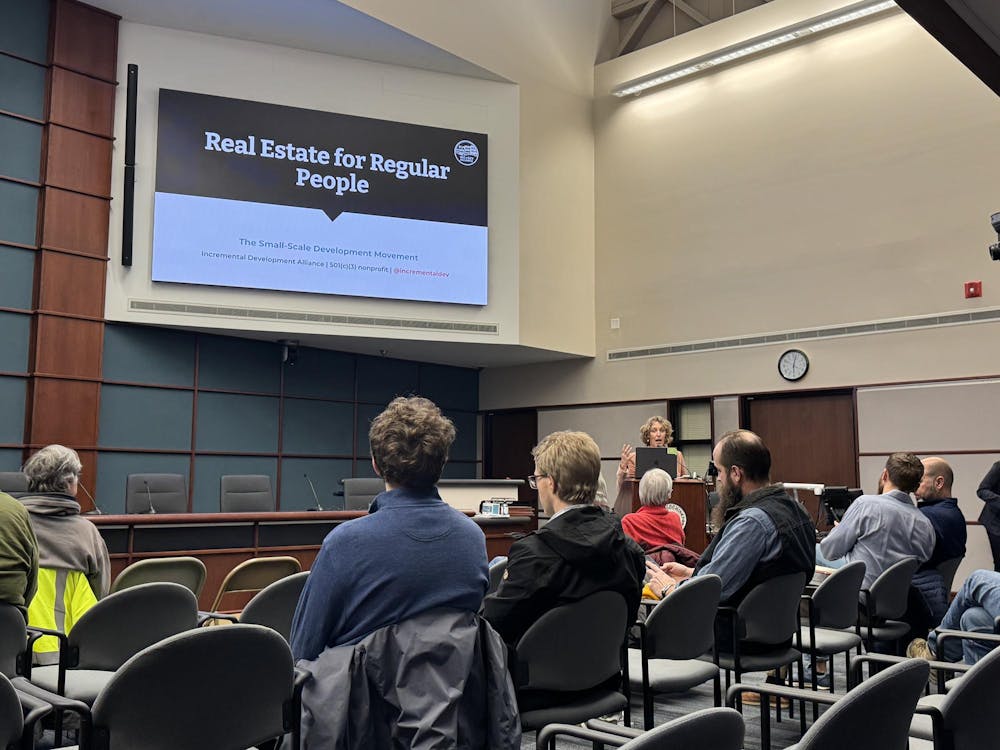
About 70 Bloomington residents, builders and community partners gathered at City Hall on Thursday evening to learn more about the new Hopewell neighborhood — the city’s largest housing development ever that has been in development since 2018.
The event, “Cultivating Neighborhoods & the Small-Scale Development Movement,” focused on one of the three Hopewell developments, Hopewell South, and the city’s approach to development and zoning reform.
“This is a pivotal moment for Bloomington, for housing in the region in particular,” Mayor Kerry Thomson said during the event. “And we’re really seeing Hopewell as a pilot for what we would like lots of housing to be in Bloomington in the future.”
The event was hosted by the City of Bloomington in partnership with the Incremental Development Alliance, a national nonprofit that trains and supports small-scale developers through community-focused projects. The lecture was led by Eric Kronberg, who works with IncDev and is founder of Kronberg Urbanists and Architects.
Hopewell is located at the site of the former IU Health Bloomington Hospital along West Second Street. Bloomington first unveiled plans for the neighborhood five years ago and the city says construction is anticipated to begin in June 2026 for Hopewell South.
Alli Thurmond Quinlan, the project lead at Flintlock LAB, kicked off the event with an overview of Bloomington’s current housing landscape and why the city needs a housing reset.
After an hour-long presentation during Thursday night's event about a new way of developing housing in Bloomington and prioritizing small scale development by local builders who know the community, Kronberg took questions from residents. One audience member asked whether the city could add housing without losing what “makes my neighborhood feel like home.” Kronberg said this is possible if zoning allows smaller-scale options like duplexes or triplexes.
One community member asked whether Bloomington’s Unified Development Ordinance, which governs the city’s land use and developments, unintentionally favors large projects. The audience member wrote “only big developers get projects approved.”
“When you make all projects hard, only those projects with enough financial return can come up with the resources to break through and get something done,” Kronberg said. “So most of those codes are not intended to only favor the big guys but they’re intended to limit the bad.”
Another audience member asked if there will be housing options for people with physical disabilities. Quinlan said Hopewell will have at least three plans that are fully complaint with the Americans with Disabilities Act.
After the Q&A, Thomson updated the audience on the progress of the development. Thomson said the city needs to fix its zoning, which cannot be one-size-fits all.
Under Hopewell South’s previous zoning, the development would have yielded just 28 homes with an average home cost of $425,000, Thomson said during the meeting.
To increase the number of homes that could be built in the south development, the city would need to amend its zoning and require a Planned Unit Development, a zoning district meant to create mixed-use neighborhood designs. Under Bloomington’s existing zoning, new approaches to small-lot urban housing can’t be achieved.
The Bloomington Plan Commission gave unanimous approval Monday night for rezoning the Hopewell South site.
The current Hopewell South development would have about 98 homes with an estimated city cost between $2.2 million and $2.5 million with the proposed rezoning. The development will include a mix of attached and detached homes and is designed to be owner-occupied, where it’s the owner’s primary residence. Thomson said homes will range in price from $83,000-600,000, depending on size.
She also said the city is studying potentially moving the Bloomington Police Department Headquarters to the Hopewell South site plan.
In January 2025, city officials proposed converting the former Bloomington Convalescent Center, located at 714 S. Rogers St., into a new police headquarters. In November 2025, the Bloomington Redevelopment Commission approved a $58,250 feasibility study by to determine whether the building can support the headquarters. The study will evaluate the buildings' structural sustainability, renovation costs, space for modern policing needs and impact on neighboring land use.
After completing the feasibility study, the city will see if they can move forward with the location.
The city is hosting a round table discussion about Hopewell on March 10. Developers can attend from 2-3 p.m., and lenders, who finance construction and development, can attend from 3-4 p.m.


