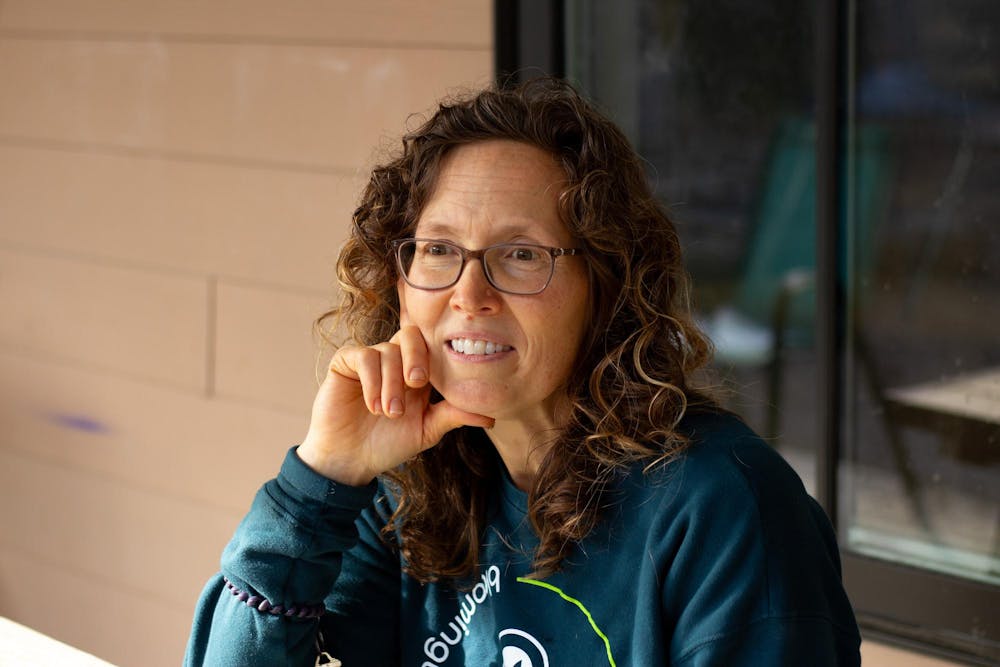
Around 5 p.m. on President’s Day, Eve Loftman Cusack, 50, finished her work for the day at Bloomington Montessori School. As she sat at a wooden picnic table on a porch connected to her classroom, she identified birds as easily as she breathed.
“There's a morning dove on the bird feeder there,” she said. “There was just a red-bellied woodpecker there in that same exact spot.”
The Bloomington native spends her days teaching children ages 6 to 9 in the school’s Walnut Classroom. Cusack has been an educator since 2000, when she started a Teach for America corps job in New Orleans public schools. She graduated from Northwestern University with a degree in sociology.
But her passion lies in birds.
“Crows have been going back and forth — I can hear them right now,” she said, pausing to take in the birdcalls around her. “I heard a golden-crowned kinglet.”
Cusack was named a Hoosier Resilience Hero by IU’s Environmental Resilience Institute in 2025, an award for her work banding birds and battling invasive plants. She and 11 others were honored during a ceremony at the Indiana Sustainability and Resilience Conference on Feb. 6.
Since 2017, Cusack has stewarded the banding station at Kent Farm Research Facility 7 miles east of Bloomington. Nine times during the summer — three Sundays on and one off, she said — she and her husband, fellow Montessori teacher Sam Cusack, wake up at 5 a.m. to prepare the station for business.
A day at the banding station starts with opening the nets. One by one, Eve and a team of usually around 30 banders open the bird-catching nets. They stand 10 feet tall and 12 meters wide, made of a mesh nearly invisible to the naked eye — nearly invisible to birds, too.
Every 40 minutes until 12:20 p.m., banders go out and check each net for birds. They’re rarely happy to be caught, she said, but local nesters tend to be much feistier.
“I have no research to back this up, but my assumption is that the migrants know that they have to conserve their energy more because they have to migrate,” she said. “Whereas resident birds, like, they know that they're staying here all the time, so they can kind of fight and fight and fight until you let them go.”
Despite their resistance, the banding process is painless for both parties if done properly. The small metal band Cusack slips on their leg weighs about as much, proportionately, as a FitBit watch does on a human, she said. As soon as a bird is banded and certain metrics taken — age, sex, size — it’s released. Cusack has the process streamlined down to two minutes per bird if she needs to move quickly.
Banding is a crucial process in monitoring bird populations and patterns, both locally and nationally. Tagging a bird with an identifiable band allows researchers to record when, how often and how far it migrates. Banding them also allows researchers to make educated guesses on how many birds might set up shop in any given place at any given time.
Banding also helps conservationists keep track of the health and resilience of bird populations. By tracking relative health metrics, such as checking for parasites and viruses, researchers can better understand how to help. Researchers can also determine the habitats and regions most in need of protection.
But Cusack thinks she makes the biggest impact in the minds and hearts of the children, college students and adults she teaches to band during camps over the summer.
“You might not care that much about birds in general, but I feel like once you've had this opportunity to hold and release a wild bird, or even just to look at one up close and see how incredible they are, it really changes your perspective and makes you care about saving them,” she said.
Eve and her husband Sam found their love of birds watching a peregrine falcon nest outside their Chicago high-rise apartment in 1997. Newly a couple, the pair were enthralled by the beauty and grace with which it glided over the urban jungle.
Soon after, they began bringing birding books on hikes at parks outside the city.
“The bird that really ignited the whole thing, I think, is the Northern Flicker,” Sam said of the medium-sized black-and-tan woodpecker. “We saw this bird, and we had never seen this bird before. We looked at it. We were on a trail, and we were like, ‘what is that?’ And we were able to look at the bird book and kind of decide what it was.”
Though neither studied biology or anything in the sciences in college, the two set off on a journey to do whatever they could to help birds. They volunteered at the Audubon Species Survival Center in New Orleans, chronicling whooping cranes and other bayou birds while Eve held down her day job as an educator.
She said she’s always tried to instill a love of birds in her students, even in her earliest days as a teacher in Lafourche — a couple parishes over from New Orleans. In the Walnut room, she sets aside time for the children to look out the bay windows into the school’s expansive backyard and appreciate the nature they see.
Her classroom is adorned with flags from around the world, hand-cut sandpaper letters for phonetic teaching and a wealth of do-it-yourself crafts materials. A petrified pufferfish sticks out among the eclectic collection of biology items.
Eve and Sam dream of visiting Peru someday. They’ve been to Ecuador — their honeymoon spot — just to see the diversity of birds in the rainforest. Peru has the second-most recorded bird species of any country in the world. But Eve isn’t jealous of the birds she protects.
“I wouldn’t want to be a bird,” she said. “They live hard lives.”
Eve participates in weed wrangles, organized by the city to weed out invasive species of plants. She’s taken to growing pollinator gardens made up only of native plants friendly to the bees, wasps and beetles that keep the birds fed.
Bird banding only happens during the summers while birds are migrating to and from their breeding and nesting grounds. Eve and Sam won’t be out again for a little while. But the moment the weather turns warm and the winds blow favorably, the pair will be out in the field, banding birds, trailing the species through another migration.