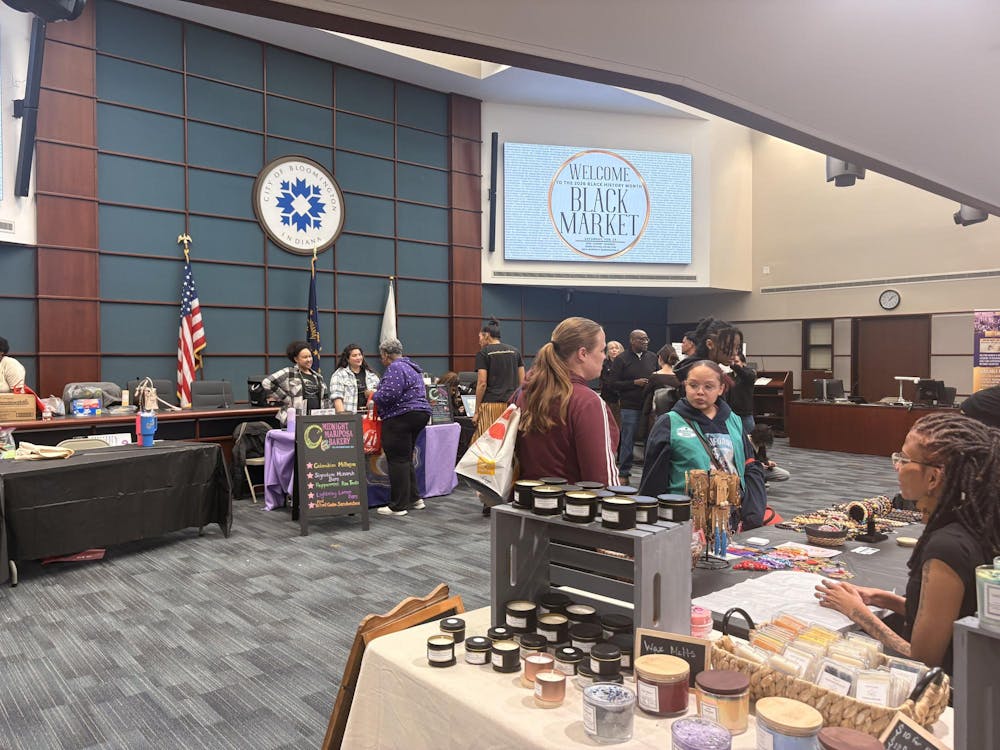
Local small business owners, advocacy groups and city leaders gathered Saturday at City Hall for Bloomington’s annual Black Market.
As part of the city’s Black History Month programming, the Community and Family Resources Department organized the event to showcase local Black-owned businesses. It also gave organizations including the Sierra Club and the Monroe County chapter of the National Association for the Advancement of Colored People a platform to connect with community members.
Community and Family Resources Department Director Shatoyia Moss highlighted two key reasons for putting on the event.
“One, sustainability amongst our community is very valuable. It keeps people engaged and it keeps our economy flowing,” Moss said. “Two, introducing the community to these small businesses that may not have a brick and mortar or even a website for them to go to, gives them face time and networking opportunities as well.”
The event also commemorated the original Black Market on Kirkwood Avenue, where a local man with Ku Klux Klan ties firebombed and destroyed the store in 1968.
Black IU students and faculty organized the original Black Market in the fall of 1968 as a space to sell goods and build community. Moss said recognizing that history is central to the city’s commitment to continue hosting the event today.
Through events like the Black Market, she said the city hopes to connect Black-owned businesses with new customers,facilitate collaboration and help build long-term support.
While vendors filled the lobby and the Council Chambers in City Hall selling homemade pastries, handmade jewelry and crochet items, advocacy groups and State Sen. Shelli Yoder used the space to discuss state and local policy.
Yoder, a Democrat representing most of Monroe County, had a table at the event and spoke with residents about issues they wanted to see resolved in the state government, such as affordable housing and childcare. She said events like the Black Market allow lawmakers to hear directly from those they represent.
Yoder offered attendees a printed-out list of bills currently circulating through the Indiana legislature as the end of the session approaches in mid-March.
Yoder said Black History Month events are important because “Black History Month is our history.”
“It is everyone’s history, and it’s important that we are intentional to educate ourselves,” Yoder said. “Because we can’t just trust that what we need to know and what we got in our formal education is enough. It’s not enough. It’s never enough.”
Vendors said the market provided visibility and a sense of community.
One vendor, Kelly Wingate, said participating in the Black Market was about more than sales. Wingate was tabling with Larissa Danielle Designs, selling homemade jewelry and candles.
“We need an identity, and we need to be showcased,” Wingate said. “And it’s a way for people to come and see persons of color businesses.”
For business owners like Renee Taliaferro, owner of A to Z Embroidery & Gifts, the event’s low vendor fees and central downtown location made participation more accessible.
In addition to hosting the annual event, Moss said the department works year-round to connect business owners with local resources and support networks. She said programming helps her department collect feedback to implement in its long-term planning.
As Bloomington marks the centennial celebration of Black History Month, Moss said the Black Market serves as both a reflection of the past and an investment in the future.
“We’re talking about legacy,” Moss said. “We’re talking about 100 years of greatness and excellence. Well, what are we doing to look forward the next 100 years?”