
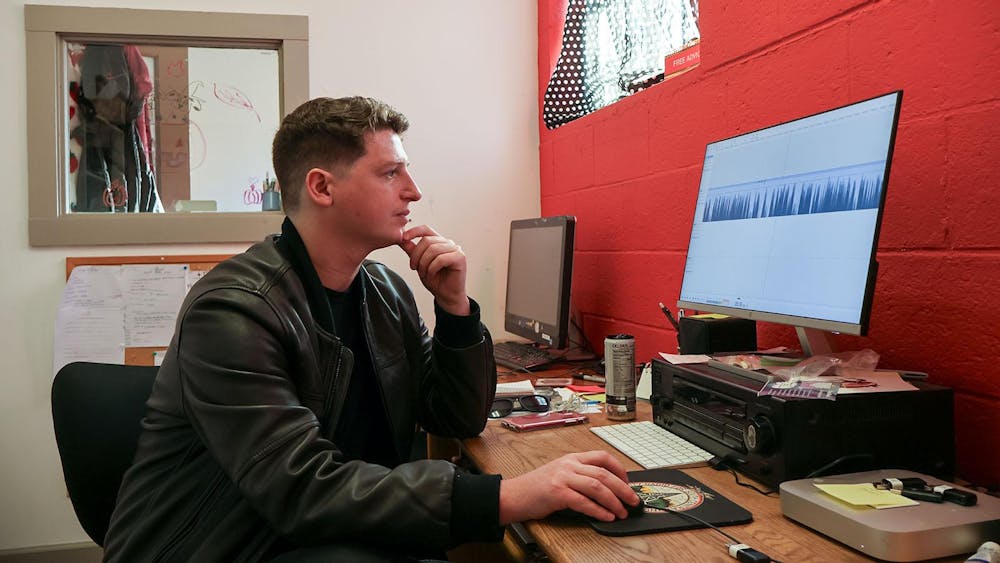
After Kade Young received an email from WFHB Community Radio’s general manager announcing that two of his coworkers would be let go, he had to fight back tears.
For Young, the news director at WFHB in Bloomington, the layoffs were more than just a professional setback; it was a personal one.
WFHB, a volunteer-driven radio station, had a paid staff of eight. That number dropped to six following the layoffs of Assistant News Director Noelle Herhusky-Schneider and Operations Manager Josh Brewer.
The layoffs came after moves by the Trump administration against public media.
President Donald Trump issued an executive order May 1 directing the Corporation for Public Broadcasting to cease all funding to NPR and PBS. The order accused both of being partisan organizations and argued the CPB's funding of them violated the corporation's ban on contributions to political parties.
NPR and PBS received a portion of their funding from CPB before the cuts, with other funding coming from sources like viewer donations and private foundations.
On July 24, Trump signed the Recessions Act of 2025, eliminating $1.1 billion in funding for the CPB through fiscal year 2027.
In response to the law, the CPB laid off most of its staff in September and announced it would close operations early next year. The cuts have thrown public media operations, like WFHB, into disarray.
WFHB has begun reevaluating its programming. While most volunteer-run shows are unaffected, off-site broadcasts that cost money to air are now at risk.
Young said the CPB provided the station with $115,000 annually, which totaled about a quarter of their overall budget. With less staff, his responsibilities have grown.
“A lot of the work will fall on remaining staff,” Young said. “Things we want to do that are bigger, bolder and provide more in-depth news coverage in the community, that’s going to be stalled.”
Young called Herhusky-Schneider his “partner-in-crime,” and said Brewer was the kind of person who quietly kept the station running. Their last day was Oct. 1, two months after the email was sent.
Part of his job always involved writing the script and editing the newscast that airs Monday through Thursday at 5 p.m. Herhusky-Schneider had been tasked with writing five-minute summaries of local government meetings and assembling sound bites into a cohesive broadcast segment.
Now, Young sits beside the empty chair and desk that once belonged to his colleague, working to fill the role she left behind.
“The last couple weeks she’s been gone, it feels like she’s out of town for a while,” Young said. “We’re still trying to find ways to make things a little more sustainable and maybe get volunteers to help with loading in some of these shows.”
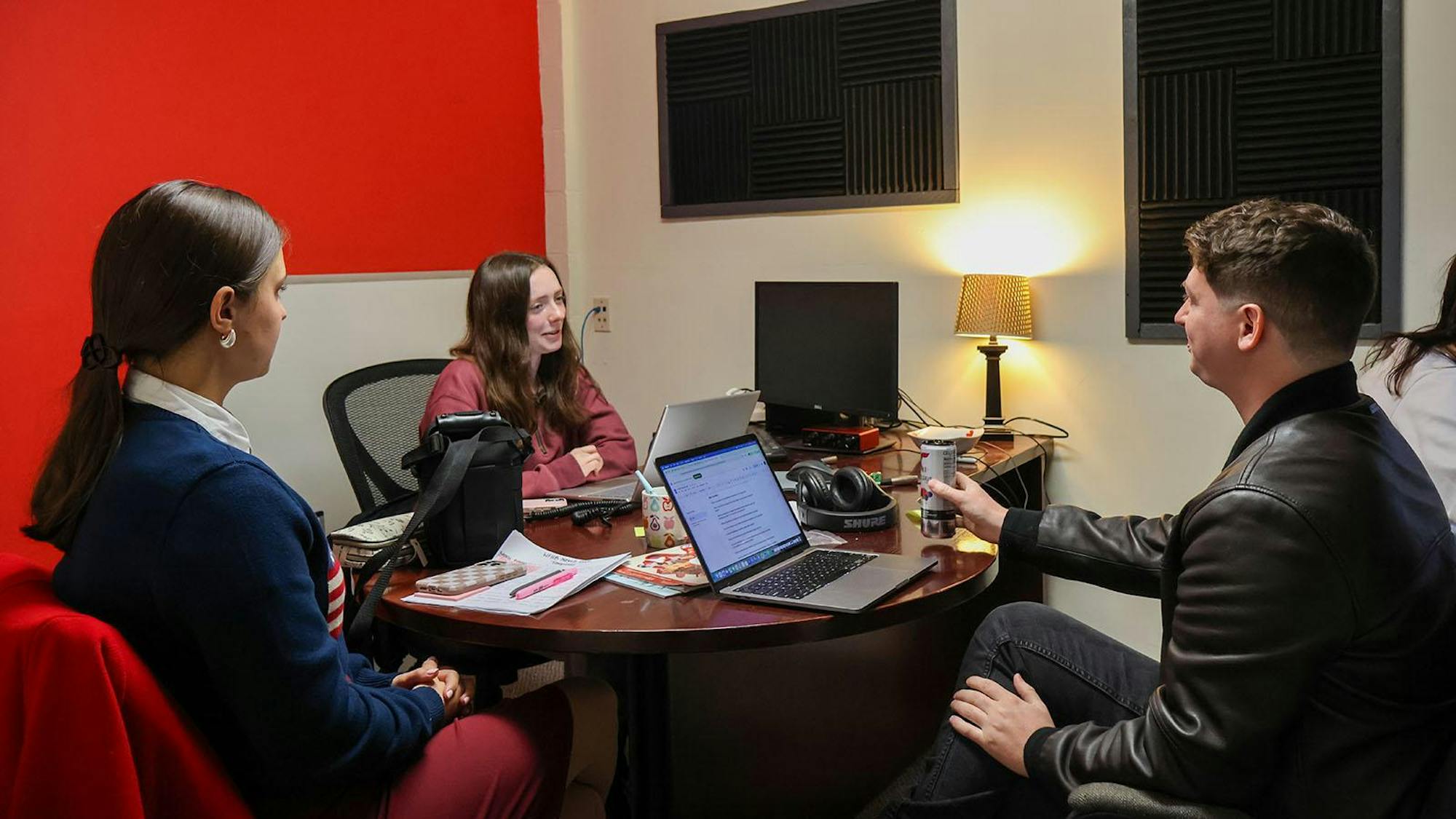
WFHB Community Radio News Director Kade Young talks to volunteers Zoe Moczek and Camdyn Glover on Nov. 10, 2025, at WFHB station headquarters in Bloomington. Over 150 volunteers have worked with WFHB on production and administrative support.
How has WFIU/WTIU been affected?
Jay Kincaid, facilities and technology director at The Media School, worked as director of WFIU/WTIU for 20 years. He served as interim general manager since September 2024 before Michael Arnold assumed his role as executive director of integrated public media permanently in October.
Kincaid said WFIU/WTIU had been operating in a deficit before the cuts. The bill rescinded $1.4 million annually for WFIU/WTIU, according to a press release by Indiana Public Media.
The deficit, combined with the loss of federal funding, could limit the station’s reporting later on.
“Voices are not going to be covering the state house or voices are not going to be covering local government,” IU Media School’s Director of Facilities and Technology Jay Kincaid said. “Just talking about weather, we’re funded to keep people alive.”
Federal funding accounts for about 5% of WFIU’s budget and 20% of WTIU's. Jesse Loudenbarger, associate director of communications and marketing at WFIU/WTIU, said the station replaced its 5% loss through community donations.
WTIU also consolidated its programming. It ended two science shows, “Earth Eats” and “A Moment of Science,” to create a new show called “Nice Work,” which focuses on science and culture.
Loudenbarger said the station has avoided staff cuts but can’t afford to fill open positions. This left them short staffed, but he said the station is running better than ever because of the support from the community.
“We’ve been breaking records in terms of how many dollars we’ve been raising in our fund drives, and we’ve increased the number of fund drives that we normally do in a year,” Loudenbarger said. “There’s just been very heartwarming support from the community.”
However, Loudenbarger is uncertain about the future after the fiscal year ends June 30, 2026.
“Our station will continue to want to be true to our editorial mission and remain committed to truth,” Loudenbarger said. “If I think about what that would look like if all that federal funding never comes back and we’re forced to make hard decisions, there’s still going to be opportunities for us to keep the radio on.”
Funding cuts draw political and community response
The cuts come amid a Republican-led campaign to diminish the role of public media, which they consider biased and liberal.
One of these efforts was started by Indiana Republican Sen. Jim Banks. He introduced the Defund NPR Act on Feb. 26, which would have eliminated all federal funding for NPR.
“Taxpayers shouldn’t be forced to fund NPR’s liberal propaganda,” Banks said in a Feb. 26 press release. “If NPR can’t stay afloat without government funding, that tells you all you need to know about the quality of their news.”
The act did not become a law. However, he and other Indiana Republicans went on to celebrate the cuts administered by the Recessions Act of 2025.
“This recessions package codifies DOGE cuts, saves taxpayers from funding left-wing propaganda outlets, and eliminates waste, fraud and abuse in our federal agencies,” U.S. Rep. Jim Baird, R-4, said in a post on X.
Indiana University senior, news reporter for WFIU/WTIU and WFHB volunteer Elyse Perry said she believes the funding cuts will only hurt the public, not help it.
“It seems like our current government, especially with funding cuts to local media, it seems like they don’t care about keeping the populace educated,” Perry said. “They don’t care about our democracy.”
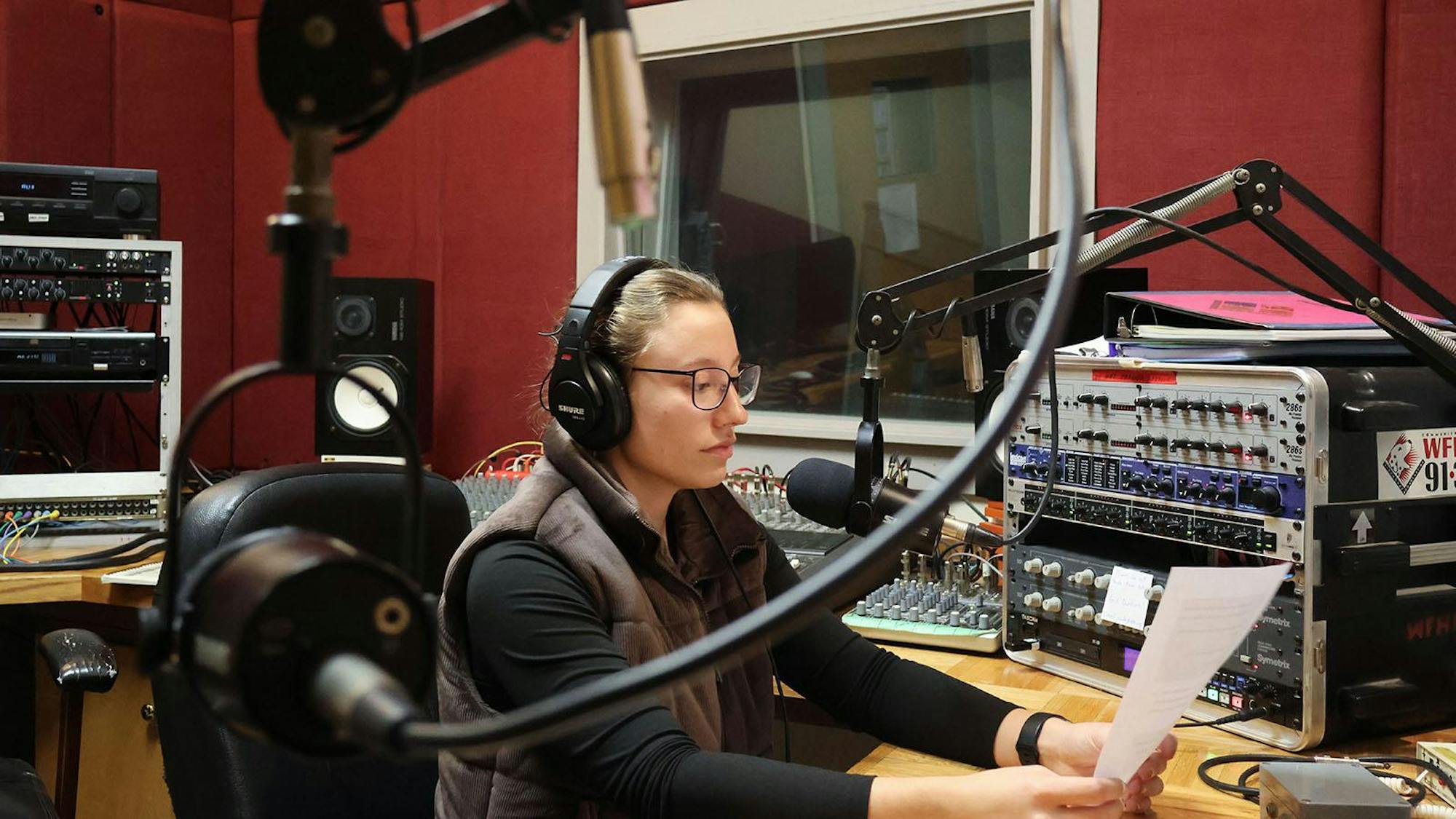
Indiana University senior and WFHB Community Radio volunteer Elyse Perry anchors for the local newscast Nov. 10, 2025, at WFHB station headquarters in Bloomington. Perry joined WFHB three years ago.
She grew up just outside of Delphi, Indiana, where the closest local radio news station was about 17 miles away. Her community rarely received media attention — something she believes would have been different if they had a local station.
Perry said local radio stations like WFHB give a voice to underrepresented communities. It's something that drives her passion for journalism, but she’s worried she may not get to pursue it after graduation.
“I’m scared, that’s where I’m at,” Perry said. “I’m graduating in May into a job market that is actively dying, and it doesn’t seem like we have a freedom of press in this country.”
Part of the effort to keep the radio on relies on the community. Local musician Carrie Newcomer began listening to WFHB and WFIU/WTIU when she moved to Bloomington in 1990 and continues to do so 30 years later.
“I think Bloomington would be a poor community without public media,” Newcomer said. “I think we would lose something vital and really important to what connects us as a community.”
Newcomer said she encourages others to support local radio by donating, advocating and listening. Young, WFHB’s news director, said he has seen support from the community increase since the Recessions Act of 2025 was passed.
Most WFHB’s past fund drives, held twice a year, saw up to $40,000 in donations. That number rose to over $100,000 this year, Young said, and he hopes to continue to see this sort of support.
Young is unsure about the future of the station once funds run out, but he is determined to keep going and stay motivated.
“If you’re a working journalist in the United States right now, you really need to speak truth to power,” Young said. “We don’t want democracy to die, so to go dark or to give up now, I think, would be a disservice to this community.”
Editor’s Note: Elyse Perry previously worked as a reporter at the IDS.
CORRECTION: This article has been updated to correct information about local media in Delphi.


