
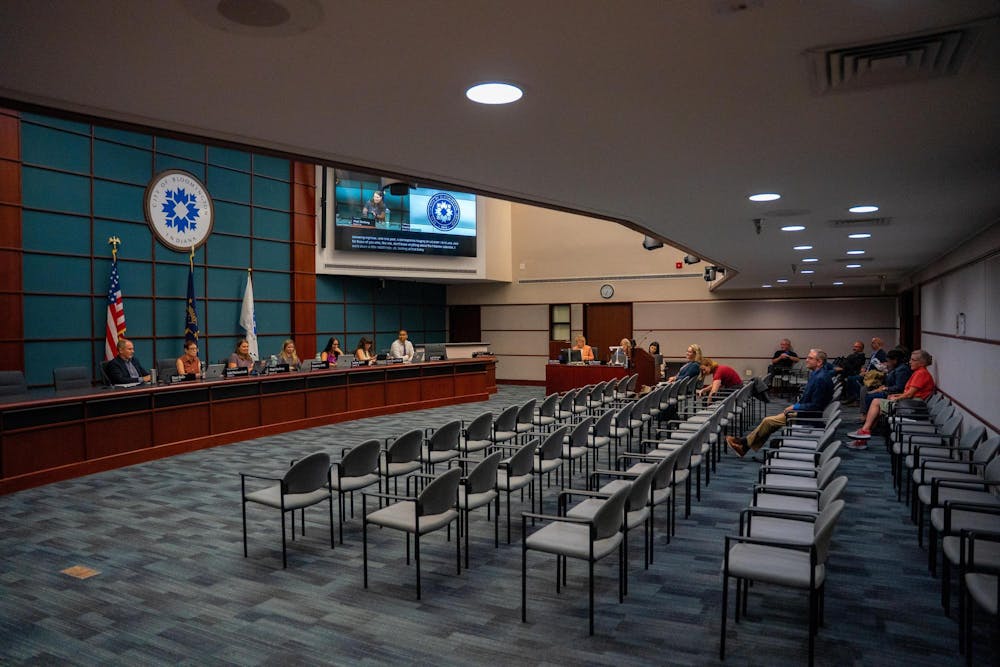
The Bloomington City Council approved the annexation of 2005 W. Cory Drive, designated a local home as a historic district and addressed other items on its last legislative agenda of the year Wednesday during its regular session meeting.
In its Dec. 3 meeting, the council approved a fiscal plan required to annex a parcel of land just outside Bloomington city boundaries. Property owner William Wamathai is seeking annexation so the property can be connected to city sewer and water, a step that would make construction of a duplex possible on an otherwise undeveloped lot.
Several residents who live near or adjacent to the property asked the council to reject the annexation.
Cory Drive resident Paul Post said the annexation was “ludicrous.” He said the lot is within Area 4, where Bloomington’s legally contested annexation efforts have already faced setbacks in court.
“It would make much more sense to let all that go through the courts and have an actual, final answer to that before we decide to go further with this one lot, creating a headache of logistical problems,” Post said.
Residents Joseph Chan and Magna Andrade, who both live next door to the parcel, also urged the council to reject the annexation. Chan said the council was “jumping the gun” without properly assessing whether development on the lot could cause drainage issues for neighboring properties.
“Am I going to have to worry about the construction or surveyors coming onto my property to survey this land?” Chan said.
Andrade was concerned about environmental impacts, including risks of erosion.
“Giving them the permission to rezone and annex without doing any of those inspections,” Andrade said. “Of course, you're just giving them all the leverage to do as they wish.”
Leslie Ruiz, another resident who was also present at the council’s Dec. 3 meeting, repeated previous concerns that the city should consider whether the lot can support a duplex. She said its karst features, formed when soluble rocks like limestone dissolve to form sinkholes or weak points, and poor drainage resulted in her basement flooding.
Council Vice President Isabel Piedmont-Smith thanked residents who shared their concerns and said they presented “great points,” but that the council must evaluate the criteria in front of them.
She said questions about what can be built on the lot, how to manage the karst area, and potential stormwater impacts will be addressed later. She also said the parcel would be subject to the Unified Development Ordinance, which includes strong environmental protections.
“So, this is really just the first step,” Piedmont-Smith said, “And we have to act on this petition.”
Assistant City Attorney Chris Wheeler also said conversations around what can be built on the lot would come later, after annexation and proper zoning. Then, he said, issues pertaining to the effects of new development can be addressed.
“It does make it a little easier, I think, for the property to get developed, but all of these issues that are being brought up are issues that would be brought up in time,” Wheeler said.
The council voted to approve the voluntary annexation of 2005 W. Cory Dr. 6-3. The parcel’s zoning as a Residential Medium-Lot (RM) was passed 7-2.
The council also took a final vote on Ordinance 2025-47, which amends Bloomington’s municipal code to designate 115 E. 12th St. as a historic district.
Built in the mid-1920s, the Craftsman-style California bungalow remains intact and is associated with Ivan Adams, a local stone carver whose work appears at sites across Bloomington and the United States. The home was owned between 1927 and 1945 by Adams and his wife Gladys.
It is also a part of Bloomington’s historic Cottage Grove neighborhood.
Bloomington’s municipal code outlines criteria for local historic designation, requiring properties or districts to be at least 50 years old and to demonstrate historic or architectural significance.
The current owners of the home, John and Amy Butler, urged the council to approve the designation.
“Ivan Adams was an exceptional carver, and preserving his memory is important to the cultural heritage of this city,” John Butler said.
Some of Adams’ work includes the Bloomington Courthouse’s WWII memorial, the IU seal at Foster Quad and the National Shrine of the Immaculate Conception in Washington.
The council debated whether the designation of a single property as a historic district was necessary, especially given that the home only met one criterion for historic designation.
“It’s a single house that’s not even notable nor outstanding,” Piedmont-Smith said.
Sam DeSollar, who serves on the city’s Historic Preservation Commission, also asked the council to approve the designation. The approval, he said, would help counteract development pressure for local neighborhoods and their residents by protecting more homes from demolition by developers.
“There are places of fabric that makes Bloomington ‘Bloomington,’” he said. “This house is a stellar example of that, in its simplicity and its form.”
Councilmember Matt Flaherty said he is unsure whether the fact of someone with cultural or historical significance living in a place is a sound criterion for historic preservation, and that historic preservation is not intended to be about preventing development.
Additionally, Council President Hopi Stosberg said she has a “pretty high” standard when assessing whether an area can be considered a historic district.
The council voted to adopt Ordinance 2025-47, 6-3. Flaherty, Stosberg and Councilmember Kate Rosenbarger voted to reject the designation.
Deputy Mayor Gretchen Knapp presented on Resolution 2025-21, the bargaining agreement reached between the City of Bloomington and the American Federation of State, County and Municipal Employees from 2026-28.
At the start of the year, Knapp said, a salary study comparing market information and current salary rates was conducted. Negotiation meetings began in July, and the contract was approved by union members by a vote of 82-7 Dec. 2.
Knapp said the costs associated with implementing the contract were fully covered in the 2026 budget. An amended salary ordinance will be brought before the council in January by the mayor’s office, Knapp said, that includes new pay schedules for city employees.
The contract also improves employees’ tenure steps, shortening the schedule for employees reaching their midpoint salary, Knapp said.
“Taking an example I gave in a particular role, it would have taken 25 years to get, essentially, a $4 an hour raise,” Knapp said. “We have shortened that schedule so that they now reach the midpoint of their salary after five years.”
Resolution 2025-21 was passed unanimously.
Department of Planning and Transportation Director David Hittle presented end-of-year updates to the city’s ongoing Housing Attainability project, outlining a multi-year timeline for updates to UDO refinement and housing attainability initiatives.
Between December and April, city staff plan to complete the first phase of public outreach, draft potential UDO amendments, review the drafts with stakeholders, and refine the proposals in preparation for adoption. During this period, the city will also provide training for developers and lenders.
Councilmembers Sydney Zulich and Flaherty warned against aggression toward students in conversations about housing attainability.
“The way we talk about students is pretty aggressive,” Zulich said. “Do you think that that has any impact on students wanting to stay here and be part of a workforce?”
Looking ahead, the city aims to complete a development review audit in the first quarter of 2026 and begin implementing short-term rental solutions in the second quarter. Beyond 2026, Bloomington plans to pursue modifications to the building code and revisit the city’s 2018 Comprehensive Plan through 2027–28.
“What is Bloomington if there’s no university?” Hittle said. “What is the university if there are no students? We absolutely have to accommodate them.”
The council’s organizational meeting is scheduled for Jan. 6, 2026.


