Editor's note: All opinions, columns and letters reflect the views of the individual writer and not necessarily those of the IDS or its staffers.
What do salamanders, the president and Indiana all have in common?
It’s a political tactic you probably forgot about the moment you left high school government class: gerrymandering.
The term “gerrymander” was coined in 1812, after a political cartoon in the Boston Gazette showed a proposed redistricting plan in Massachusetts. Gov. Elbridge Gerry approved a district designed primarily to help Gerry’s party, the Democratic-Republicans, gain seats. The district in question bore a striking resemblance to a salamander, hence the “Gerry-mander” name.
Since then, the practice has evolved through different eras. In the Reconstruction era, gerrymandering was used as a tool to suppress Black voters and reduce their political power. Although racial gerrymandering has since been declared unconstitutional, both Democrats and Republicans rely on rigged maps to win elections. More than two centuries later, President Donald Trump is continuing this by targeting Indiana to gerrymander away our democracy.
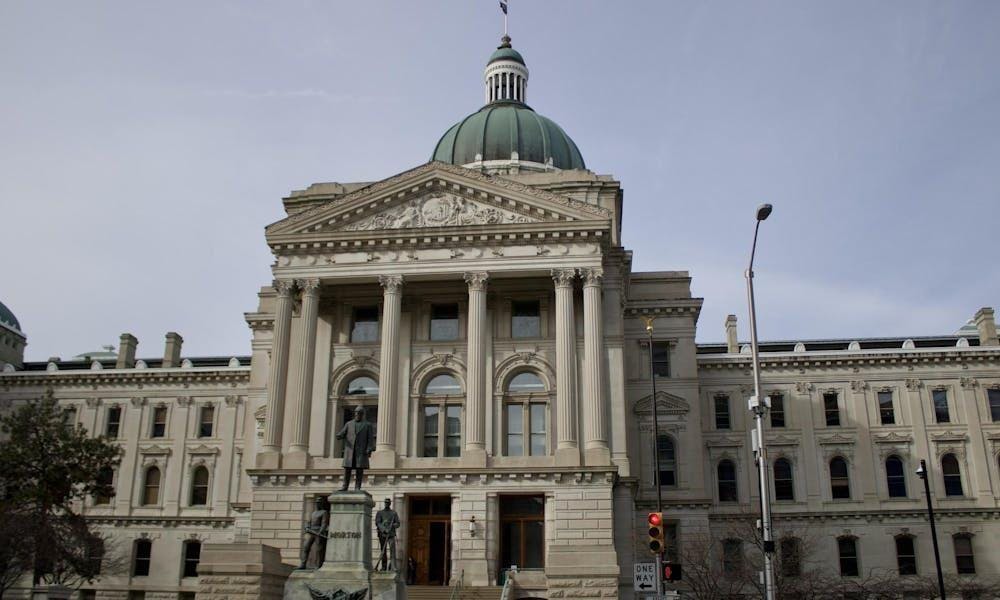
Earlier this week, Indiana House Republicans released a draft of a new congressional map in House Bill 1032. Conveniently for President Trump and Gov. Mike Braun, this map breaks up our state’s two Democratic-held districts. If it were to pass, Hoosier Democrats, despite a large constituent base, would not have a single representative in the House of Representatives.
The proposed map for Indiana is, quite frankly, ridiculous. Among the most flagrant violations of democracy is the split of District 7, which, as it stands today, loosely follows the borders of Marion County. Under the proposed map, Indianapolis residents would be split into four separate districts, sharing with Hoosier's along the state’s western, southern and eastern borders.
At the risk of sounding fatalistic, why bother? Indiana was the first state to be called for Trump in the 2024 Presidential Election. A mere two districts are hardly a threat to our state’s long-held Republican majority. Which begs the question: Why the pressure to redistrict?
The answer is simple. Trump knows he’s fighting a losing battle with the American people. If the people actually supported his policies, there would be no need to rig elections. According to Gallup, a data analytics platform, President Donald Trump’s job approval rating has fallen five percentage points to 36%, the lowest of his second term, while disapproval has risen to 60%. This isn't just according to Democrats — both Republicans’ and independents’ ratings of Trump have worsened significantly since last month.
This spells bad news for the upcoming 2026 midterm elections. As of now, Republicans hold a narrow majority in Congress, leading by only six seats in the House and six seats in the Senate.
When elected officials manipulate district lines to control election results, it is an affront to the very constituents they serve. The power in this country comes from the people; when district lines are intentionally redrawn to alter outcomes, it shifts that power dynamic. The American people are supposed to be the ones deciding who rules us, not the other way around. Indiana’s proposal doesn’t reflect civic engagement, population shifts or community needs. It reflects panic, rooted in the fact that Trump is losing ground with the American people, cheating us and targeting our lawmakers to get away with it.
The state Senate, where several Republican senators have expressed opposition to the redistricting, is expected to meet next week. Many of these Republican senators, facing intense pressure within their own party to redistrict, are standing up to the heat. According to the IndyStar, “at least a dozen bomb threats or swatting attempts” were levied against several Indiana lawmakers and politicians who have expressed their resistance to the proposal.
The gerrymandering pressure we’re seeing right now is a direct threat to the integrity of every vote cast in this state, especially those of Indiana University students. College students already face voter suppression, such as bills that would make us only eligible to vote in our hometowns and unable to use our student IDs as a valid form of identification. When districts are engineered to dilute certain voters’ power, young people are often the first voices pushed to the margins.
Nothing will change unless the people, including us, speak loudly enough that lawmakers can’t ignore it. The most effective way to resolve this issue is to demand that redistricting power be taken out of the hands of politicians who benefit from it. States like Colorado, California and Michigan have already created independent redistricting commissions through ballot initiatives and sustained public pressure. Indiana can, too. You can call or email Indiana's U.S. senators Todd Young and Jim Banks before next week’s vote to make your voice heard.
Ainsley Foster (she/her) is a senior studying Elementary Education and Children’s Mental Health.