
Editor's note: All opinions, columns and letters reflect the views of the individual writer and not necessarily those of the IDS or its staffers.
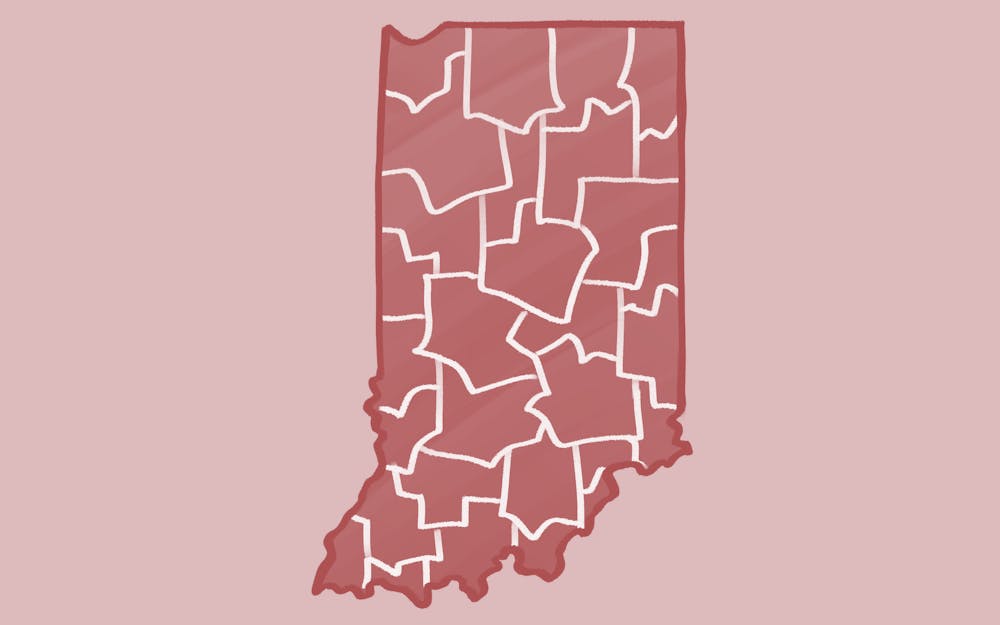
In October, Indiana Gov. Mike Braun called a special legislative session to consider redrawing the state’s congressional districts. This was supposed to begin Nov. 3. Instead, the Indiana legislature opted to meet for their regular session a month early, in December.
The move reflects a nationwide push to redraw district maps to favor one party or another. Texas, Ohio, Missouri and North Carolina have already enacted maps that favor Republicans, a potential nine extra seats in Congress. California and Utah have enacted maps that favor Democrats, a potential six seats, to combat these efforts. These moves continue a concerning trend of sharp partisanship and animosity between the two parties. It must stop.
The president’s party typically loses seats in Congress in the midterm elections, which will take place next in November 2026. Republicans have a narrow majority in the House of Representatives, 219 Republicans to 213 Democrats. If things continue on this trend, the Democrats could take the majority in 2026.
In Indiana, seven of the nine seats in the House of Representatives are controlled by Republicans. The map redraw would aim to flip the remaining two seats.
The efforts in Indiana come after a “months-long pressure campaign” by President Donald Trump and his administration. President Trump spoke to Indiana Republicans, and Vice President J.D. Vance made two trips to the state to talk about redistricting.
The office of the president should not be endorsing what is quite plainly gerrymandering and cheating. The president, as the highest office in the country, should be a model for the proper way to conduct the government honestly and justly. While he is a member of a political party, Trump also represents the entire country.
The historical purpose of redistricting is to ensure congressional districts reflect population changes within a state. In the 1964 ruling of Reynolds v. Sims, the U.S. Supreme Court deemed it was unconstitutional to provide the same amount of representatives to districts that no longer had the same population. This ruling led to the practice of redistricting every decade after the census.
The ruling was made to ensure everyone was getting equal representation in government, that everyone's votes mattered. Attempts to skew the districts so that one party is more likely to win over another simply go against that.
It indicates a trend of vast polarization between Democrats and Republicans which has increased sharply in recent years. A poll found that in 2022, 72% of Republicans and 63% of Democrats viewed the opposing party as more immoral than other Americans, each up by about 30% from 2016.
It comes straight from the top. Regarding the government shutdown, the White House website displays in bold letters “Democrats have shut down the government." The message could leave everyday Republicans angry and Democrats alienated. Both come to the conclusion that the opposite party is wrong.
The messaging on the White House website pushes an opinion that Democrats are the enemy. It works the opposite way as well. Democrats fight back the redistricting efforts by Republicans with redistricting efforts of their own, treating the opposite political party as an enemy they must overcome.
This kind of thinking is becoming detrimental to our country’s political health.
Our democracy relies on the two parties being willing to compromise with each other. It relies on the parties to view each other with respect. If we don’t have that, in the words of Johanna Dunaway, research director at Syracuse University’s Institute for Democracy, Journalism and Citizenship, we reach a point “where the two opposing entities are systematically and intentionally undermining each other’s legitimacy.” That does not make for a productive and trustworthy government.
The mid-decade redistricting efforts are the latest in the trend, and they indicate an active participation from the states in the competition. Each party is trying to undermine the other, to win, and that is not how our government should run. We should not feel so threatened by the other party that it feels imperative that we cheat to win.
Right now, we need to put checks in place to put an end to partisan gerrymandering. Our government, on both sides of the aisle, needs to be held accountable. Something needs to change. This could be the start, if Republicans and Democrats band together and tell our state legislatures we don’t want this.
As college students, we need to start our lives as voters by thinking critically. We need to think beyond party lines, and we need to think about who we are voting for and why.
We have the power to change things with our votes. Our voices. It is time to start.
Sasha Burton (she/her) is a sophomore studying elementary education with minors in Spanish and English.



