
All opinions, columns and letters reflect the views of the individual writer and not necessarily those of the IDS or its staffers.
Pasta night plans? We all know the fresher the herbs, the better the sauce. But to get your hands on some basil, you must decide: buy a plastic package sprayed with chemical mist at your local Kroger, or exchange a cutting of your friend’s basil plant for a promise of pasta later? Convenience or connection?
We all know food underpins community: family-style dishes comprise holiday centerpieces, offers of pizza draw college students to events, watch parties are nothing without snacks. In these ways, your relationships with food are inextricable from those between people, and plants cultivate those connections.
“We evolved really intimately with plants,” Dr. Keitlyn Alcantara, assistant professor in IU’s Department of Anthropology, said. “They are what allowed us to survive as a species.”
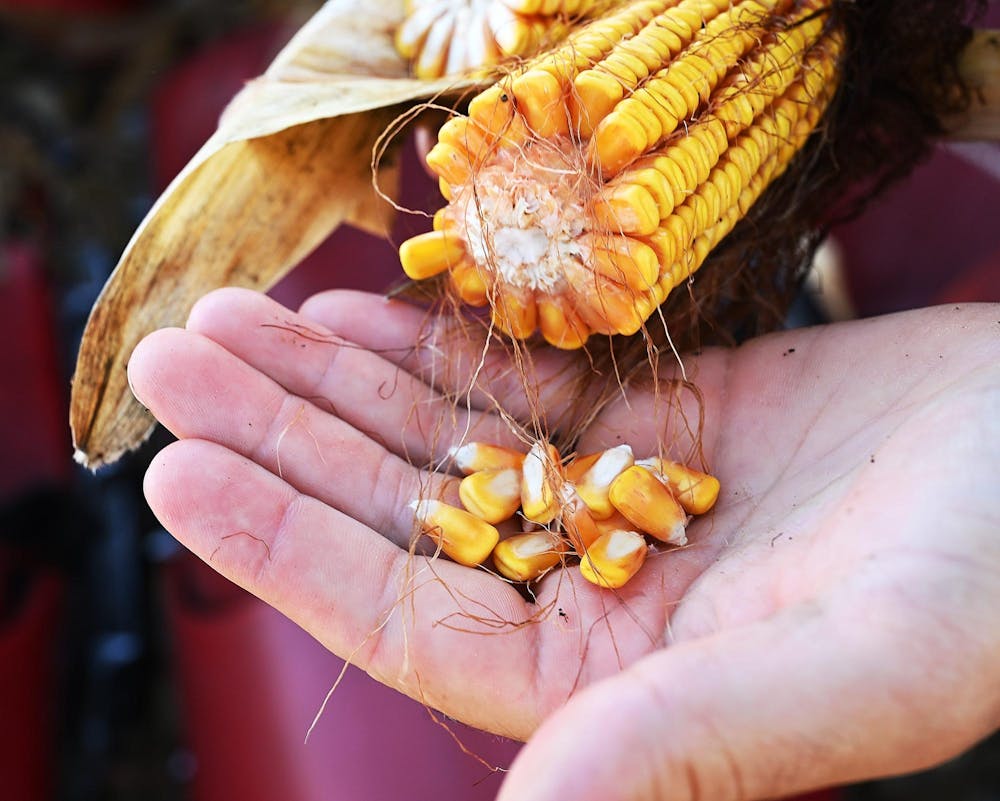
Settled society as we know it started with the Neolithic Revolution 12,000 years ago, the period when nomadic tribes transitioned from hunting and gathering to farming crops and domesticating animals in one permanent community. The drastic lifestyle changes affected ways of living, eating and even storytelling. In Indigenous communities of the corn belt, the maize crop sustains not only the stomachs but the stories of its people.
“It’s (corn’s) not only important; it’s integral to people who define themselves as people of the corn,” Dr. Olga Kalentzidou, senior lecturer in IU’s Department of Geography, said. “It feeds the land, it feeds people, it feeds the ecosystem and it feeds the stories, the creation stories from which these people come.”
On Oct. 17, around the time of maize harvest, Alcantara and Kalentzidou hosted the Multifaceted Maize Panel, bringing together viewpoints from people who interact with maize in different ways to explore how those varying relationships between people and maize shapes our societies and to unearth displaced and erased Indigenous histories of this region.
“Just like corn can come in many, many forms and many attributes and many qualities, so were the people in this discussion,” Kalentzidou said.
Indeed, the diverse relationships the panel’s participants had to maize made for an interesting discussion: for example. Irad Santacruz, a Tlaxcalan chef creating local laws to ban genetically-modified organism seeds with small-scale farmers; Panagiotis Sainatoudis, Peliti Seed Bank founder redistributing seeds in Greece; and Ryan Conway, a Shawnee community organizer growing Tenskwatawa corn in the Bloomington’s Healing Garden and Evansville’s Angel Mounds.
Conway’s work, specifically, exhibits the importance not only of maize, but the power of seeds themselves. This year, he began planting Tenskwatawa, a variety of ceremonial maize native to Indiana and important in Shawnee culture, using the historical ridge-and-furrow system; both crop and method had been displaced, yet Conway has already made an impact.
“Having to tend to it, having to harvest it in community is something that’s revitalizing the community of Shawnee here in Indiana,” Alcantara said. “So it’s bringing people back.”
This cycle of information, culture and community nurtured through seeds is interrupted when modern food systems turn seeds into products. This infrastructure turns a deaf ear to the stories and information held by seeds, causing more problems than it solves.
“A lot of these GMO seeds, they’re constantly having pests or mold or all of these problems that emerge when the people who are managing these seeds aren’t really listening to the seed itself,” Alcantara said.
This is now true of 60% of the world’s seeds, monopolized by four chemical companies. They hoard power and patents, forcing farmers to plant their copyrights. Then, like when one Indiana soybean farmer Vernon Bowman found a loophole in 2013, Monsanto squeezed him for even more money. In Greece, the EU prohibits farmers from keeping indigenous, local or nonhybrid seeds and their seedlings, thus forcing them to re-purchase GMO seeds every season; they have no sovereignty, stripped of self-governance.
“This has gone too far,” Kalentzidou said. “So, what Panagiotis and local seed advocates are doing is definitely part of an alternate, reciprocal food system that pushes against corporatization and hybrid patents.”
To resist GMO seeds is to protect biodiversity while intentionally moving back to precolonial cuisines, indigenous foodways and returning democracy to agricultural systems.
“We are not keeping these seeds in order to mold on our shelves, as Kaya DeerInWater said,” Kalentzidou said. “It’s an exchange mechanism, a reciprocity mechanism. So, you take the seeds, you give it to farmers or gardeners, they cultivate them, so you can start this cycle again.”
This reciprocity, this circularity, that is integral to Panagiotis’ seed bank, is what the concept of seed sovereignty stands for; it means farmers being able to keep their seeds, own them, plant them, harvest them.
“Seed sovereignty for me is learning to honor and pay attention to the relationships that seeds exist within and that makes a richer and more resilient community for everybody,” Alcantara said.
It’s about control and placing it back in the hands of the people, like the anti-GMO movement that Santacruz organizes in Tlaxcala. The problem seems large, but the solution is local.
“I always say to people, ‘come and grow something with us,’” Kalentzidou said.
Local, for you, can start with a visit to the Healing Garden, or simply plant a friend’s basil propagation; be curious, engage with your community, and you can’t go wrong.
Odessa Lyon (she/her) is a senior studying biology and English, pursuing a minor in European studies.



