
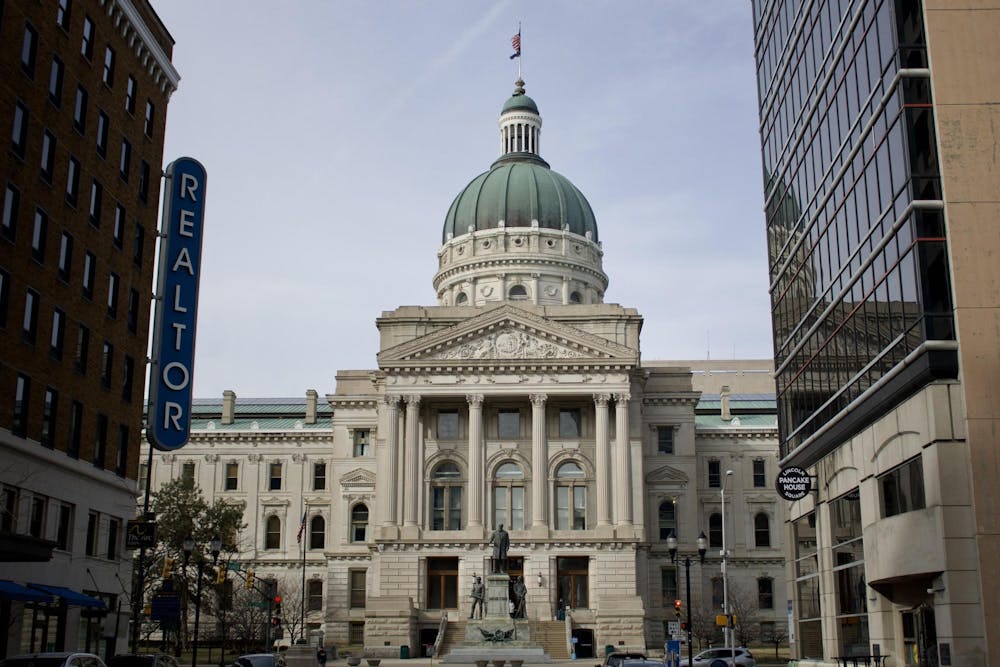
The Indiana Senate turned down a Republican redistricting bill in a 31-19 vote Thursday, ending a months-long fight over Indiana’s congressional districts.
Twenty-one Republicans broke with the national party line to vote against House Bill 1032, which aimed to give Republican candidates an advantage in the 2026 midterms by dramatically reconfiguring Indiana’s nine congressional districts.
The changes included overhauls to the 1st and 7th congressional districts, which are held by Democratic U.S. representatives.
The 1st District, held by U.S. Rep. Frank Mrvan, stretched further southeast in the proposed map, splitting the current district in two.
The map also divides the 7th District, held by U.S. Rep. André Carson, into four parts, placing primarily Democratic voters from Indianapolis into districts with rural, Republican-led counties. Monroe County would have moved from the 9th District to the 8th under the proposal.
Senate Democratic Leader Shelli Yoder, D-Bloomington, commended the results of the vote in a press release.
“This was never about one party winning or losing,” she said. “It was about whether Indiana would honor a simple promise: voters choose their leaders, not the other way around.”
Yoder voted against the bill. Republican Eric Koch, who represents part of Monroe County, voted in favor of redistricting.
Gov. Mike Braun condemned Republicans who voted against redistricting, calling them “misguided” and having “partnered with Democrats.”
“Ultimately, decisions like this carry political consequences,” Braun said in a statement. “I will be working with the President to challenge these people who do not represent the best interests of Hoosiers.”
The changes aimed to boost Republicans’ chances in Indiana’s congressional elections, allowing Republicans to control of all nine of the state’s seats.
The bill was part of a broader push for redistricting in Republican-led states ahead of the 2026 midterms. Republicans have introduced similar measures in Texas, Missouri, Ohio and North Carolina, and in California, Democrats followed suit with a measure that could ensure five new Democratic seats in the next U.S. House elections.
Republicans control 40 of the 50 seats in the Indiana State Senate, while Democrats hold the other 10. Half of the Indiana State Senate is up for election in 2026, including 22 Republican seats and three Democratic seats.
The lead-up to the vote
In the months leading up to the Thursday vote, Indiana Republicans were divided on whether to support the redistricting.
In October, President Donald Trump called several Indiana Senate Republicans to persuade them to redistrict, according to The New York Times. Vice President JD Vance visited the state twice, once in August and once in October, to secure support for the proposal.
But Rodric Bray, president pro tempore of the Indiana Senate, said Nov. 14 the Senate would not meet to consider redistricting in December.
“There are not enough votes to move that idea forward,” Bray said in a statement.
Trump responded in a Nov. 16 post to Truth Social condemning Indiana State Senate Republicans and Indiana Gov. Mike Braun for allowing redistricting to stall.
In the post, Trump said Republicans who don’t support the measure should be replaced in the Republican primaries.
“It’s weak ‘Republicans’ that cause our Country such problems — It’s why we have crazy Policies and Ideas that are so bad for America,” Trump wrote.
After Trump’s post, more than a dozen Indiana Republicans were subject to bomb threats, swatting or other forms of intimidation.
On Nov. 25, Bray reversed course to announce legislators would meet in December to discuss redistricting.
The proposal passed 57-41 in the Indiana House of Representatives on Friday. Twelve Republicans in the Indiana House of Representatives voted against it, including Republican Reps. Dave Hall and Peggy Mayfield, who represent parts of Monroe County.


