
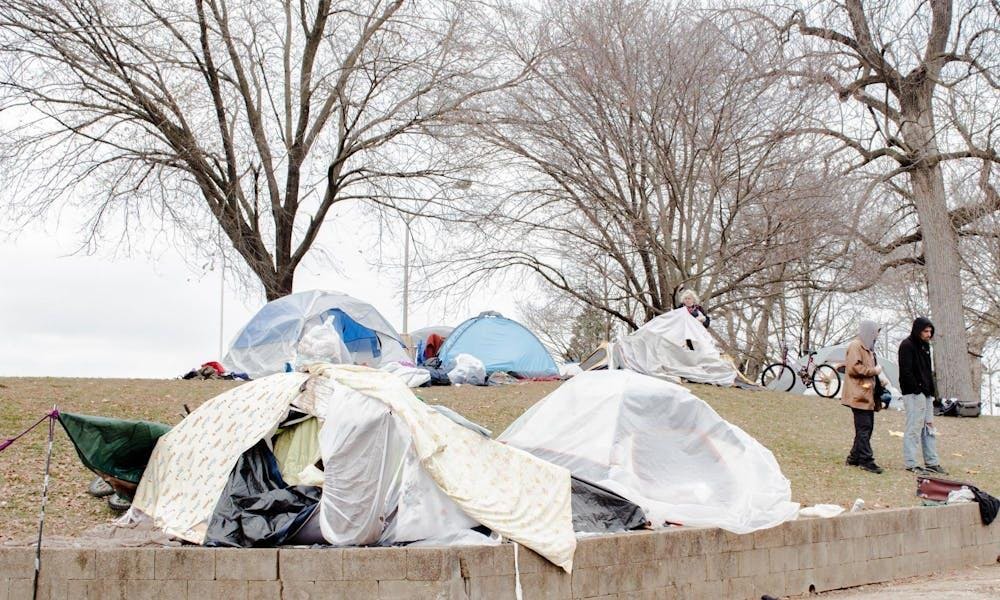
The U.S. Department of Housing and Urban Development awards more than $3.5 billion in grants each year to address homelessness. For the first time in over a decade, the criteria for funding are changing.
This could slash funding renewal protection for homelessness assistance programs by 60% by requiring annual reviews before renewal, according to the National Alliance to End Homelessness. Monroe County currently employs a “housing-first” approach to homelessness aid and response, but changes may require them to shift the strategy.
CoC is a federal program through the HUD that distributes funds to communities and nonprofit providers with the goal of ending homelessness. Its annual $3.5 billion budget is then dispersed throughout the country for states to address homelessness solutions within their respective regions. Indiana’s counties are divided into 14 regions, which independently decide how to allocate the funds. Region 10 includes Greene, Lawrence, Martin, Monroe, Morgan and Owen counties.
HUD released its annual Notice of Funding Opportunity last month. NOFO is a document which details grant opportunities and the requirements to earn the funds. This fiscal year’s NOFO funding award criteria shifted drastically from years past.
Eligibility criteria remained largely the same in recent years, Mary Hamric, the strategic partnerships director of Heading Home of South Central Indiana, said. The changes announced Nov. 13 are something providers are still trying to understand the effects of.
“A lot of it is unknown to us,” Hamric said. “It’s very new and kind of a different thing than we’ve seen in over a decade.”
Hamric said one of the biggest changes in the new NOFO is how grants are renewed. Grant funding under NOFO is split into two tiers. Tier 1 guarantees almost all projects’ renewal unless they had critical performance issues and was where 90% of CoC funding fell. Under the new guidelines, only 30% of grants are protected in Tier 1. The remaining grants will be subjected to merit reviews to earn renewal.
This means that if Monroe County’s CoC ranking falls, it could lose funding for programs that have operated uninterrupted for years.
The uncertainty of the future makes planning difficult, Hamric said.
“CoC funding is our backbone,” Hamric said. “It’s what keeps permanent supportive housing units open and what allows our outreach teams to exist.”
CoC has historically funded programs such as permanent supportive housing, rapid rehousing and outreach. Monroe County partners with Community Solutions — a national nonprofit which runs the Built for Zero movement. Built for Zero has the goal of finding an ethical and sustainable solution to homelessness and has been adopted by over 100 cities across the country.
In a press release Nov. 24 in response to HUD’s NOFO adjustments, Community Solutions said the current NOFO criteria will “compound” existing housing issues.
“Congress should direct HUD to renew all 2026 CoC grants for 12 months because keeping Americans safely housed matters more than bureaucratic timelines,” Rosanne Haggerty, Community Solution’s president, said in the release.
The new NOFO deprioritizes a housing-first mode, Hamric said. Housing-first is a model of homelessness response that emphasizes the importance of permanent housing as the solution to the issue, rather than focusing on less critical, more long-term issues first.
The new standards prioritize transitional housing, mandatory participation in on-site substance-use treatment and programs that enforce local camping bans — all of which Hamric said don’t follow a housing-first mentality.
“Things are not going to get better until their primary need of shelter or housing stability is met, right?” Hamric said.
Joseph Callahan is a Monroe County resident. He spoke at the county commissioners meeting Thursday, advocating for responses to homelessness within the community other than overnight shelters.
"I also would not go to a shelter,” he said while addressing the commissioners. “I'm obstinate as a mule. I want to do things on my own. I don't want to be a burden to others. And to be under someone else's rules is not something that everyone is prepared for.”
NOFO also states substance-use disorders no longer qualify as mental health conditions for permanent housing eligibility.
The NOFO said HUD may deny funding to organizations with public complaints, verified negative media attention or a history of subsidizing activities that “conflict with this NOFO.” Hamric doesn’t know how HUD will define or interpret those terms.
Hamric said providers within Monroe County are still reviewing over 100 pages of documents. They hope lobbying Congress will get 2026 funding approved regardless of NOFO requirements.
“We just don’t know yet what’s going to happen,” she said. “But we know it could fundamentally change how providers in Monroe County are able to do this work.”


