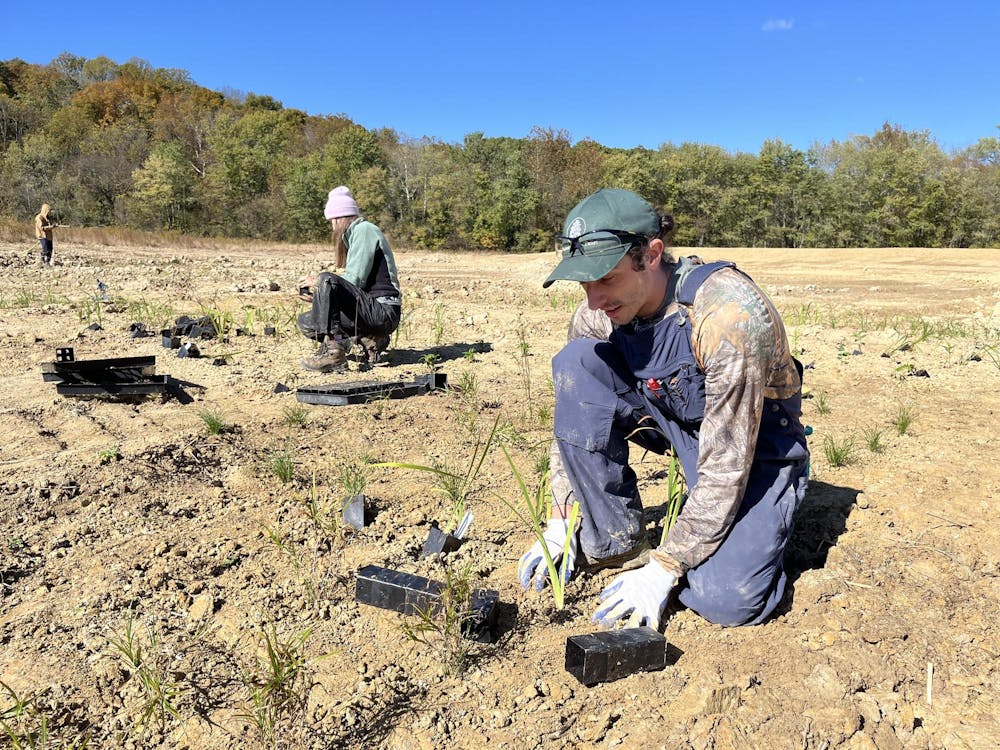
Sycamore Land Trust announced Oct. 24 it restored two wetlands near its Beanblossom Bottoms Nature Preserve about 10 miles north of Bloomington.
The restored areas will promote biodiversity and improve water quality, Tom Swinford, Sycamore Land Trust land preservation director, said.
The organization restores and protects nature across southern Indiana. It oversees 146 properties totaling 11,727 acres of land, where it facilitates habitat restoration, invasive plant removal and land stewardship.
Wetlands, or marshy habitats that form in frequently flooded areas, provide habitats for migratory birds and aquatic animals. Wetlands also control flooding, restore groundwater reserves and improve water quality by slowing the flow of water and allowing pollutants to settle in the soil.
Landowners or developers often remove wetlands to make room for construction or agriculture, and wetland habitats are rapidly shrinking across the U.S. Indiana has lost 85% of its wetlands in the last 200 years, according to the Indiana Department of Environmental Management.
Wetlands connected to rivers and lakes are protected under the Clean Water Act. But in 2023, the Supreme Court ruled that wetlands not directly connected to above-ground bodies of water didn’t qualify for protection. In 2024, Indiana’s state legislature followed suit with a bill reducing the kinds of wetlands under full state protection.
Those decisions removed protections for wetlands without direct links to bodies of water, including habitats formed by groundwater, rainfall or snowfall.
Christopher Craft, a former IU professor and an expert on wetland habitats and restoration, said without legal protection, Indiana’s “isolated wetlands” are often removed to make room for corn and soybean crops.
Sycamore Land Trust’s new wetland habitats sit on the Oliver Preserve and the Dan Efroymson Preserve, part of its Sam Shine Foundation Preserve complex, near the Beanblossom Bottoms Nature Preserve.
The Beanblossom Bottoms Nature Preserve stretches across 824 acres of marshes and swampland along the floodplains of the White River. The area is home to bald eagles and several other endangered species. It has earned multiple recognitions from national environmental agencies or organizations for its importance to local biodiversity.
Before Sycamore Land Trust acquired its Oliver Preserve and Sam Shine Foundation Preserve complex, Swinford said parts of the land were used for agriculture, including growing corn and raising cattle. People dug ditches to funnel water toward the creek, preventing it from pooling and creating a wetland.
To restore the wetland habitat, Sycamore Land Trust filled in the ditches and hired contractors to dig out a shallow basin. The land stewardship team planted all 10,000 trees by hand with help from a tractor borrowed from The Nature Conservancy, an environmental nonprofit.
By removing some of the soil used for agriculture, Swinford said they decreased the elevation of the area, allowing groundwater to drain into the basin.
They planted native trees suited to the wetland habitat, including oaks and sycamores, around the wetland at Oliver Preserve.
Land Stewardship Assistant Gabriel Wahl and Sycamore Land Trust’s land stewardship team used a specialized drill called an auger to lay out grids of holes 2-3 inches deep on the dug-up land. Then they planted 2,200 “plugs,” or tiny seedlings grown in small balls of dirt.
The seedlings were native plants suited for marshy habitats, like rushes or sedges.
Over the next few years, as rain starts to saturate the wetland, Swinford said those plants and trees should grow and spread across the area.
“You know, the thing they say about tree plantings, of course, is ‘first year they sleep, second year they creep along, then the third they will leap,’” Swinford said. “Everybody likes that.”
Earlier this year, Wahl left the U.S. Navy to pursue his master’s degree in environmental policy and natural resource management at IU. He said he’s always wanted to work in nature, and helping to restore the wetland at the Oliver Preserve felt like the fulfillment of that dream.
“Constructing wetlands that are going to benefit the local area for us, like, humans, but also the biodiversity of wildlife and vegetation, and seeing that kind of in-real-time change, is something really, that is really impactful on me,” Wahl said.
Wahl said he also looks forward to seeing the wetlands develop into habitats that promote biodiversity.
In 2022 and 2023, Sycamore Land Trust completed two different wetland restoration projects at its Sam Shine Foundation Preserve complex. The area has attracted river otters, migratory birds, beavers and endangered Kirtland’s snakes.
Swinford said restoring the wetlands around Beanblossom Bottoms Nature Preserve should increase habitat for a host of animals, from snakes and turtles to bald eagles, and provide an area for endangered bats that live nearby to forage.
“There's going to be all kinds of animals coming through this area, and they will then call this place home too and help it, you know, become a thriving wetland,” Wahl said.
CORRECTION: This story has been updated to include correct information on tree plantings, location description and naming.