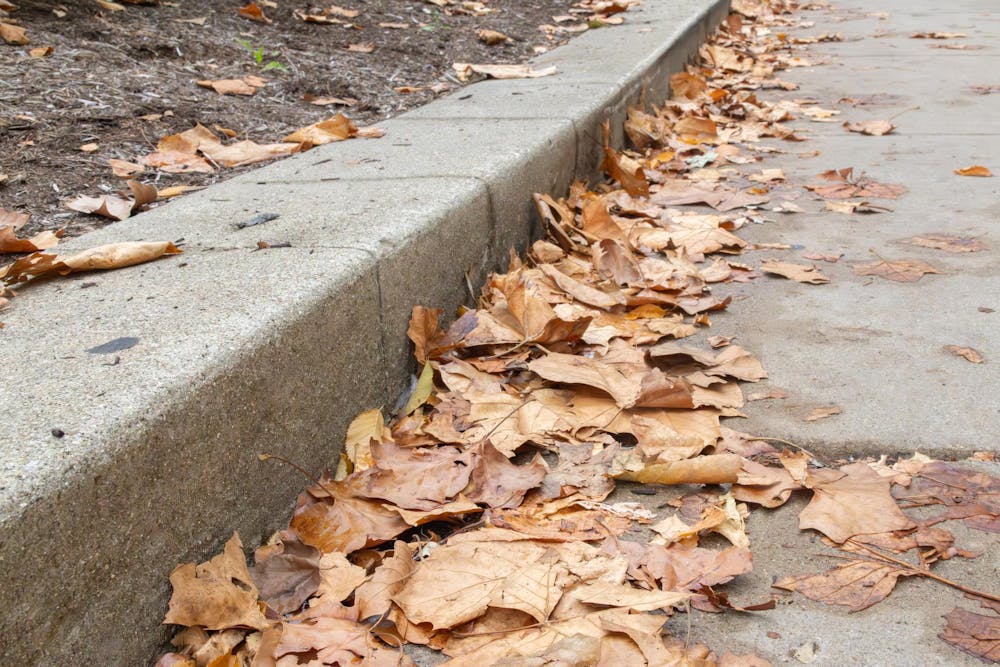
Bloomington's autumn foliage is predicted to reach peak fall colors in early November this year, and residents will need to rake, mulch or compost their leaves.
Nate Nickel with Bloomington Public Works said if they don’t, leaves could clog the storm drains and cause flooding. That poses a safety threat, especially in winter.
“It freezes, and the streets are a mess, and the sidewalks are dangerous,” Nickel said.
The City of Bloomington stopped offering curbside vacuum collection for fall leaves in 2023.
Nickel said the city council ended the service after extensive discussion and resident input, saving money on staffing and equipment and decreasing the climate impact from collection trucks.
“It really came down to the greenhouse gas emissions, the negative climate effects that vacuum leaf collection had, as far as sending heavy vehicles out and performing that task,” Nickel said.
Now, homeowners or renters who choose to rake their leaves will need to rake them into a container to leave on the curb, Nickel said.
The City of Bloomington collects yard waste every other week from April to November, and every week of November and December.
Yard waste, or vegetative matter from landscaping maintenance or clearing projects, should weigh less than 40 pounds and must be in plastic or metal containers or brown paper bags.
Lazarus Sears, director of Bloomington Sanitation, said these can be obtained from grocery stores, hardware stores or at the Sanitation Division at 3406 S. Walnut St.
Residents can also purchase optional 64-gallon yard waste carts from the Sanitation Division to dispose of their yard waste. These $70 containers use the same design as a recycling or trash cart.
Leaf pickup costs $1 per container most of the year but is free in November and December. Sears said the cost will be charged to residents’ utility bills.
Sears said residents with mobility issues can qualify for a “flag stop,” which allows them to put yard waste out for pickup next to their house, instead of at the curb. To apply, residents should contact the Sanitation Division and call 812-349-3443.
Nickel and Sears recommended using leaves in mulch or compost.
Leaves can be incorporated in mulching by shredding them with a lawn mower or leaf shredder and spreading them across a yard or garden. The mulch cover controls the moisture of a yard, and as leaves break down, their nutrients return to the soil. This can feed plants and improve their growth, according to the City of Bloomington’s resources on mulching and composting.
Compost is created by placing leaves or other organic waste in a bin exposed to the soil and on flat ground. The materials inside will eventually break down into a nutrient rich fertilizer.
According to Bloomington municipal code, compost piles must be at or below six feet tall and enclosed at ground level to avoid attracting rodents.
Retired tree farmer Ray Major lives in Bloomington’s Eastside neighborhood, where he keeps a fenced-in circular garden plot and about 25 saplings in cages.
Every fall, he and his son Eli Major, a naturalist with the Indiana Department of Natural Resources, take his truck and pick up bagged leaves left out by their neighbors. Now his garden is fertilized almost entirely by leaves and grass clippings.
“It grew a couple bushels of tomatoes and 15 or 20 big winter squashes and okra and peppers and onions and garlic and all kinds of food,” Ray said.
Ray said homeowners can improve their gardens or plant beds by working leaves into the soil. The soil will absorb more nutrients over time, and after a year, Eli said the soil will be healthier than soil sold in many gardening stores.
Ray said he'd like to see more people get involved in gardening, and more gardeners to use their leaves or organic waste in compost.
“There’s only one vegetable garden in the whole street and that is mine, and I don’t get a gold star, I just get tomatoes,” Ray said. “So that would be my pie in the sky solution for leaf problems.”