
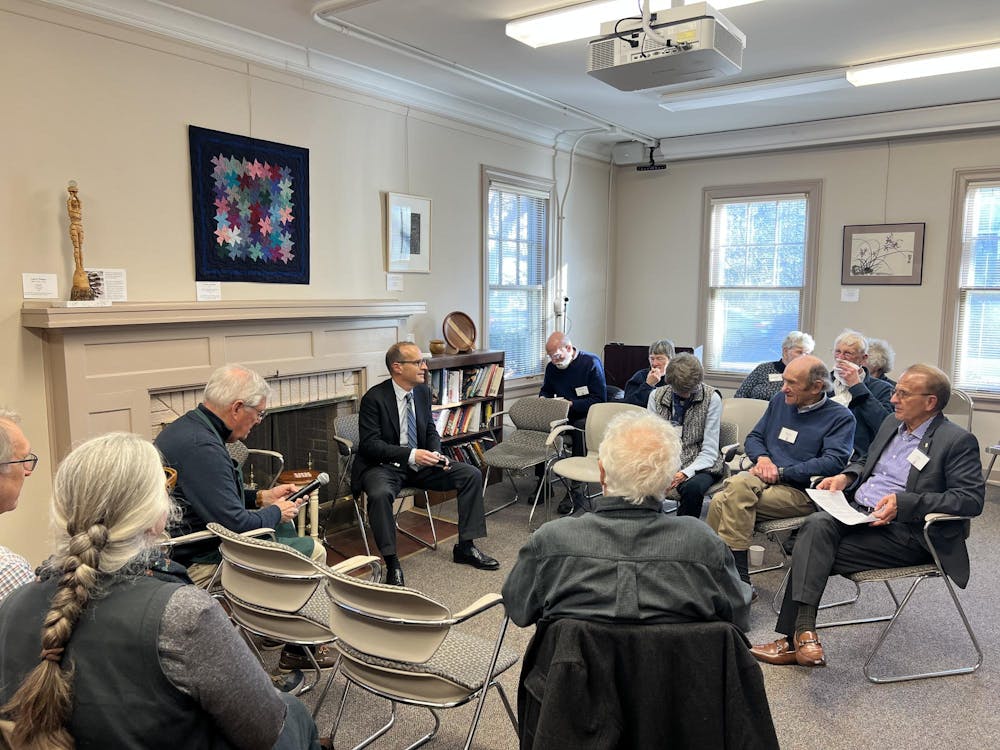
About 15 Indiana University professors emeriti met with IU Bloomington Chancellor David Reingold on Wednesday to discuss their concerns about emeriti rights, faculty governance and academic freedom.
Reingold opened the discussion, which took place at the Emeriti House, by talking about his weekly meetings with faculty to familiarize himself during his first semester as chancellor. Reingold started his role in June.
He said he is optimistic about seeing the meeting attendees’ commitment to the university.
“I keep telling people, everybody within it (the university) runs it,” Reingold said. “We all are the ones that, sort of, are the guardians of it, the holders of it, anyway. So, I've walked away from all those lunches feeling quite optimistic that the spirit is strong.”
Provost Rahul Shrivastav also attended the meeting, arriving about halfway through the conversation, which ran for over an hour. Shrivastav did not speak to the group.
Several emeriti, including Emeritus Professor of Physics Steven Gottlieb, did not share Reingold’s initial enthusiasm and immediately questioned the chancellor’s statement about who runs the university.
“How can you make that statement when everything is being done to end shared governance?” Gottlieb said.
In June, the Board of Trustees passed BOT-19, which states only employed members of the university can participate in votes and faculty governance. Language in Indiana Code, established by the state budget bill, prohibits emeriti from voting on faculty governance.
Emeriti are retired professors who are granted the title for significant contributions to the university but are not employed by the university. Three emeritus faculty are suing to challenge these prohibitions on participating in faculty governance.
Reingold said that despite Indiana law prohibiting emeriti from voting on university policy, he feels the “day-to-day” efforts of the university are still “in the hands of the faculty.” He listed hiring, promotion and tenure decisions and class development as some of these day-to-day examples.
Bob Arnove, chancellor’s professor emeritus of education, and Bruce Jaffee, emeritus professor of business economics and public policy, continued to press the chancellor on shared governance, directly asking the chancellor if he would support the Bloomington Faculty Council’s resolution from Sept. 23 that asked the Board of Trustees to restore emeriti participation and voting rights in faculty governance. Jaffee also criticized the language in the state budget bill for being “fuzzy.”
“Are you going to support the resolution to the trustees to overturn their policy?” Jaffee asked. “Not the legislation that might be fuzzy, the black-and-white trustee thing that killed participation on committees by merit.”
Reingold said IU’s general counsel interpreted the BFC’s resolution in such a way that it would be illegal for the trustees to support it.
“If the trustees were to follow that resolution, they would essentially be saying that we are not going to be following the law,” Reingold said.
Scott Sanders, emeritus professor of English, spoke to Reingold on the greater context of faculty-administration relations under President Pamela Whitten, telling the chancellor “you've heard this before, but I think you need to hear it often.”
He said he and other faculty think the administration has demonstrated a pattern of attempting to control faculty and influence research away from topics that the administration and Republican state and federal legislature might find inappropriate. He pointed to studies on climate, racial history and gender issues as examples. He also said this pattern has spurred fear among faculty.
Sanders said he thinks the administration is “trying to turn faculty into malleable, controllable, non-independent thinkers.”
Despite intense questioning and conversation, the discussion ended with a round of applause for Reingold. The attendees lingered afterward to chat with the chancellor. Several emeriti said they are empathic for Reingold’s position and grateful to him for participating in events like Wednesday’s.
“I don't envy him, the position he's in, but I'm glad that he is in it, because I was persuaded by what he said today, that he understands what's at stake,” Sanders said after the discussion. “It doesn't mean he can guarantee that he can defend it, but that's what — he knows what's worth defending.”
Jaffee echoed a similar sentiment, although he was unsatisfied with the chancellor’s position on the BFC’s resolution. He said he felt the chancellor’s efforts to listen with discussion and Q&A events are “very positive,” despite differing opinions on how administration has handled shared governance issues.
Not all attendees were moved by the chancellor’s words. Emeritus Professor of Operations and Decision Technologies Wayne Winston, the husband of former trustee Vivian Winston, criticized the length of Reingold’s answers. Indiana Gov. Mike Braun removed Winston and two other alumni-elected trustees from the board this summer after language in the budget bill gave him more authority over the board.
“He gives a 10-minute answer to a one-minute question so he doesn’t have to answer many,” Winston said.
Arnove had similarly fiery comments on the administration’s actions and Reingold’s answers, saying faculty’s serious concerns have not been adequately answered. He pointed to the perceived lack of safety felt among tenured professors and mentioned faculty’s thoughts of leaving the university.
“It's taken this administration, in two years to seriously dismantle 200 years of efforts to have an international, be prominent, research one university,” he said. “And we've seen it before our very eyes being destroyed.”


