
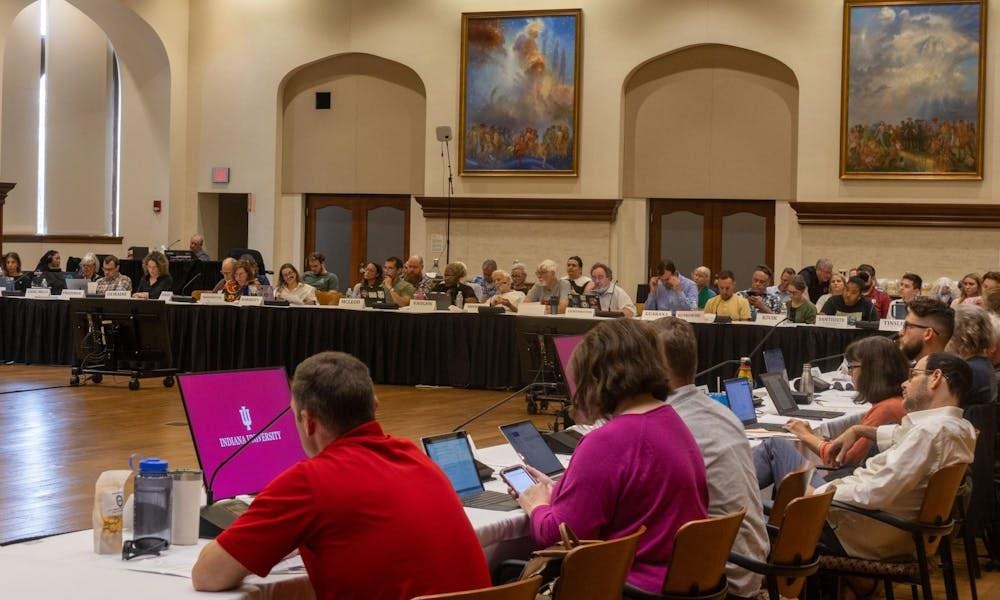
The Bloomington Faculty Council passed a resolution supporting emeritus faculty rights and discussed tenured faculty review during its first meeting of the semester Tuesday.
The resolution supports three Indiana University emeritus professors’ lawsuit against a Board of Trustees policy which prevents retired faculty from voting on faculty governance issues and from serving on any committee or task force related to faculty governance.
Prior to the passing of the BOT’s June 12 policy, BOT-19, language in the state legislature’s May 6 budget bill, House Enrolled Act 1001, prohibited emeriti, retired professors who are granted the title for their significant contributions to the university, from voting on faculty governance.
Maurer School of Law Professor Jeffrey Stake expressed his disapproval of the policy during the open discussion section, claiming that BOT-19 discourages retirement and tells emeritus professors they don’t count.
“(Retired faculty) work to build a community of scholars, and now they're ostracized, banished,” Stake said. “What a waste of resources, decades of understanding of IU and experience with what works and what doesn't, and knowledge of how the faculty responds and doesn't to given initiatives.”
Stake ended his speech by warning academics of the policy and academic climate at IU and received applause from the crowd.
“The ostracism message says, if you want to devote your career or your life to the university, don't do it here,” Stake said. “If you're already here and you care, never retire, because you will become one of them.”
Professor Emeritus of Psychological and Brain Sciences Steven Sherman is one of the plaintiffs named in the lawsuit against BOT-19 and attended the meeting with over 15 other faculty emeritus, who sat in the public section.
“This isn’t about winning or losing because as the present stands, the university loses,” Sherman said in an interview. “And to eliminate emeriti from contributing in the many ways that they do is just wrong and I hope they get it.”
The BFC resolution also calls on the trustees to revoke the policy and “restore participation and voting rights to emeriti faculty for the good of the university community.” The emeriti in attendance stood up to a round of applause when the motion passed.
“(My department) is dependent upon our emeritus faculty,” David McDonald, BFC member and professor in the folklore and ethnomusicology department, said. “My department, for one, is losing out a huge labor resource for mentorship and advising for our students, stewarding them through the graduate school classes.”
Along with BOT-19, several other state bills and BOT policies came under scrutiny at the faculty council meeting.
A Monroe County judge denied the retired professors’ motion for a preliminary injunction Sunday. The preliminary injunction would have allowed Sherman and fellow plaintiff Maurer Professor Emeritus Alex Tanford to continue serving as retired faculty representatives on the council.
Trustees policy BOT-24, passed June 12 in order to align with the state legislature’s bill, establishes a post-tenure review system within five years of tenure being granted and every five years after that. The review judges faculty across three categories: teaching, scholarship and service. The default workload allocation for the Bloomington campus is 40% teaching, 40% scholarship and 20% service.
Tenured faculty will also be reviewed based on their “productivity,” including teaching workload, number of students taught, time spent on assignments, oversight of graduate students and research and creative scholarly productivity. Faculty will then receive a performance rating on a scale of four categories, from “Unsatisfactory productivity” to “Exceeds productivity expectations.”
The policy outlines up to a year of performance plans and probation for faculty in the lower two categories, which may result in termination if expectations are not met after the plan. Spring 2026 will constitute the first year with the policy in place. According to the policy, the first group to be evaluated are the 20% of faculty who’ve had tenure the longest. Faculty who have had tenure for the prior five years will also be among the first evaluated.
Vice Provost for Faculty and Academic Affairs Carrie Docherty said at the meeting Tuesday that the new post-tenure review policy would be a positive for faculty as their research changes throughout their career.
“We do different things, we focus in different areas, and that's why, in many ways, this workload expectation is incredibly important.” Docherty said. “So as our career evolves, what are the things that we are focused on, and are we meeting those identified expectations?”
Faculty will meet with their department head to discuss the performance plan before the plan is ultimately finalized by Provost Rahul Shrivastav and Chancellor David Reingold. The provost will have final say in dismissal matters with faculty who fail to meet their performance plan goals. Faculty have an opportunity to appeal with the Faculty Board of Review.
“I think it is critically important we are not going back and redeciding if we all would have received tenure again,” Docherty said.
CORRECTION: This article has been updated to correct a quote from professor Jeffrey Stake. This article has also been updated to correct the date that BOT-24 was passed.


