Ideally, co-director and producer Michelle Hernandez and her team — including two IU alumni who grew up in Zionsville— would have had a year and a half to make their short film “Things You Know But Cannot Explain.” Instead, they had about five months.
The short film, a stop-motion animation piece centered around Wiyot tribe artist, and honorary uncle to Hernandez, Rick Bartow, is being featured on AMC+’s “Future of Film: Indigenous Voices” series until Dec. 15.
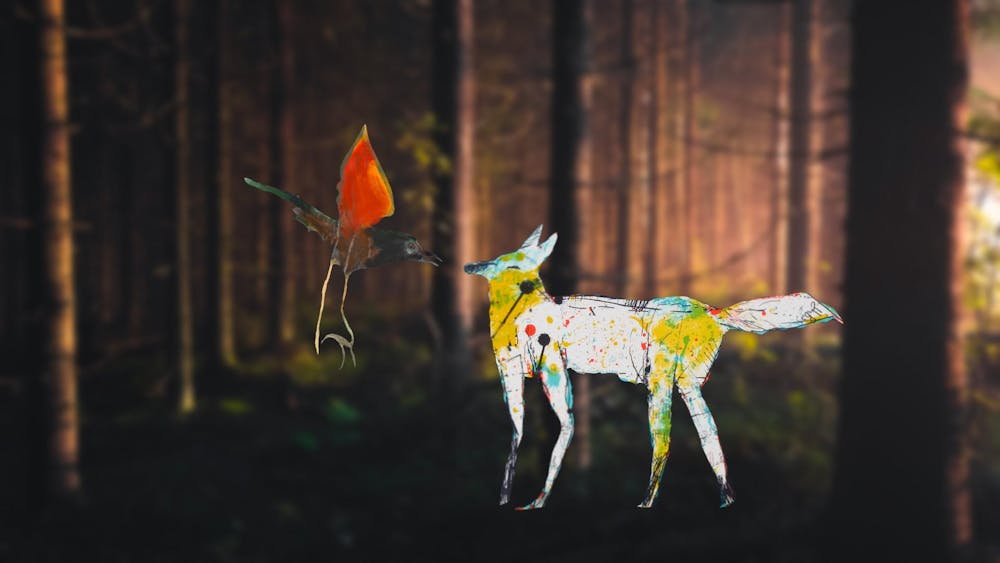
Bartow, who died in 2016, often worked with pastel and graphite to create his signature large drawings. He also painted, sculpted and made prints. Many of his works depict surrealist human and animal figures. According to Bartow’s website, which is maintained by the Richard Bartow Trust, his work is featured in more than 100 public and museum collections.
“Things You Know But Cannot Explain” traces Bartow’s journey of coming to embrace his Indigenous heritage — Hernandez said that Bartow first thought his heritage was Yurok rather than Wiyot. The short film is narrated in the Wiyot language, Soulatluk.
Hernandez’s team had such a tight turnaround because the film came out of a repurposed theater grant that Zuzka Sabata, the film’s co-artistic director alongside Hernandez, received before the pandemic. Sabata and Hernandez rewrote the grant and conceived of a series of four films about Bartow.
Hernandez said Bartow’s diverse styles inspired the stop-motion nature of “Things You Know But Cannot Explain.”
“I think it's just really amazing to see different artworks come together and make something,” Hernandez said. “And so, I was like, ‘How do we bring this to life?’ Bring it to on the screen and respect his artwork, as well. And so, I think stop-motion animation was the way we wanted to go about it. And then we also realized we kind of made the storybook kind of aspect to it. And so, when you watch it, it's like a storybook come to life.”
Chris Burrus, a 2019 graduate of IU’s master’s program in musicology, composed the music for the film. Burrus said he worked at the Eiteljorg Museum of American Indians and Western Art in Indianapolis, where Bartow had been a fellow, and remembered having seen Bartow’s work.
“I was just really tickled of the idea of trying to see how I could set this to music,” Burrus said. “And then when I learned that Rick Bartow was himself a musician, that just kind of opened up this whole extra component of figuring out how to how to engage with him and his artistic identity because I had already found his work so moving, but then there was also this idea that he had a identity as a musician, as well.”
Hernandez and her team combed through hundreds of archived versions of Bartow’s artwork to narrow down the list of what they’d use in the film, she said.
Many of Bartow’s works, Hernandez said, reflected the horrors he witnessed serving during the Vietnam War and the history of the Wiyot tribe, which Hernandez is part of, as well.
“When you have kind of this dark history from growing up, to learning about your history and culture, you find ways to deal with that PTSD and deal with that trauma,” Hernandez said. “But I also have noticed that his images even got more livelier, as you see that he's, like, healing from it. And I love that aspect of using art to heal yourself. And I also love that he incorporated every part of him in each piece and what he saw in nature.”
Richie Wenzler, a 2012 IU graduate, served as the film’s editor. He and Hernandez run Sugarbush Hill Productions, the company that produced the short film. He described his role as making sure that the animation flowed from one image to another.
“Like it was like hundreds of images and try to figure out, like, ‘What was the right speed and the right tempo to make sure that everything flow naturally from, from one piece to the other?’” Wenzler said.
Hernandez talked about Bartow’s reclamation of his Indigenous identity within the growing revitalization of Wiyot culture and language. The Wiyot tribe, according to their website, has 600 members. They are native to the Humboldt Bay area of northern California.
She described the tribe’s traditions as sleeping, not lost, and said the younger generations are waking them up. She said she wants people to know that Indigenous cultures are still alive and present. The use of Soulatluk in the film is one example.
“Something that I've heard growing up was when I would tell people I was native, they're like, ‘Oh, you guys are still around?’” Hernandez said. “And I want people to realize, yeah, we're still present. We're still here, we're still making artwork. We're still living our culture and our identity. And we're speaking our language.”