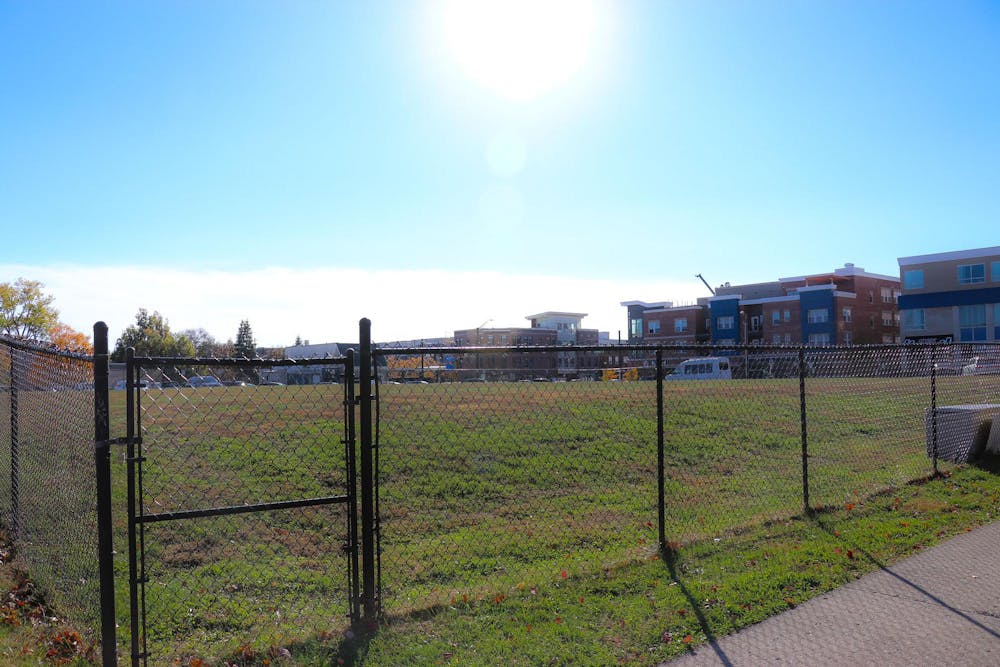
Fourteen years ago, the sound of mail trucks and conveyor belts echoed from the Bloomington Main Post Office — once housed on land now owned by First United Methodist Church off Fourth Street. Today, the industrial noises have been replaced by open air, green grass and the laughter of children playing behind a low wire fence.
In a downtown area surrounded by bustling restaurants, shops and bars, the church’s lot at 206 E. Fourth St. stands out for what it isn’t: developed. The post office that once occupied the block was demolished in 2013, and within a year, the area was graded, seeded and fenced to create a safe open space. Church leaders at the time wanted to erect a structure there, but more than a decade later, the land remains a mix of asphalt and grass — an intentional choice by church leaders.
“We constantly have internal conversations as a church, because we do that with our building as well,” FUMC Pastor Lisa Schubert Nowling said. “You have to be thinking about the assets that you have and how they might be used in our case for ministry in the larger community of Bloomington.”
Those conversations, she said, aren’t tied to any immediate development plans, but reflect the church’s ongoing effort to dream responsibly about its property and purpose. Since the pandemic, FUMC has gradually returned to discussions about how its downtown presence can best serve both its congregation and the community, from its preschool partnerships to outreach events on the green space.
According to church historian Arlen Packard, the former downtown post office was built in 1959 and long owned by Indianapolis-based F.A. Wilhelm Construction, which leased the facility to the U.S. Postal Service for decades. The church later acquired the property from F.A. Wilhelm Construction in 2000 and continued managing the USPS lease for the following decade. Packard said the primary motivation for the purchase was to secure much-needed parking space.
“One of the big reasons we purchased it, was for the parking, because without that, we literally had no parking, you know, a little place behind the church that maybe holds about eight cars,” Packard said.
When the postal service vacated the building in 2011 and moved to new locations on South Walnut Street and East 10th Street, the site sat empty for about two years before FUMC contracted Phoenix Demolition in 2013. After demolition, the church leveled and seeded the lot and later added fencing.
What began as a cleared post-industrial parcel soon evolved into a green space integrated into the church’s ministry and community outreach. For FUMC, leaving the lot undeveloped reflects a broader philosophy of stewardship — using land as a resource for community, not just construction.
“We also use it, not just for the parking possibilities, but as an outpost for ministry — for some of our community partnerships and the organizations that share space here at the church,” Nowling said.
On weekdays, the South Central Community Action Program’s Head Start — a preschool that rents space inside the church four days a week — uses the field for outdoor play. Local nonprofits use the open space for outreach, gatherings and celebrations.
Beacon Inc., a Bloomington nonprofit combatting homelessness, hosted its seventh annual Solidarity Sleepout on the field in June. Another organization, New Hope for Families, which offers shelter and early childhood education for parents and children in transition, has also used the space for outdoor gatherings and family-centered fundraisers.
Meanwhile, Exodus Refugee Immigration, a statewide resettlement agency with a Bloomington office located within FUMC organizes soccer games on the grass, bringing together congregation members, which Nowling said brings vibrant ministry to the church.
“It's people of all ages and stages, and it's a really beautiful moment in our life together,” Nowling said. “So, in that way, we're holding fast to that value.”
The green space has also supported other congregations in need. After a fire damaged the front area of First Christian Church in October, FUMC opened its space so volunteers could continue distributing breakfasts to the community.
Meanwhile, the asphalt section fulfills its original purpose: the church partners with FlexePark, a parking service, to make spaces available during downtown events like Pridefest, the Fourth Street Festival and IU football weekends.
Nowling said the partnerships reflect FUMC’s wider mission of hospitality and outreach.
“Even if those organizations themselves would not consider themselves to be religiously affiliated, we believe that the spirit is working in all of those opportunities to serve and to engage and to offer hospitality in Bloomington,” Nowling said.
The church handles mowing, snow removal and general upkeep, recently repaving the asphalt lot to improve safety and appearance. Revenue from FlexePark helps offset those costs.
Still, as Bloomington grows, the church faces questions over leaving downtown land undeveloped.
Eric Greulich, development manager of Bloomington’s Planning and Transportation department, said no development plans have been submitted for the site.
Nowling said that misconceptions persist — that the church is waiting for a developer to buy the land. In reality, the lot remains an active part of FUMC’s ministry.
“In the meantime, I just want people to know that we value that space and that we hope people will see how we are using it for some really vital ministries that are part of this church,” she said. “And even if you drive by and don’t see anybody in the green space, know that it is used often.”