Editor's note: All opinions, columns and letters reflect the views of the individual writer and not necessarily those of the IDS or its staffers.
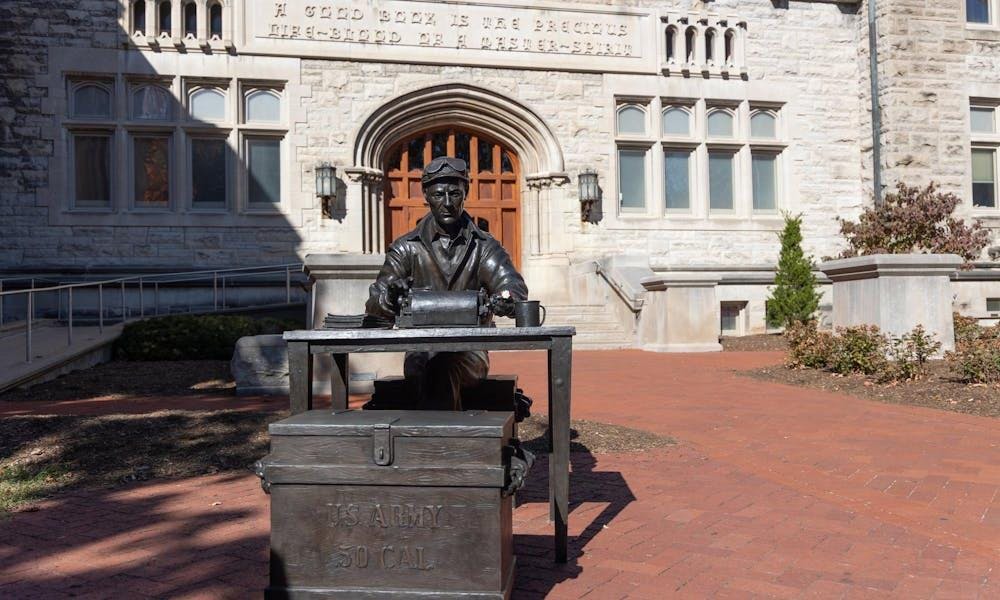
Out in front of IU’s Franklin Hall, the current home of the Indiana Daily Student, sits a statue of Ernie Pyle, the famous native of tiny Dana, Ind., who gave his life far from home for the cause of journalism and the public’s right to know as a correspondent in World War II.
Ernie — I can’t just call him Pyle, having once sat for a semester at his rolltop desk in the Journalism building bearing his name — died from machine gun fire on the island of Iejimain April 1945.
He was then the world’s most celebrated war reporter. He wrote not of generals but of what were called “dogfaces,” mostly young kids who signed up for war and who died by the thousands. Ernie sent home dispatches that were printed in as many as 700 newspapers, not so much breaking news but instead timeless accounts of what life was really like under fire and in foxholes.
Ernie’s statue has been reposed in front of Franklin Hall — facing south, within view of Bryan Hall, where IU’s highest-ranking administrators work — since 2014.
These days, I fully expect tears to be rolling down Ernie’s cheeks.
That’s because of the assault perpetrated on IU student journalists, on the 158-year-old Indiana Daily Student (which Ernie once edited), on student press freedom (affirmed in several federal court cases) and on the very First Amendment that journalism upholds and practices.
Last week, the director of student media was egregiously fired, apparently for pushing back toward a never-been-a-real-journalist dean, his cabal and a clueless and retributive central administration. The media director, Jim Rodenbush, raised reasonable objections, by accounts I have heard and read, with the dean’s master plan — the kind of plan that thrills academicians and theorists with how neatly everything fits into boxes on an org chart and “solves” issues, no matter how practically unworkable and disagreeable parts of the plan may be.
Worse than firing the student media director is that the student editors were ordered — ordered — not to print real news stories and columns in a scheduled Oct. 16 print edition. Instead, they were to reserve that print issue for Homecoming content only. The students had planned, as in past practice, a real news section wrapped around a Homecoming section inside.
Those are the same students — led this semester by co-editors-in-chief Mia Hilkowitz and Andrew Miller, already accomplished journalists — who have been empowered by federal court cases, by the IDS charter and by decades of understandings and agreements (including from previous IU presidents and journalism school leaders who preceded The Media School).
When the students refused to remove those non-Homecoming stories from the issue, Bryan Hall, specifically David A. Reingold, a chancellor just more than four months into his job, ordered the Media School dean to instruct the student media director to have the students leave out news. Rodenbush and the students, rightly, refused.
And so the administration ordered “Stop the presses,” a cry that traditionally comes only from a newspaper’s editors.
As it turned out, the issue was anything but objectionable. Go see that Oct. 16 issue online, the one with the gigantic headline “CENSORED” in red on the front page. That front page is an understandable and laudable response. But look inside that issue and you will find no objectionable content, just good journalism from a student’s point of view.
And you will see a 12-page Homecoming guide with such wild-eyed (I jest) content as: “Homecoming weekend event schedule;” “Homecoming through the years” (photo page); “Homecoming Court 2025” (photos and bios of 12 students); “A guide to Indiana's Homecoming parade;” “COLUMN: Where to find the best bison merchandise in Bloomington;” “Campus goes loco for hoco;” and “Welcome home!”
That content was intended for campus visitors and the IU community, but print readers never got to see that issue. If they didn’t venture online, they missed it completely because of the university’s strong-armed actions.
It’s a shame because that issue is a professional effort by some great students, better than most Indiana newspapers could have produced — bright, informed, fun, topical, varied.
Some of the bigwigs say the print issue was canceled as a business move.
Subterfuge, pure and simple. What kind of business is it that negates about $5,300 in ad revenue? Yep. If you look at the black boxes the students placed where ads were supposed to go in print, that's the money that was lost. When the master plan is to increase revenue for student publications, you throw away more than $5,000 in sales income? And censor at the same time?
The Media School’s plan to replace the journalism school and to remove that name from the school’s title was a loser, in the eyes of many journalism alumni, from the get-go, 11 years ago. But that’s history.
The future is that, among several other things, the place needs to be renamed quickly to something like the School of Journalism and Contemporary Media or at least the School of Contemporary Media and Journalism. Yes, journalism needs to be returned to the title!
Not only were student media and their director attacked by the administration’s actions, but also attacked was the reputation of the journalism being taught by some excellent professors in The Media School — as journalism has been taught there for more than a century.
The dean on Monday announced a task force on what is labeled as Editorial Independence and Financial Sustainability of the IDS and Student Media. It remains to be seen who is appointed to that task force and whether its recommendations will be listened to or put on the shelf and replaced by an administrator’s version.
Prime members of the task force should include several members of the journalism faculty, active and emeritus, to quickly produce a new study aimed at rescuing the school from the censors’ label and reestablishing the prominence of the study of accurate, fair, assertive, responsible, truthful journalism.
Nineteen journalism professors and over a dozen emeriti professors have signed strong letters condemning the administration’s actions and seeking — in the words of the First Amendment — redress of grievances.
In this process, the administration needs 1) to fess up to its completely wrongheaded actions, 2) reestablish a print function fully under the students’ control and 3) rehire Jim Rodenbush. I would call those the Ernie Pyle Accords.
If not, the name I will call it is The School of Controlled Media
Merv Hendricks is a 1973 IU Journalism graduate who was IDS editor-in-chief in spring 1972 and IDS assistant to the publisher, 1972-1975. He was for 24 years an editor at Indiana community newspapers and for 16 years director of student publications at Indiana State University.