
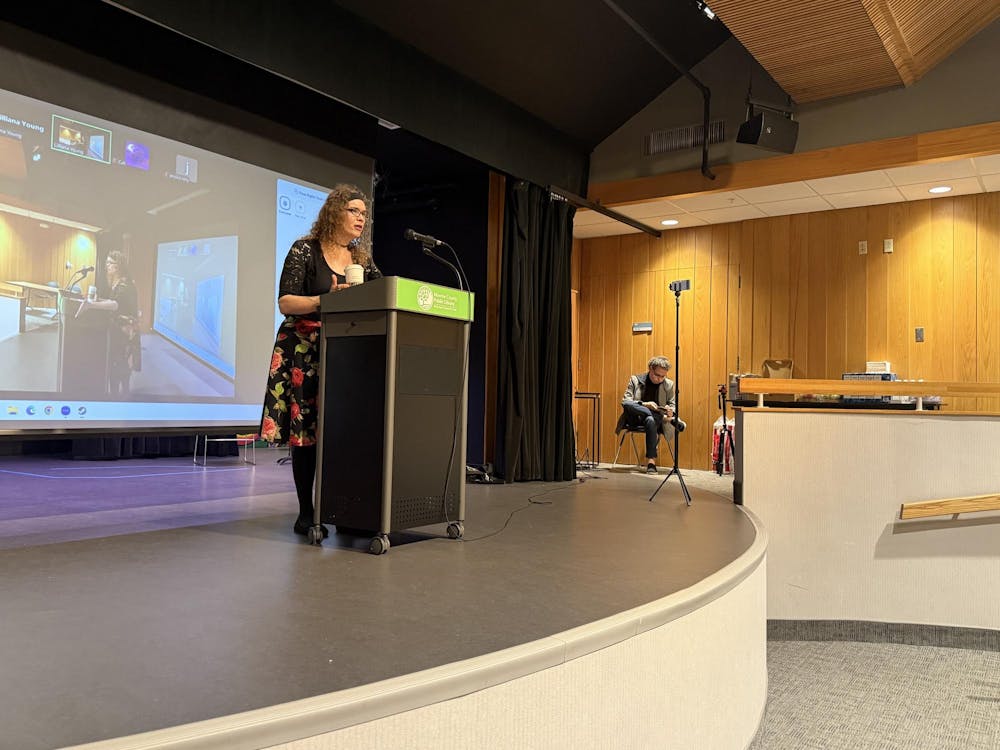
At a town hall Tuesday, Lilliana Young shared her plans to make Indiana a “better, safer and more welcoming place” for transgender Hoosiers — by challenging an incumbent.
Young is running against longtime Democratic State Rep. Matt Pierce for the District 61 seat, entering what is usually an uncontested race.
The town hall, which drew roughly 15 attendees, focused on transgender rights and issues within Indiana. Young, a transgender woman, shared personal experiences and heard from community members about challenges facing transgender citizens.
Young, a Democrat, announced her candidacy Sept. 21 for Indiana House District 61 in a post on BlueSky. The primary challenge is the first for Pierce in over a decade, who has held the seat for over 22 years and has not faced a primary or general election challenger since 2010.
Pierce first won election in 2002 and serves as a senior lecturer in The Media School at Indiana University. He won in his most recent reelection in November 2024 without opposition in either the primary or general election.
Young, 40, works as a hostess and busser at a restaurant in Bloomington. Originally from the Dallas area, she moved to Indiana a decade ago when her ex-wife, who is from Spencer, Indiana, wanted to relocate closer to her family after their daughter was born.
For the past year, Young has served as secretary of the Bloomington/Monroe County Human Rights Commission, appointed by Mayor Kerry Thomson. As a member of the commission, she participated in efforts surrounding Resolution 2024-14, also referred to as Bloomington’s Safe Haven Resolution, for gender affirming care to the City Council.
Passed in June 2024, Bloomington’s Resolution 2024-14 expressed the city's commitment to supporting access to gender-affirming healthcare within legal limits. This was in response to Senate Enrolled Act 480, passed by the Indiana General Assembly in 2023, which prohibits gender-affirming healthcare for transgender Hoosiers under 18.
Young said she began considering running for office around March and April, finalizing her decision in June. For the past five months, she has been taking classes from the National Democratic Training Committee and the Democratic Socialists of America on how to run and organize campaigns.
Young said her decision to run came from frustration with the current political landscape.
“I’m pissed off,” Young said in an interview. “Rather than just watching my political YouTube videos and being mad all day, I think I want to take that anger and channel it into something more serious and productive.”
Young aims to focus on six main issues during her campaign, including wage and worker’s rights, access to housing, access to health care, strengthening public education, accountability of government and human rights.
Another issue she hopes to address is transgender rights and access to gender-affirming care. As a transgender woman, these issues directly impact her own life.
“I want to see all of the anti-trans legislation in the state get repealed,” Young said. “I want to pursue codifying into the state constitution LGBTQ protections.”
According to data analyzed by the Williams Institute between 2021-23, 0.7% of the adult population in Indiana identified as transgender, which is around 37,300 people. In recent years, Indiana lawmakers have enacted legislation that directly targets transgender individuals, particularly surrounding sports.
House Enrolled Act 1041, which became law in May 2022, bans transgender girls from participating in girls’ K-12 school sports teams. Most recently, on March 4, 2025, Indiana Gov. Mike Braun signed two executive orders reinforcing prohibitions for transgender athletes in collegiate sports.
“I am not going to shy away from trans rights being a significant issue for me,” Young said. “It's not the only issue, but we are in kind of a political climate where a lot of Democrats are urging each other to be softer and quieter on that, and I refuse.”
Andy R., a non-binary attendee at Tuesday's town hall who asked to withhold their last name due to safety reasons, said Young’s willingness to openly advocate for transgender rights stands out in the current political climate.
“Most politicians are either throwing us under the bus or ignoring that we exist,” Andy said. “It would be kind of nice to see more people defending trans people.”
Andy said they were invited to the event by a friend, as they were both concerned about transgender rights. Andy said having a transgender candidate willing to be open about her identity, like Young, demonstrates courage.
“Inherently, just having a trans person being willing to come out and be open about it and be open about herself,” Andy said. “It shows a lot of bravery.”
Young identified housing as her top priority if elected, proposing to legalize rent freezes, build public housing and fine landlords for vacant properties. She plans to introduce legislation to implement these policies, viewing them as essential first steps to addressing Indiana’s homelessness crisis.
Drawing from personal experience, Young said her economic circumstances shape her policy priorities. She said she and her wife both work service jobs, live on the poverty line, receive Medicaid and face constant anxiety about making rent each month.
“The first and best solution to that is simply build low-cost housing units and give people a place to live,” Young said. “There’s no reason why we should have a single vacant house or apartment in this entire state when as many people need a place to live as they do.”
Young’s challenge centers partly on Pierce’s approach to representation.
“Matt Pierce has squandered his position,” Young said. “He’s the incumbent of the safest blue district in the state, and there’s this myth that being a minority party means you can’t really get things done because you’re at the whims of the majority party.”
Young said Pierce could use his safe seat to campaign for Democrats in competitive districts, hold press conferences highlighting problems in state government or criticize Republican legislation more forcefully.
Young emphasized accessibility to voters and described her political approach as intentionally disruptive. She said she makes time to speak with anyone interested in her campaign and encourages constituents to reach out directly.
The Democratic primary election will take place May 5, 2026.
“The status quo has got to be shaken up,” Young said. “And I think that I can be good at that.”
CORRECTION: This story has been updated to clarify Young and her wife share the same economic circumstances.

