
Editor's note: All opinions, columns and letters reflect the views of the individual writer and not necessarily those of the IDS or its staffers.
No positive change has happened at IU from the top down in the past three years. Even as the Board of Trustees and president congratulate each other for their outstanding accomplishments, we, the faculty — those who make this an institution of higher learning and knowledge-production — need to stand with our students, staff and alumni to remind the administration and our state representatives that we are the ones who make IU an outstanding university.
The thousands of students who graduate every May go through our classrooms and labs, learning lifelong skills that will lead them to many professional pursuits, including service in the Indiana legislature. Our alumni span the globe, contributing to many different economic, social and cultural endeavors, with their IU classroom experiences as the foundation for making Indiana and the world better.
Protecting freedom of expression on campus and academic freedom in the classroom were chief principles of past university leadership. They were the cornerstone of teaching and learning, as well as research and innovation. That is why, in the face of an unconstitutional rule (UA-10) passed last July by the IU higher administration with little real faculty input, a group of faculty decided it was time to defend our university's core values.
UA-10, now BOT-33, is the expressive activity policy covering the entire university. From Aug. 1, 2024, to Nov. 15, 2024, the policy did not allow any form of expressive activity between 11 p.m. and 6 a.m. — with no explicit exemptions for peaceful, normal activities protected under the First Amendment, like talking with a group of friends after a late basketball game. At a Board of Trustees meeting on Nov. 15, 2024, those restrictions were eased a bit but still forbade protesting, making speeches, and circulating petitions. (There are other parts of the rule that have not been challenged, including a restriction against expressive activity happening less than 25 feet from any building entrance.)
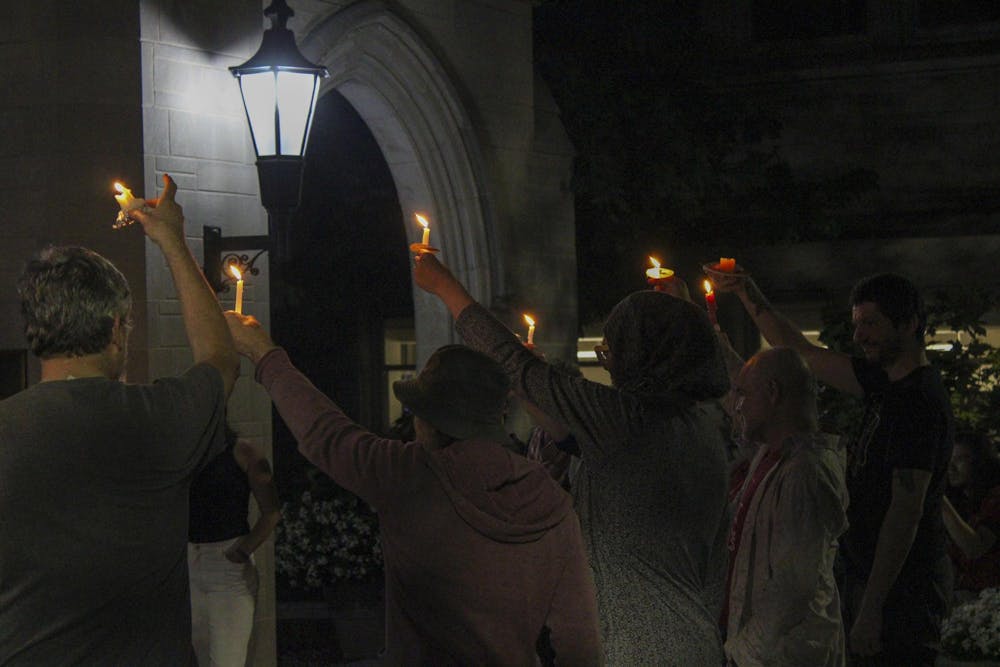
A handful of faculty suggested a peaceful candlelight vigil to protest the policy and mourn the start of a new academic year under such restrictions. A few dozen of us responded the day before the fall semester began. For 12 weeks, students, faculty, staff and alumni assembled every Sunday at 11 p.m. at the Sample Gates. Eventually, at least 13 of us (mostly faculty) received formal letters of reprimand. The provost and deans warned us that additional violations would likely result in dismissal.
Some were disciplined because IU Superintendent for Public Safety Ben Hunter and his staff could easily identify them based on previous protest activities and their physical presentation — race, gender and religion. Others self-reported in solidarity and outrage at the shameless profiling. Yet we persisted. Afraid, joyful and angry, we were held together by the shared conviction that what we were doing was right and that standing up for free speech at IU was worth the professional risk. We had faith we would prevail.
All administrators above the level of chair played along with these unconstitutional rules, even when they acknowledged the evident injustice. Some faculty being reprimanded were encouraged to speak truth to power, with verbal (but never written) winks of solidarity.
And then things started to change. In response to an American Civil Liberties Union lawsuit that included several curfew breakers, a judge issued an injunction instructing IU to stop enforcing the "likely unconstitutional" policy. In his ruling, Federal Judge Richard Young ruled that, “[UA-10] likely burdens substantially more speech than necessary to further the University’s interest in public safety,” and that the protesting faculty “are likely to succeed on the merits of their claim that the Policy violates the First Amendment.” Even as the Board of Trustees and general counsel presented their unconstitutional actions as justified, changes in the policy emerged. First, they were framed as “clarifications.” Eventually, the Board of Trustees rescinded the 11 p.m. to 6 a.m. curfew entirely.
Throughout this process, changes happened because those who protested were supported by allies. Public reminders at demonstrations, media attention and letters to the board, president, provost and general counsel helped to bring about these changes.
It wasn’t the provost who brought about these positive changes. He rejected a recommendation from the Faculty Board of Review that the policy was unconstitutional — we know of three constitutional law professors who have backed the FBR’s recommendation. Instead, he dug in his heels and stated that the rules of the university counted above the U.S. Constitution. When he finally rescinded the letters of reprimand, he acknowledged that he was forced to do so because of the preliminary injunction from a federal judge. He did not acknowledge any wrongdoing. Nor did he apologize for the harm that was done.
It was not our deans who brought about positive change, as they shrugged their shoulders and refused to intervene.
It wasn’t the president who brought about positive change, as she has remained quiet about holding faculty accountable to an unconstitutional policy. Even after the policy was changed by the Board of Trustees, she remained unmoved by the blatant injustice.
The Board of Trustees’ vote in June was a passive acknowledgement that the policy was wrong. One of the new trustees, Jim Bopp, said publicly that he agreed with the federal judge. But the board as a whole did not acknowledge any wrongdoing and issued no apologies.
Credit for the victory of restoring freedom of speech at IU belongs to those who showed up and refused to be silenced. Upholding the principles of academic freedom so we can do our jobs as educators and scholars is the responsibility of every faculty member at IU. Each one of us counts, and each one of us needs to show up to defend our values and mission. It only took two dozen people to reverse IU’s policy on free speech. Imagine what 3,000 faculty could accomplish if they stood together! Because WE are IU.
David A. McDonald, President of the American Association of University Professors, IU Bloomington Chapter
Heather Akou, President-Elect of the Bloomington Faculty Council
Maria Bucur, Vice-President of the AAUP, IU Bloomington Chapter
On behalf of the Curfew Breakers



